| Author |
 Replies: 48 / Views: 7,710 Replies: 48 / Views: 7,710 |
|
Pillar of the Community
Canada
872 Posts |
Hello all. This is my first post in the coin community. I thought I would start out with the below penny from 1989. Yes, it is silver in colour and yes, I have read other posts regarding other pennies that appear silver in colour. My initial speculation was that it was plated or chemically altered but I have done some research and now I am not sure. Typical copper penny from 1989 weighs 2.5 grams the "silver" penny from 1989 weighs 2.85 grams the pennies are exactly the same dimensions. same thickness. same 12 sides. same width. the strikes are identical. the conclusion is that it is a different metal due to its extra 14% weight. plating or chemically altering wouldn't add that much extra weight IMO. if you pass a strong magnet over the copper penny, you can move it slightly (it won't jump to the magnet but it does have a slight magnetic attraction - even silver has a slight attraction) if you pass a strong magnet over the "silver" penny it does not move at all. the conclusion from the magnet test is that the penny is not of the same composition as the copper or else they both would have shown the same attraction to the magnet. so it isn't copper, silver, nickel, or steel IMO. Any ideas out there? Thanks to the guys at LC coins for their help in these experiments. 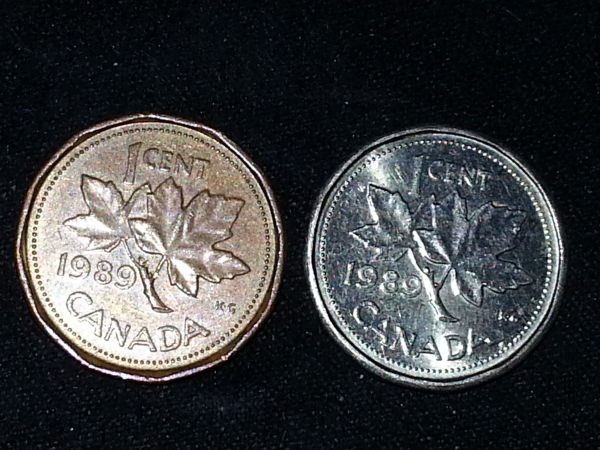 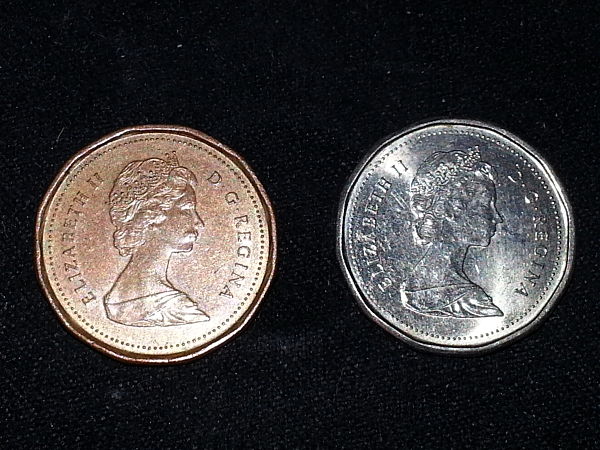 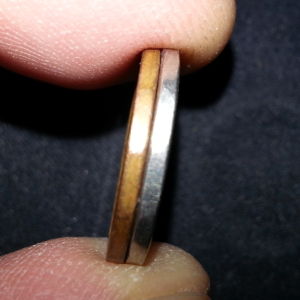 |
|
|
|
Pillar of the Community
Canada
5417 Posts |
|
|
Pillar of the Community
United States
5825 Posts |
If the coin feels "greasy" DO NOT touch it anymore.
There would be a high possibility that it's been dipped in mercury.
And mercury is toxic; it can be absorbed through the skin.
And DO NOT heat it.
The mercury will vaporize and breathing the vapors is even worse.
Are you familiar with the expression "mad as a hatter"?
Making hats (felt? animal skins?) used to involve mercury.
After a couple years the absorbed mercury would cause madness.
And there's plenty of other examples.
|
|
Pillar of the Community
Canada
2632 Posts |
Could be double or triple plated adding enough extra weight to stop the coin from reacting to the magnet.
|
|
Pillar of the Community
 Canada
872 Posts |
thanks for your response. what makes you think it is dipped in mercury? after the magnet test, I don't believe it is dipped or an altered coin. and it doesn't feel greasy at all. it looks like a penny and feels like a nickel coin.
|
|
Pillar of the Community
Canada
5342 Posts |
Take coin to a large bullion dealer with an XRF machine, if they will xray it for you, this will answer the composition of your coin. My guess is either wrong planchet or plated.
|
|
Pillar of the Community
Canada
1487 Posts |
Scratch the edge, and if it's plated you will be able to see the copper. I did this once with a dealer's coin. I told him if copper showed I would pay him $5 for the coin. No copper and I would pay the $250 he wanted. I paid $5 and left much more confident.
|
|
Pillar of the Community
Canada
1984 Posts |
Coins dipped in mercury have a more matte pewter-like look to them. I don't think that this one is dipped in mercury. This is something more typical with older coins....usually from the 1930s or earlier. While I haven't tested the plating, I think that this is mercury. 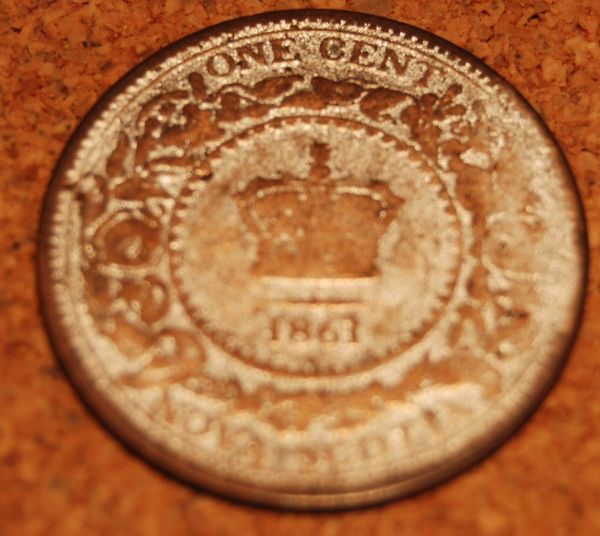 |
|
Pillar of the Community
Canada
1984 Posts |
I like the look of the lustre. Also, I think the detail would be much worse after 0.3g of plating. I am going to guess cent struck on 1989 new Zealand 5 cents. Copper nickel, 2.83g, 19.4mm, 36 million struck by the RCM. SPP's XRF would tell you whether this was the case pretty easily. |
|
Moderator
 Australia
17000 Posts |
Quote:
if you pass a strong magnet over the copper penny, you can move it slightly (it won't jump to the magnet but it does have a slight magnetic attraction - even silver has a slight attraction) The effect you are seeing is diamagnetism - it is actually being repelled by the magnet, not attracted to it. You need one of those super-powerful rare-earth magnets to see this effect on a coin. And I agree, if the diamagnetism is different, then it likely is a different metal. A simple plating or a soak in mercury cannot eliminate diamagnetism. Get a coin you know to be made of cupronickel alloy (like a 5 cent coin from 1982-1999) and compare the magnetic reaction with that of your coin. If they are similar (ie. no reaction at all) then you do indeed likely have a cupronickel wrong planchet. XRF would confirm it. The New Zealand 5 cents mentioned by Smallcentguy is an excellent candidate. Don't say "infinitely" when you mean "very"; otherwise, you'll have no word left when you want to talk about something really infinite. - C. S. Lewis
|
|
Pillar of the Community
Canada
872 Posts |
thanks for all of your responses john100, zonad, kanga, smallcentguy, pennyman007, and zxcccxz. the new zealand 5 cent planchet which is copper/nickel, wouldn't it be magnetic? my "silver" penny is not. great idea about the xrf machine. I just don't know who would have one here in victoria, b.c. And I will resist the temptation to scratch the edge!
|
|
Pillar of the Community
Canada
1984 Posts |
Cupro nickel is generally not magnetic but it depends on the alloy I think. British cupro nickel coins aren't magnetic. Edge scratching is I think often the way people test such coins (using a very sharp hard steel device like a sewing needle). Unless of course you happen to have something like $50,000 or whatever an XRF costs.
|
|
Pillar of the Community
Canada
2632 Posts |
Perhaps a metallurgist in your area or maybe a geologist. Maybe you could send it to SPP-Ottawa if he chimes in.
|
|
Pillar of the Community
Canada
5342 Posts |
Almost sure a bullion dealer like JM coins would have an XRF due to all the fake silver maples leaf and eagle coins, at the Coin Expo a xrf manufacturer was demo a 1000.00 portable units, contact JM if they will help you out?
|
|
Pillar of the Community
Canada
618 Posts |
|
|
Moderator
Canada
10476 Posts |
Hi robmck1967, a friend of mine pointed me to this thread,
Send me a PM here, and I can help you out directly (I have an XRF in my lab). Or, as a last resort, I can give you the name of someone in Victoria who has an XRF in their lab and who -may- test it for you on my behalf.
"Discovery follows discovery, each both raising and answering questions, each ending a long search, and each providing the new instruments for a new search." -- J. Robert OppenheimerContent of this post is licensed under a Creative Commons Attribution-NonCommercial 3.0 Unported License. See: http://creativecommons.org/licenses...0/deed.en_USMy eBay store
|
| |
Replies: 48 / Views: 7,710 |










 Posted 11/23/2013 10:37 pm


