Quote:
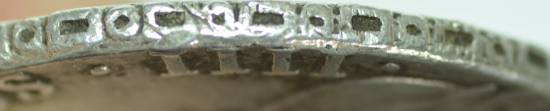
The edge from this mint are different (and less regular) than Mexican ones.
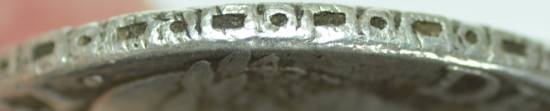
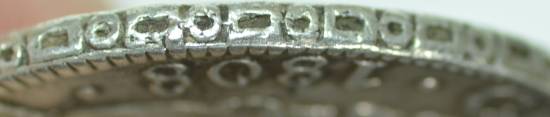
I agree that the Bolivian edge is different from the Mexican - the individual segments are larger and the wall thicknesses are greater. The Bolivian edge pattern also typically fills the width of the Bolivian edge because Potosi coins tend to be slightly thinner but larger in diameter than Mexican issues. What I do not agree with is that the Bolivian edge can be classified as an
irregular edge. The segments along the edge DO NOT VARY APPRECIABLY NOR DO THE WALL THICKNESSES. At least not on a genuine edge.
The ONLY purpose for the added work of milling the coins edges was to preclude clipping of silver by thieves. There is nothing to be gained and a lot to lose if the edge is too irregular. It is the regularity of the edge pattern that makes for success in milling and the covering of clipping difficult.
Clipping is actually a word that is a carry-over from the days of the thin hammered or roller die pressed coins. The edges of these coins were clipped (adjusted) to make the correct weight. But unofficial adjustment of the edges by thieves became a problem. Milling was instituted and coins grew much thicker as a result.
So "clipping" can actually refer to more gentile edge filing to remove silver once milling was adopted.
This is one reason the edge milling was intentionally not too deep. A coin with a worn edge would be weighed by the merchant and a value adjustment would be assessed at point of sale. But only if the coin was suspect - the result of face wear or edge wear or a combination of both.
An irregular edge pattern that can not be relied on encourages clipping because then a re-applied counterfeit edge does not need to match a "standard" edge pattern for that mint. In the 1780s it would have led to rampant clipping.
I have coins in my collection (I do focus on Mexico City) that have had their original edges ground off and NEW edge designs were then applied. This process can remove about 0.50 to 1.5 grams of silver per coin. In practice it happened most often to off center coins - examples that showed TOO MUCH dentil on one side and no dentils on the other. The thief just "took the excess" outside the circle of the die face. I used one such example in my book as an illustration of the class. The coin must have originally been slightly eccentric because the thieves did not remove silver from all of the circumference just the portion that had "long dentils". About 1/3rd of the original edge remains but a false edge has been added to the other 2/3rds. The re-applied edge is a fair copy of a Regal edge but shows irregularities including circles with flattened sides caused by the adjacent rectangle cutting into the circle - a feature typical of a poorly spaced edge die.
So, how many Bolivian coins may have been targeted for that same practice - I do not know. But I would suggest that since the coins of Potosi were typically the largest in diameter of the branch mints, that they too were likely targets for this same scam.
Spotting these slightly "shaved" coins is not easy especially if they circulated for long periods afterwards - but be suspicious of ANY 8R that is 1/2 gram under its theoretical worn weight. I use 26.5 grams as a VERY suspect weight for a Mexico City coin in typical VF grades. Wear to VF does not remove that much silver naturally. When you find a coin like that look for a bad edge - oddly space laps and more than three joins. Your coin may have been clipped.
Now back to the issue that started this -a two segment edge punch.
While no published photos of Bolivian die making tools exist to my knowledge - the matrix blocks I have seen ALL have three segment edge punch patterns. There were in fact at least 2 such engravings PER block. Always in threes. All Matrix blocks for the colonial mints were originally prepared in Spain and were not produced locally. That is why the King's portrait varied during the inter-regnum period mint to mint.
So why 3 edge segments why not 2 or 4?
From an engraver's point of view a 3, 5, 7 or 9 segment punch are the only ones that make sense at all once you realize what the edge die looked like. The edge die was cut into a block of steel at the base of a channel which was cut in the block. The edge die was NOT just a thin steel bar the thickness of the coin as most sketches of edge mills would lead you to believe. I have now seen several edge mills and dies used in the late 18th and early 19th centuries and they are consistent in their appearance. The actual edge design occurs at the bottom of a narrow groove recessed INTO the die block. Depth varies. Side alignment for positioning the segments was in that situation (at the bottom of a channel) difficult or even IMPOSSIBLE depending on the depth. But a punch made the width of the die slot that fit one rectangle INTO the last rectangle already punched makes for quick and perfect alignment time after time. It is just the pressure needed to impress the punch into the die block that limits the number of segments applied at one time. Three appears to be the chosen number as long as one man powered the die press. Today or anytime after steam power presses came to be, the entire edge die could be made in ONE pressing - but not in 1800.
So unless there is some form of solid factual proof to the contrary, I see no reason to presume or even speculate that a 2 segment pattern punch would even exist. Using a two segment punch (or any other even number) should lead to many more serious errors in overlapping than are ever seen in reality.







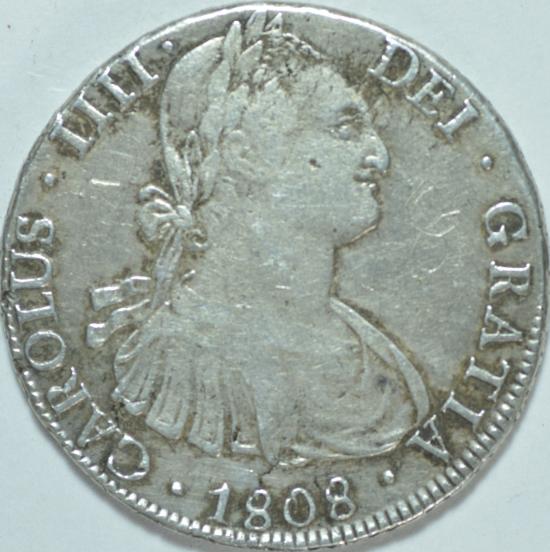
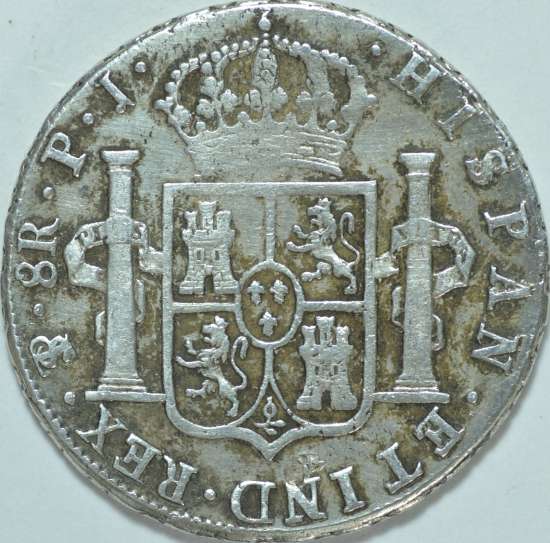















 Posted 12/09/2013 08:20 am


