| Author |
 Replies: 17 / Views: 6,689 Replies: 17 / Views: 6,689 |
|
Pillar of the Community
Germany
1856 Posts |
A few years ago I was finally able to realize one of my "long time numismatic dreams". I bid on, and won a Santiago mint columnario 8 Reales dated 1768, (Assayer A, Agustin de Infante y Prado). I never thought I would be able to own such a coin. These coins always go for very high prices. I & A Goldberg had just recently sold 2 columnarios from the Millenia collection, albeit in very high grades with correspondingly higher prices. Anyone familiar with these series will know how scarce Santiago mint 8 reales minted from 1751-71 are, compared to similar coins from Mexico, Peru and even Guatemala. I think that as a type only Popayan and Nuevo Reino (Colombia) columnarios are rarer. In total about 45-60 Santiago pieces are thought to exist of ALL dates combined. This is a coin I have wanted to own for many many years, but all examples sold were always priced WAY above my means. The 1768 date is the most common of the series, (least scarce is more appropriate ) date in the Santiago columnar series with as many as 14-16 known example. This coin had some problems, it was described as having corrosion removed, and a bit porous with tiny chopmarks, so apparently it had circulated in the far east. It also seemed to have been buried at some stage, according to the catalogue description. These defects made the price more accessible, but the overall appearance was still pleasant, so I decided to bid. They just do not show up very often! Due to the still not-inconsiderable amount of money involved, I decided to ask the auction house to send the coin for certification/encapsulation to NGC/NCS. After a couple of weeks the unexpected news came that NGC deemed to coin to be a counterfeit. I was of course quite disappointed, even if relieved that my intuition to have the coin graded saved me from having, unknowingly, a very expensive fake in my collection. Here are pictures of the coin, (I actually never had the coin in-hand), the only ones I have from the auction house. I am still disappointed when I look at these pictures of the coin which was supposed to be the crowning jewel of my latin american collection. Please let me know what you think- and if there is anything one can tell from the pictures that point to this coin being a fake. Regards, Germanicvs 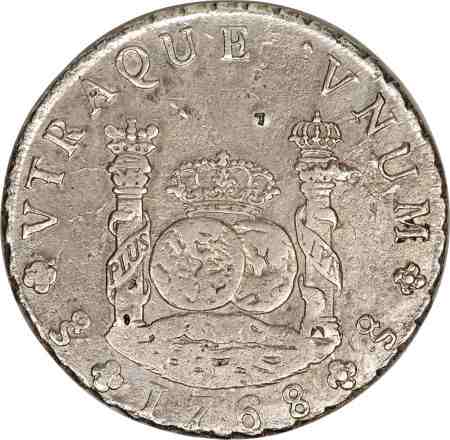 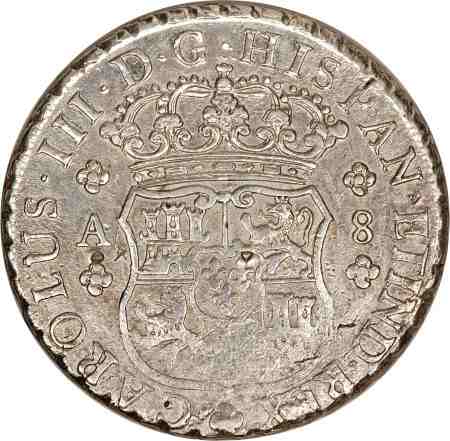 |
|
|
|
Pillar of the Community
United States
1770 Posts |
As you may know Robert Gurney, Gord Nichols and myself for the last 4-5 years have been working on a ANS book for the Contemporary Counterfeit Portrait 8 Reales - due out late 2014/early 2015 based on the current schedule. Along the way I have come to realize that contemporary counterfeits of this type are VERY RARE for all mints. In the last C4 Ringo Stacks sale he owned JUST one and I own just one - although I do not hunt them down but simply do not see them being sold very often. I can't remember the exact composition (XRF verified) of my specimen but it showed good platinum & gold (i.e., levels between 0.1-1.0%) suggesting it was silver of this period (18thC) but the silver was debased and copper was in the alloy in place of the lower Ag content. In other words a well made example of the period. Most seem underweight but at times lead is sometimes added to bring the weight near 26.5 grams. It seems to be a type not counterfeited very often - and I say that with the assumption here not to include any of the obvious modern types that specialist know are bad an arm's length away. Would like to analyze these pieces for their assays if you come across any others in the near future.
John Lorenzo
United States
|
|
Pillar of the Community
United States
1962 Posts |
John, it's highly unlikely that analysis as a contemporary counterfeit applies here. You're talking about Pillar 8R CCs being rare in general, which they are (though they are out there)... but Santiago pillar 8R are EXCEEDINGLY rare (healthy 5 figures rare) and I don't think any CCs of that mint's output would have been made (and the diework wouldn't be this good). Considering the rarity/value here, the working theory has to be numismatic forgery of some sort.
GERMANICVS, wow... I remember reading the thread on the other forum that you bought this piece, but I didn't see an update that NGC called it fake. One note - you say specifically "NGC/NCS". Can you elaborate on that? NGC's submission process has evolved on this a bit. Back when they NGC first introduced the NCS division, the flagship "NGC" holder was still reserved for problem-free coins. Once they started NCS, besides conservation/cleaning, a coin with an obvious problem which would likely "bodybag" it for NGC (like those small chops on this piece) would be a candidate to submit directly to the NCS division for placement in a "Genuine" holder (if that was the case), with the problem noted.
I bring this distinction up because I've seen some questionable things in those NCS holders (two EGREGIOUS goofs come to mind specifically), moreso than the regular NGC holders... I've always had the impression (and I thought I read this somewhere) that it wasn't exactly the most experienced NGC evaluators who were seeing the NCS-submitted coins.
Did the auction house pass on any feedback from NGC/NCS about why they called it fake?
Anyway, aside from that... you're probably the most knowledgeable here on Santiago pillars. What do YOU see, if anything? I don't know them at all (go figure, have never had much of a reason to research a potential purchase!). Also, honestly hard to tell much about the surfaces from those pics. The coin overall looks OK at first glance... Just now looking at some auction appearances... the pillars side die is clearly matches other specimens. You mention in the other thread having Carlos Jara's book on Santiago... and Carlos himself chimed in on that thread. In the aftermath of that, did you reach out to him for his thoughts?
Looks to be a coin you would need to scrutinize in hand to be certain.
Edited by realeswatcher
12/05/2013 6:41 pm
|
|
Pillar of the Community
United States
1962 Posts |
Boy... the more I compare this to other pieces known... a bit more worn, but really looks pretty decent. Even what can be seen of the deeply engraved edge pattern looks proper. IF it's fake, it is sophisticated numismatic forgery (which of course the value would certainly invite)... this is no Chinese job. By the way, if you're willing to share (I can't find this piece in archives), what auctioneer was (maybe?) fooled by this piece? Had to be major to handle something like this, I would guess...From the site I stupidly neglected to notice something on this very evening... http://coins.ha.com/c/item.zx?saleN...&lotNo=50890Edited by realeswatcher
12/06/2013 12:29 am
|
|
Pillar of the Community
France
1591 Posts |
Here are the Hi-res auction pictures : 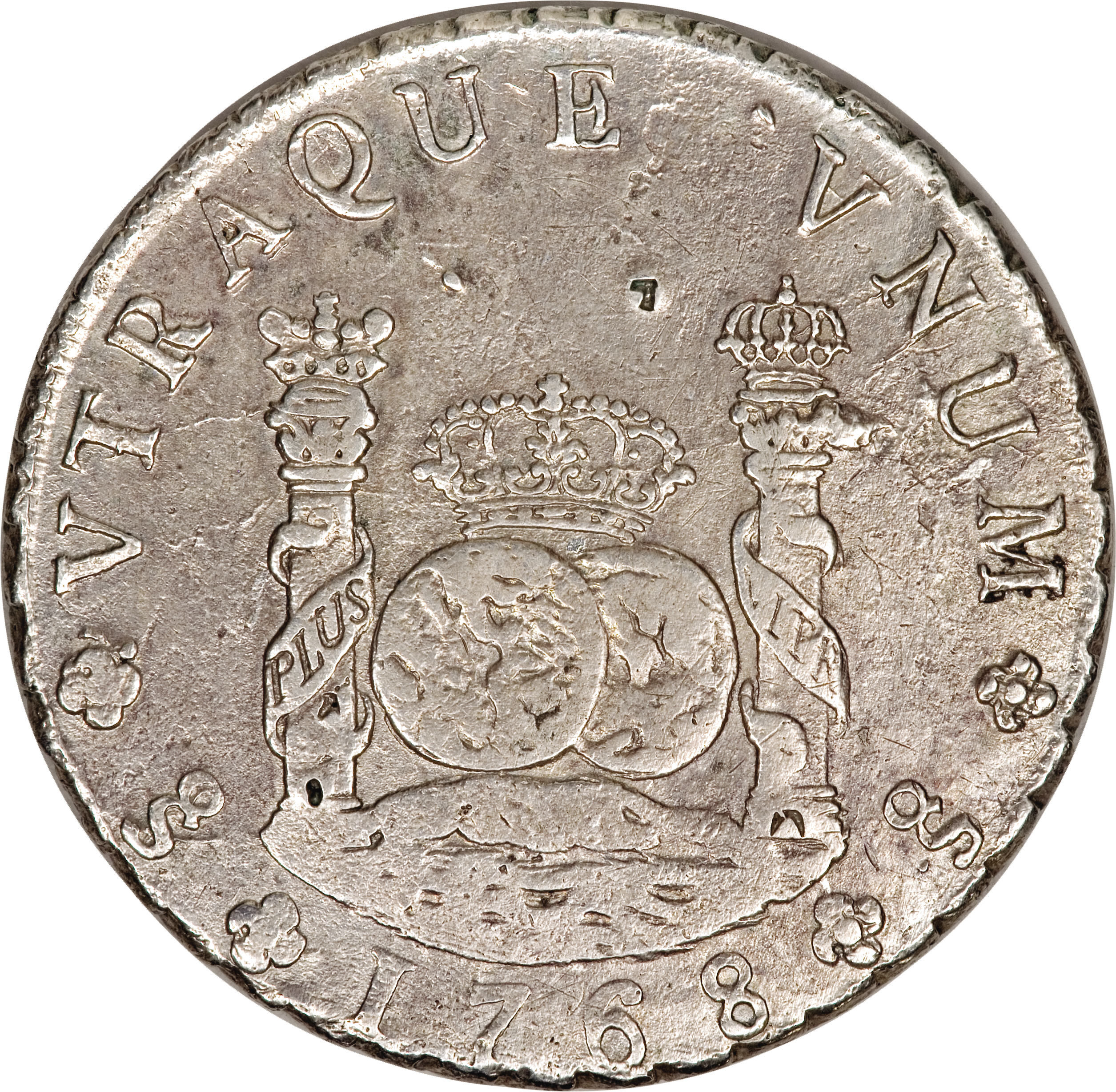 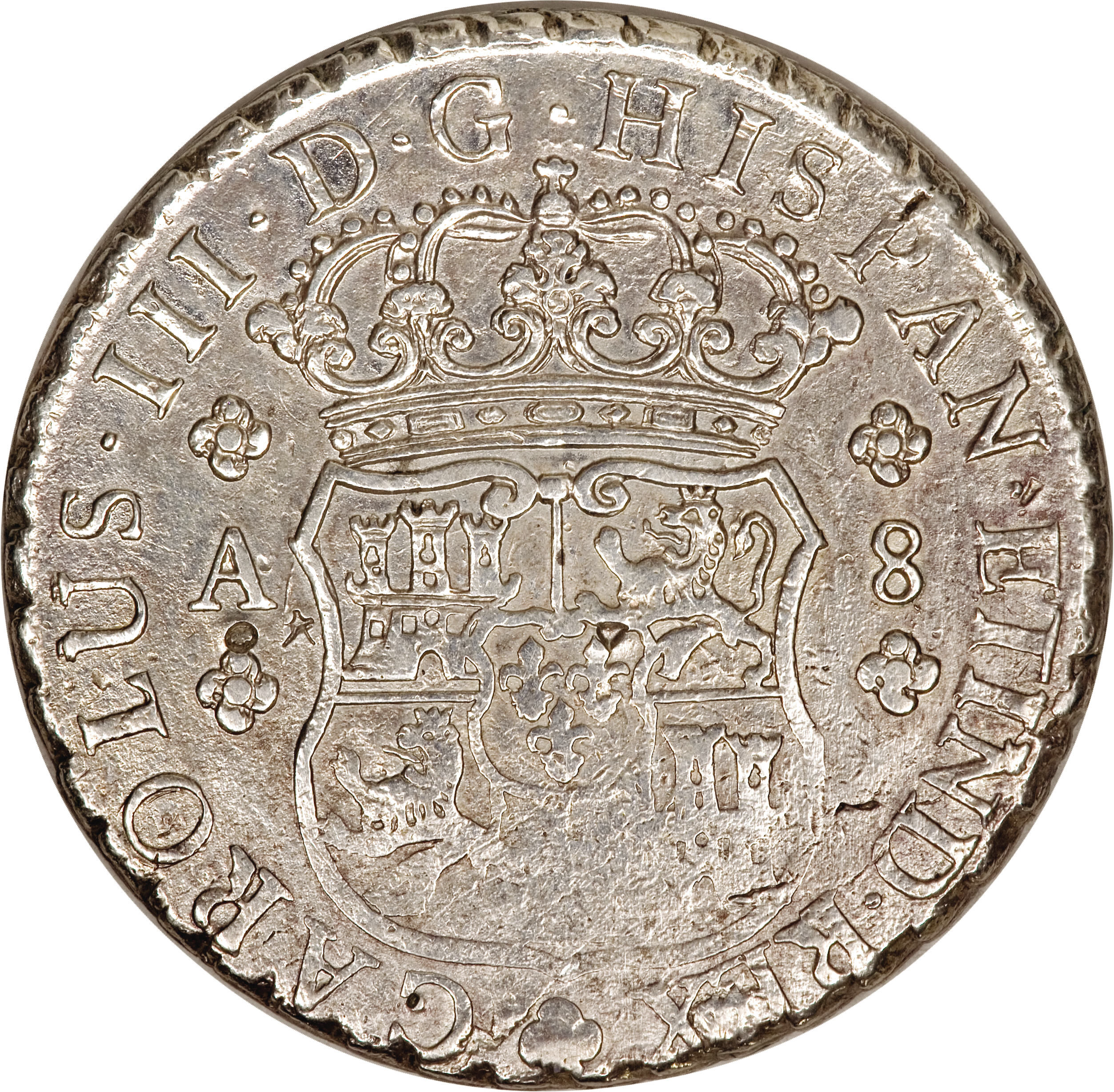 |
|
Pillar of the Community
United States
1770 Posts |
HMMM ... in VNUM is that an upside down A punch where the cross bar was not completely polished off for this counterfeit obverse die or just a strange/awkward place for a die crack? Again the composition would tell if modern or of the period but this is not modern. Unfortunatley more research is needed with SEM/EDS to see if a piece has been made with melted silver where Pb values decrease below the normal levels seen in the regals for the period in question. Also the microstructure could give indications of remelting if the Au & Pt levels appear normal (i.e., 0.1-1.0% generally) and Ag ~ 90% even for this type. I was looking at the remelting issue for the 1733/1734 Felipe V 8R Cob Klippe pieces. Chinese pieces based on past research of the 20thC are Fe/Ni or German silver (Cu/Zn/Ni) predominantly and would have been spotted immediately as realeswatcher alluded to in a previous post. My point to realeswatcher is that there has yet to be a study to confirm if a piece has been made with pieces of good 8R melted silver of the period - its microstructure other than lower lead levels or how this would look at 500X magnification with a SEM device still needs to be researched & developed ... I am thinking about it ... I have yet to own a 1733/34 Klippe called real for this type of evaluation ... some people have speculated most these issues are fakes anyway ... I do own three contemporaries of this issue all with different alloys ...
|
|
Pillar of the Community
France
1591 Posts |
colonialjohn : I have two klippe, if you want to have fun with them :)
One salvaged from the Roosjwick - I don't see how that one would be a fake :)
|
|
Pillar of the Community
United States
1962 Posts |
John, about the VNUM on this piece... those are die cracks. The originals I'm seeing have similar die cracks all over the pillars side, including that extra metal blob on the right pillar. The die was clearing deteriorated. As to the age of this piece... It's either a genuine/regal piece, OR a much later NUMISMATIC forgery. Logic dictates that - there just weren't enough originals produced to justify a contemporary fake being produced... and again, it wouldn't be this faithful to the original. It wouldn't necessarily be "modern" (like, say, last 15 years from China), but maybe late 1800's to mid-1900's? Looking at the Heritage hi-res pics (which are much clearer)... the surfaces don't look great up close like that... sort of reminiscent of a cast? But, you could argue that porosity could be remaining from cleaned-off environmental impacts? What do we think of that mark on the P of HISPAN? Kind of off in a different direction with the Klippes... I still think those many of those Klippe fakes you've brought up are generally later pieces. They certainly do emanate from Mexico, though... so it's ENTIRELY conceivable they could have been made with old coinage that would show proper trace elements... and maybe "some" could be early? On this topic, was searching something recently which led me to a thread on another forum where the poster discusses how his grandfather found a stash of fake "cobbs" in the late 1940's... he believes that they were silver (from what he himself can tell, and he's had a few other reales collectors look at what he has) and seems to think the stash may be about 100 years old. cointalk.com/threads/mexico-silver-brass.195958 The poster mentions most were sold in a family financial crisis, but his grandfather kept a single example, and it is along the lines of the pieces you've been looking at:  Edited by realeswatcher
12/06/2013 3:56 pm
|
|
Pillar of the Community
United States
1962 Posts |
Quote:
Also the microstructure could give indications of remelting if the Au & Pt levels appear normal (i.e., 0.1-1.0% generally) and Ag ~ 90% even for this type. Definitely worth looking into... even laymen's knowledge, smelted/reforged alloys are always a bit different (weaker, they say, talking of reforged steel), right? Then again, who knows what the ORIGINAL regal coins were made of. They of course had a good mined supply of silver in much of Latin America, but some recycling could have come into play... like Washington's silverware for the first U.S. coins, right? |
|
Pillar of the Community
United States
1770 Posts |
It seems so that these three fake Klippes are late 19thC/early 20thC production pieces based on the alloy compositions. They all had good Pt & Au levels but we talked about this already - I am ready to analyze some of the so called real Klippes.
The remelting aspect would just require a good sample size and time with SEM/EDS - reserved for a later researcher. I am no longer at EDAX and currently only have limited SEM/EDS usage with another employee needing to do the analysis in my new company (Kearfott).
|
|
Pillar of the Community
United States
1962 Posts |
You know, John, as a stand-in, have you considered zapping some of the plentiful amount of late 1720s-early 1730s cobs (as opposed to klippes) to get some pertinent data points? The only variable should be that after the 1728-dated pieces (in theory, at least), the silver fineness was lowered from 0.931 to 0.917... The Rooswijk and Vliegenthart produced large amounts of 1729-33 dated pieces. If you stick with 1730-1733 (considering that 1729 could be a transition), that would probably work. Of course you'd have to factor in copper leeching... but note that many from the Rooswijk in particular are fairly corrosion-free (though somewhat stripped-down to bare silver), so that might be somewhat minimal? There also always seem to be a few non-salvage 1732, 1731 pieces available in the auctions... Also, there was a "cave hoard" out of Mexico that some sellers distributed on ebay starting about 5-6 yrs back which were primarily 1730, some 1729 pieces... all corrosion free with just some slight sandy patina. Not a perfect solution, but a reasonable match and genuine examples are much more readily available (and cheaper). ====================== ====================== Anyway, "Germanicvs", sorry to get off-track... any more thoughts on your erstwhile 1768? |
|
Pillar of the Community
United States
5362 Posts |
Very interesting post. The coin looks REAL (Genuine) on initial review. Initially I wondered what the basis of claiming forgery was for NGC? But I looked at the coin NOT as a Santiago issue (which I know very little about) but instead I looked to see if the way it was made left fingerprints. The dies that made the original impression clearly were made with a punch set. But many features have been reworked as if the die sinker was not very good. My overall impression was that this is NOT an engraved die. The rarity of the mint should preclude a contemporary counterfeit that is made this well. That is not 100% certain but VERY high odds exist against that possibility. So, I agree that we face only two reasonably possible results Genuine or Numismatic Forgery. As the coin presently appears, there is obvious surface corrosion that looks VERY good to me. This is both good and bad because forgers often cover their work by using acid to erase traces of their work. It also is the reason for the NCS/NGC involvement. There are no edge photographs available so I have no comment there. Too bad I would like to see if the surfaces are consistent all around. I noticed there are genuine looking die cracks and die erosion traces. This is the best place to hunt for evidence that occurs in modern transfer dies that does not appear on a genuine coin. When cracks are TRANSFERRED in the case of a numismatic forgery they often lose the sharpness of the original steel breaks. I focused there and noticed some evidence of possible transfer. But I could not enlarge the photos clearly enough 200X or higher. Not conclusive. Next I looked at die erosion effects for what I would call erosion on top of erosion. I think I have found a good spot to look at: 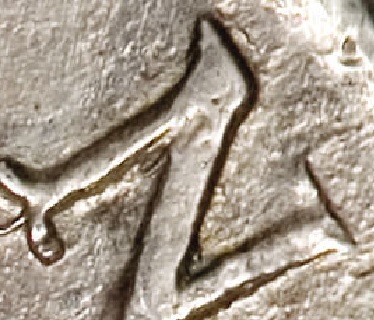 Notice what looks like a J or a closed loop under the notch in the N. Also note in the center of the letter itself an odd looking surface area (like a fill effect) to "cover a void". I enlarged the area further and I believe this is the first of many fingerprints of an excellent transfer die forgery. I suspect a collapsed bubble made in the process of a liquid matrix (plastic cast) transfer process. Could be wrong but I do not think so. 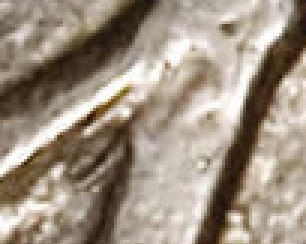 In this case, I would concur with rejection based on the appearance of the coin as a probable image transfer. For the experts in this mint - is the host coin (less the corrosion) known to exist? It is rare enough that it should be. |
|
Pillar of the Community
United States
1801 Posts |
First thing I find interesting on this coin is the 'blob" of metal on the right hand column (royal crown column) that matches the "blob" visible on the plate coin for 1768 in the Gilboy book. Having personally never seen a Santiago Pillar in hand (these are way out of my league price wise), I am wondering if this die characteristic appears in all the coins of this year.
Second thing about the Santiago mint is the notations and disagreement among all the researchers over just which dates actually exist for this mint. There are (per Gilboy notes) only 6 dates that all the researchers agree on. 1768 A is one of those dates, though referred to in Gilboy as "the seemingly genuine eight reales of 1768 bearing the initial A".
|
|
Pillar of the Community
United States
1962 Posts |
Heritage, Cayon, Goldberg...  |
|
Pillar of the Community
 Germany
1856 Posts |
Swamper Bob, Colonial John, Reales Watcher, Mathieu, Jfransch,
Many thanks for all your comments (and my apologies for being late with a reply myself).
To give a little more background: as Samperbob rightly says, the coin was sent by the auction house to NCS (not NGC) as it was already assumed it was cleaned coin. NCS declared it to be a counterfeit.
I, in fact, never, saw their report, nor their reasons for declaring it so. However, this was confirmed to me by the auction houses' Sr. Foreign Coin Specialist.
Interestingly, the piece was also shown to a well known spanish colonial coin expert, who likewise declared the coin a forgery. In his opinion, the piece was cast from a mold (I am here translating the spanish word 'fundida' as 'cast') prepared from a genuine coin. According to this expert, after casting the piece was then re-touched on same areas, for example the date and the mint marks. (I do not want to divulge the name of the expert in order to respect his privacy).
To me, this was quite definitive and closed the book for me on this episode. However, this was not the end of this story - If I recall, this piece actually reappeared some time after that at an auction in southern europe. I saw the catalogue, and was quite surprised to see that.
|
|
Pillar of the Community
United States
5362 Posts |
Unfortunately when there is a potential for profit to be made the same forgeries will crop up again and again.
Cast or struck - the fact that the image is a transfer made using a wet process is fairly conclusive.
|
| |
Replies: 17 / Views: 6,689 |







 Posted 12/05/2013 6:32 pm


