| Author |
 Replies: 17 / Views: 5,437 Replies: 17 / Views: 5,437 |
|
Pillar of the Community
United States
3184 Posts |
Hi all, I'm more on the US coin side and many collectors when it gets to key date/more expensive coins like to have their coins slabbed by PCGS or NGC as a way to verify authenticity and to protect the coins.
I've seen some ancients that I would love to own however how come so many are not slabbed? With the chinese counterfeiting things, I could see them easily getting a really athenian owl lets say and making a good copy of it!
Thank you!
|
|
|
|
Pillar of the Community
United Kingdom
3626 Posts |
|
|
Pillar of the Community
United Kingdom
4208 Posts |
Heres some reasons:
1. People like to handle ancients. Theres no reason to not handle them unless they're gold, and people still do that. YOu can handle something sealed in plastic.
2. There is no grading system which will work for ancients. Too many variables, it just doesn't work out effectively. EF could mean anything.
3. There really arent that many coins worth slabbing. You just need to authenticate them and services exist for that. Plus, the edge of the coin is important to ID fakes and you cant see that inside a slab and a fake slab is easier to get than a fake coin.
|
|
Pillar of the Community
United States
1391 Posts |
The coins predate the slabs by millenia?
Ancient coin collectors have been around for a lot longer than the whole slabbing fad (which seems to mostly be an American thing). Ancient collectors have more traditional ways and are not likely to change anytime soon.
|
|
Pillar of the Community
United States
4778 Posts |
Quote:
We like to handle our coins.... ^This Its quite a feeling to hold coins that circulated thousands of years ago. For me its a way to connect to history. Its a good thing too that nearly all ancient coins won't be damaged by simple touching; most aren't delicate like modern mint-state coins. As for determining authenticity with ancients, as in collecting other types of coins, education is key! |
|
Pillar of the Community
United Kingdom
946 Posts |
Also for storage. Slabbed coins tend to be purely investment coins, such as Morgan dollars etc. Whilst ancient coins are an investment, they tend to also be works of art or relics of the ancient past (if not both) and are too good to be imprisoned in plastic. |
|
Pillar of the Community
United Kingdom
856 Posts |
My coins are a mere 360 years or so old, but the same principles apply as everyone else has said.
The coins are circulated and toned. handling them (within reason of course) isn't going to damage them and you get a sense of connecting with history which I just don't think you do with a coin in the slab.
They are hand made, so there isn't an even amount of wear across the coin. Some parts can be well struck, others worn. Surface scratches, evidence of cleaning, dings and dints are all common on coins that have been found in the ground. Pretty much all of mine would be rejected by the UK TPGS for any or all of those things.
Grade isn't everything. Toning, centrality of the strike, an even thickness to the planchet can all affect the 'eye appeal' (and therefore cost/ desirability) of a coin in ways that you don't get with more regular machine made coins.
But I think the bottom line is that collectors of ancient/hammered coins just aren't generally worried about having coins slabbed. And if the demand isn't there ...
|
|
Pillar of the Community
United States
3486 Posts |
If I may be blunt:
Collectors of ancient coins KNOW their stuff and do not need a third-party
'expert' to referee.
I admire these collectors a lot.
|
|
Bedrock of the Community
Australia
21792 Posts |
As BenByfield has noted, there are many more variables attached to the grading of an ancient coin, than with modern coins. Some intending buyers attach more consideration to a combination of those variables than others, who may have a different combination of variables in mind, that they feel would contribute to the value of the coin.
The best way to assign a grade to an ancient coin is (I think), is the way major auction houses around the World already do it. That is, give a grading opinion based on a combination variable factors that contribute to it, attached to which is a brief description and a picture. The intending buyer then makes up his own mind as to how much he wishes to pay for it.
A slab does not really have any room at all to mention what may be a large list of details to be attached to a grading, despite the fact that the coin itself may be nevertheless very valuable. A picture of the slabbed coin would still be very necessary anyway, if it was intended to be sold.
Slabbing of only a few ancient coins in an otherwise extensive collection of them also presents irksome storage and display problems.
|
|
New Member
Italy
25 Posts |
the encasing of the handmade ancient coinage is not to be encouraged as we see the variety and differences in the strike of the coin that from the same die. the ae3 is best example from late 4th ad some can be thick with high detail to reversal and other can be same die only with less of flan metals and light base detailings yet more detailings on the obverse of the coinage. the casement of them for protectingtion is ok for the fine metals but the ae's from this time should be graded as can be but not sealed. if the different coinage was cased up then to see not the thickness, the edge, the differenting strikes, the coloring, and to not be feeling the coin that is feel so beautiful is so sad just for business people. to be sure of any coinage it is much of a better thing to ask of a collector of ancient coinage for opinion. please hold your coinage, feel your coinage this way is to learn more than the eyes can ever teach.
|
|
Moderator
 Australia
17007 Posts |
I can think of numerous reasons why I personally don't like slabbed ancients; many ancients collectors agree with me, for these reasons and others. Not all the TPGs will slab ancients; they quite rightly recognize their own incompetence in the field. ANACS doesn't. ICG used to. PCGS doesn't. NGC only recently implemented its Ancients service, with its own unique non-Sheldon grading system. There are specialist "services" that authenticate and certify ancient coins; David Sear's ACCS is one such. But they're not "slabbers"; they don't entomb the coins in plastic. As such, they're pretty useless when it comes time to sell, since you could (in theory) simply swap a bogus coin out for the genuine one. The goal is getting a third-party opinion about coins you already own. Many ancients are very high relief and physically don't fit well in slabs. I recall seeing an attempted slabbing by ICG in a "normal-sized" slab, where the coin was so thick and squeezed in so tightly that the slab plastic was distorting and cracking. Slabs were originally designed with one thing in mind: the commoditization of coins, to allow them to be traded sight-unseen via the Internet and mail-order, safe in the knowledge that what you imagine a coin given a certain grade will look like will be pretty much what you actually get in the slab. This doesn't work out all that greatly in the real world even with modern coins; with ancients, the extra variables involved in grading and valuing them (strike, corrosion, patina etc) mean a simple one-dimensional grade is inadequate and they can never be traded sight-unseen without the risk of severe disappointment. Examining the edge plays a much more important role in the ancient coin experience than it does for moderns. The three-pronged holders coming into fashion now are an improvement on not being able to see the edge of a slabbed coin at all, but they still detract from the experience. From an admittedly small, old and biased sample size, the TPGs simply aren't very good at identifying and attributing ancients. Just about the only slabbed ancients I have seen have been where someone has posted a slabbed coin that has been incorrectly identified. They're getting better (at least, I hope they are) but those early efforts still sitting around in slabs are not adding to the confidence ancients collectors have in the slabbers. These ancient coins have survived for over two thousand years without the assistance of a TPG to protect them. We're not entirely convinced they need the help. Besides, are slabs really that good, long term? I mean really, really long term? We simply don't know; slabs haven't been around long enough. Will the coin collectors a millennium from now be cursing our bones for putting their coins in those stupid slab things? Quote:
With the chinese counterfeiting things, I could see them easily getting a really athenian owl lets say and making a good copy of it! Ancient coins are hand-made; they do not lend themselves to being copied by the mass-production techniques currently favoured by the Chinese counterfeiters. As yet, China is not a major source of fake ancients. That being said, there are plenty of fake ancient coins out there. Lots of poor-quality fakes come from the middle east, sold to tourists who are ignorant both about local antiquities laws (where selling fakes is perfectly legal but selling genuine ancient coins to tourists is not) and about how ancient coins are actually supposed to look. Many of the better fake ancients come from Eastern Europe, where the locals since the collapse of communism have made a thriving business out of making fake antiquities. When even the experts sometimes disagree for years on the authenticity of particular hoards, I personally doubt the abilities of the TPGs to judge authenticity if they were submitted the higher-quality fake ancients. But once it is in a slab, people will tend to take its authenticity for granted. Which leads to the final point regarding counterfeiting: if they can make a fake ancient coin good enough to fool a TPG, then making a fake slab will be child's play for them. Of course, this goes for modern slabbed coins, too. TPGs are, I fear, fast becoming obsolete as far as counterfeit protection is concerned. Your best protection against counterfeits is the same as it's always been: buy coins only from trusted dealers with a track record of giving money back if their coins are later proven fake, even if decades have elapsed. Never, ever buy ancients on ebay, unless you already know the seller from off-eBay transactions. Don't say "infinitely" when you mean "very"; otherwise, you'll have no word left when you want to talk about something really infinite. - C. S. Lewis
|
|
Moderator
United States
16697 Posts |
Quote: if they can make a fake ancient coin good enough to fool a TPG, then making a fake slab will be child's play for them. Of course, this goes for modern slabbed coins, too.  swcoin.ecrater.com
|
|
Pillar of the Community
United States
1391 Posts |
Quote:Never, ever buy ancients on ebay, unless you already know the seller from off-eBay transactions. Uh-oh, I'm already in trouble. |
|
Pillar of the Community
United Kingdom
2624 Posts |
I only buy from one ebay seller, he is local enough to me that I can visit his house and thoroughly inspect the coins before purchasing. Just from meeting the guy I could tell he was the real deal anyway, he loves coins and is a fair guy... he has told me that anything I buy off him he will always take back if I need him to. As for the slabbing, they don't slab ancients much because its just plain wrong. Most ancients collectors are just that, collectors. They aren't interested in somebody else opinion of their coin because they are just interested in the coins; not as a tool to earn money but as an item. |
|
Pillar of the Community
United Kingdom
856 Posts |
As Sap says, the original idea was to allow people to buy a coin unseen with reasonable confidence that what they received would be the grade stated. But hand made coins don't lend themselves to this as, while you'll probably get general agreement about which coins out of a batch are nice and which aren't, personal views then come into it much more than with milled/ machined modern coins. As an example, here's a coin I posted before. Not an ancient, but ... you'll see that while well struck it's on an oval planchet and as a consequence, the legend on the right side is missing. Now some will mark it down heavily for that. Me? The portrait, being far better than average, makes up for it, even if someone else says it's just VF-25. Plus, when I weighed it (something it's difficult to do if it's slabbed!) it's full weight, so it's a quirk of manufacture rather than someone clipping bits off it for the silver. So in this case, the weight is a clincher. But whatever your views, I just don't think it's something to buy unseen on a brief description or grade, or by a poor through-the-slab photo. 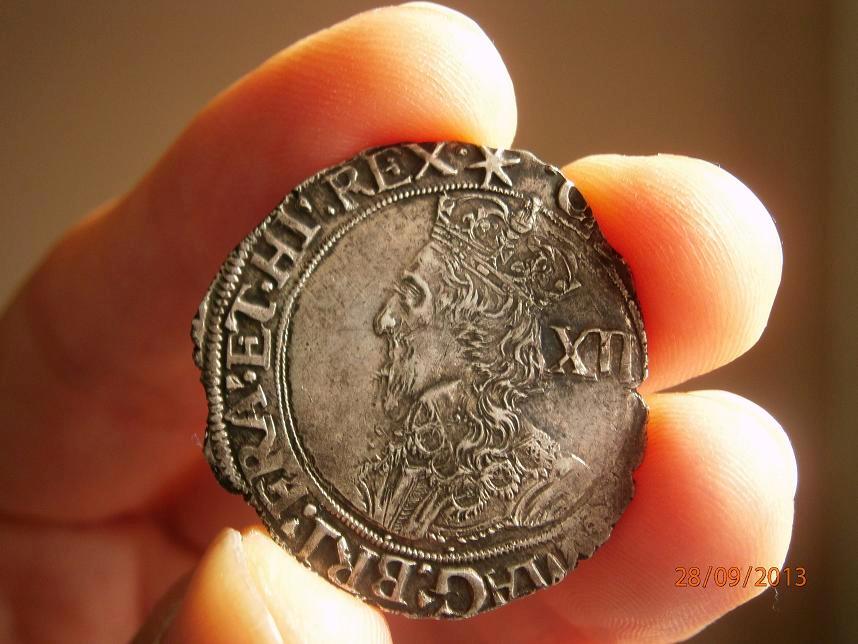 |
|
Pillar of the Community
United Kingdom
946 Posts |
As what usually happens with posts they go off topic, but anyway. Quote:Never, ever buy ancients on ebay, unless you already know the seller from off-eBay transactions.~ Sap Whilst education, via good online ancient coin websites, such as Forum Fakes List is a must before "dabbling" in buying what looks like ancient coins on a website such as ebay, to state " never, ever buy ancients on ebay, unless you already know the seller from off-eBay transactions" comes across as paradoxical when CCF is orientated around members who use ebay to sell their coins, ancients included. Also the idea behind online retail is that people may not live near to a "brick-and-mortar" retailer and thus with the retailer having an "online shop" they can reach out to a wide market and the buyer has the opportunity to buy things that are not available to them locally. It really does seem absurd for me to state what online retail is and thus what ebay is meant to be about. However I think (and hope) what the moderator Sap would have stated is that it is important to educate yourself first and foremost on fake "ancient" coins and if possible, go to a local Coin Fair, meet established dealers and see and handle what ancient coins actually look like and then the buyer can have a better idea when browsing on ebay for ancient coins. So anyway, back to the subject of Slabbing ancient coins. Edited by Masis
12/24/2013 08:30 am
|
| |
Replies: 17 / Views: 5,437 |










 Posted 12/23/2013 12:05 pm


