



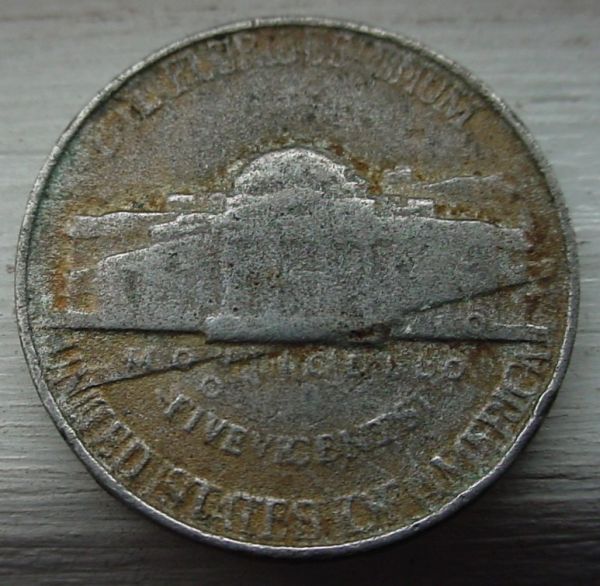
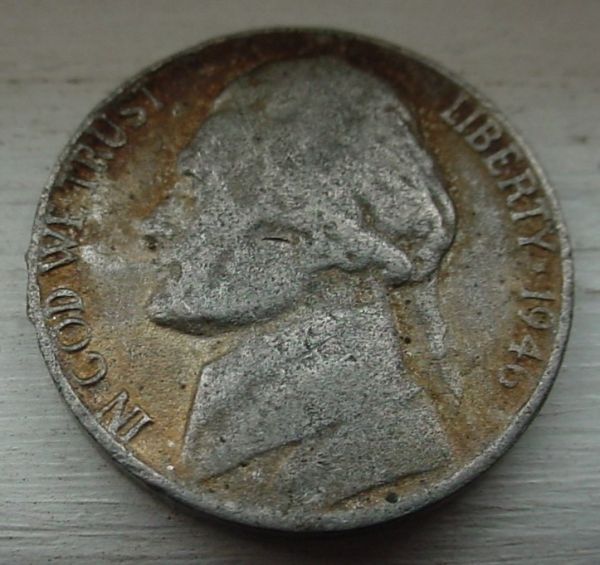
I'm thinking it may be a counterfeit because it's considerably underweight plus the toning and surface qualities seem off but why and how would it be done? This came out of my dad's collection. Other than a few proof and mint sets, I'm pretty sure all his coins came out of circulating pocket change during the 1940's-1960's. Thanks for looking and replying with any thoughts you might have about it....
I agree with SCDave who posted this coin that it is a counterfeit. If it were struck twice rotated in collar you would see the doubled strike on both sides. Plus the pitting and the fact that it is underweight are also red flags.
I don't have a good scale, just an old kitchen type that reads in grams but when I weighed a regular nickel it was 5.5 grams and this one only weighed 3.5 and it just feels light. It does pass the ring test when you drop it on the table though...
The stationary die is the anvil die and the die striking the coin is the hammer die. Traditionally the anvil(stationary) die was the reverse die, not the obverse die. Also the MO at the beginning and the O at the end of MONTICELLO is too bold in both strikes to be a double strike. I stand by this being a counterfeit and the reverse mold was messed up with the double image when it was made.
Could have been struck with a counterfeit soft die pressed against the reverse. I don't like how parts of the supposed strike look flattened, nor the overall condition of the coin which could be covering up some evidence. Mike Diamond might be a good person to consult on this coin.
Disclaimer: While a tremendous amount of effort goes into ensuring the accuracy of the information contained in this site, Coin Community assumes no liability for errors. Copyright 2005 - 2026 Coin Community Family- all rights reserved worldwide. Use of any images or content on this website without prior written permission of Coin Community or the original lender is strictly prohibited. Contact Us | Advertise Here | Privacy Policy / Terms of Use