| Author |
 Replies: 13 / Views: 2,610 Replies: 13 / Views: 2,610 |
|
|
Pillar of the Community
United States
3359 Posts |
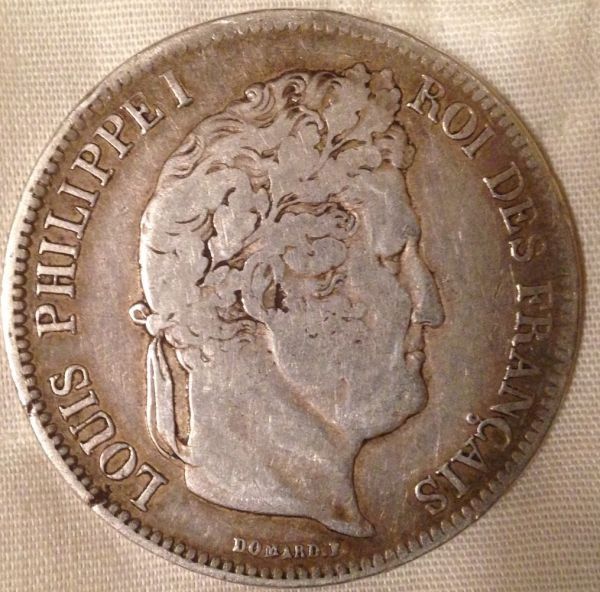
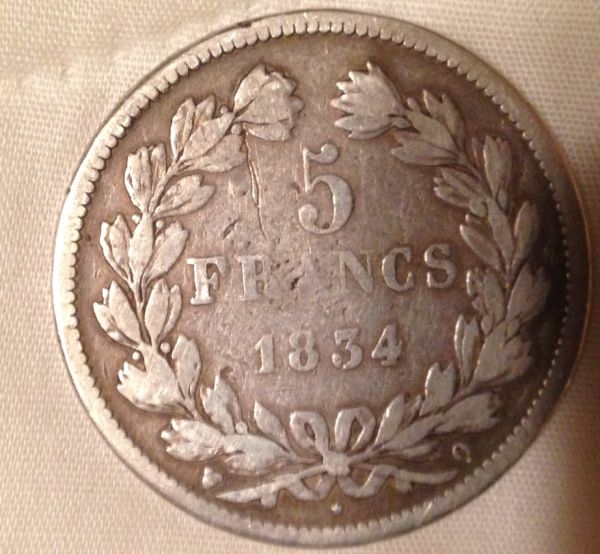
I'm researching a dubious 1834Q French 5F I bought earlier this week. The weight is in tolerance for the amount of wear, the color is right, the details are sharp...but the coin clunks when tapped or dropped. I've compared it with a lot of other 5F's, which all ring like silver. The only other thing which sets off alarms are 3 equally spaced raised bars on the edge, which I don't see on genuine coins. These coins have raised letter edges and the bars have the appearance of extra letter I's. Counterfeit Louis Philippe 5F's are pretty common and many have good sharpness of detail. However all the lead counterfeits in cgb's archives are 5-7 grams underweight and this one isn't. I'm suspicious that this one might be lead antimony tricked up to get the weight and appearance right. In looking for a way to improve the ring test, I ran across ultrasonic velocity, which is used in the following to detect counterfeit silver bars: http://about.ag/UltrasonicThicknessGauge.htmThis is not an inexpensive way to test metal (certainly not worth it for this 5F), but it is non-destructive. It looks like an excellent way to spot lead counterfeits. Has anyone here tried it? "Two minutes ago I would have sold my chances for a tired dime." Fred Astaire
|
|
|
|
Pillar of the Community
United States
1234 Posts |
Is there any chance of an image?
From what I read on the link it sounds like a beefier version of the ultrasound machine they use in hospitals. If it's save for a baby then it should not hurt your 'baby' there are ultrasound generators used to break up kidney stones but it seems this method is non-invasive. They also use ultrasound for archiology, again non invasive.
For one coin I could not justify the expense of buying a machine. There are many different methods, acid, X-ray, here's a longshot but if you have a good doctor or a pregnant relative you might be able to get an image of the coin with medical ultrasound it probably would not be as accurate as the gauge you mention but if you scope a good one and that one you might see a major difference in them.
Good Luck and keep us posted
|
|
Pillar of the Community
 United States
3359 Posts |
Ultrasonic thickness gauges are used for things like tank walls when you can't use a caliper gauge. I found them on-line for $500-1000. So you could justify one if you were running a lot of tests on coins. One test on a counterfeit 1000g bar would pay for it though. Here's one of the raised bars, between the words DIEU and PROTEGE. 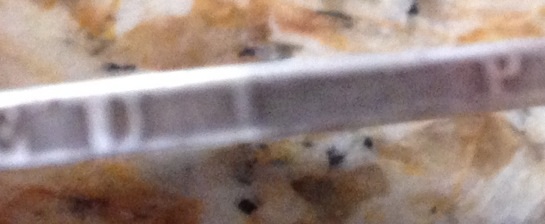 "Two minutes ago I would have sold my chances for a tired dime." Fred Astaire
|
|
Pillar of the Community
United States
1760 Posts |
Post a picture I have done enough XRF research on China CC coins and World contemporary counterfeits (CC) to provide an answer. Supply a picture of a real coin and this counterfeit - can be side by side or individually.
John Lorenzo
New Jersey
United States
|
|
Pillar of the Community
United States
3359 Posts |
"Two minutes ago I would have sold my chances for a tired dime." Fred Astaire
Edited by thq
01/01/2014 6:34 pm
|
|
Valued Member
Belgium
83 Posts |
Frankly speaking, ultrasonic detection will not help you in this case. Ultrasonic investigation is used for cases in which their is a high difference in density between 2 different materials. It is commonly used to check on weldings or to find weak points in materials. Due to the extreme difference between air and metal this can be detected.
As long as your coin is made of solid metal, such an investigation will give you no answers. For coins in a basic alloy that were coated in a silverbath of some kind, I do not even believe that this technique will help you.
Concerning the 3 raised bars on the edge inscription: these coins are created using a mint ring that is in place with the actual dies. Due to the force of the actual coin striking, the edge inscription is created at the same time. This can be proven by the fact that only 1 orientation is possible (the edge is always readible in 1 orientation of the coins, also called a position) and will in most cases for an entire year start at the same place in relation to the dies. The 3 raised bars are actually the place were the mint ring is put together. Similar raised bars can also be seen on the similar pieces of 5 francs of Belgium.
|
|
Pillar of the Community
2087 Posts |
Quote:
Concerning the 3 raised bars on the edge inscription: these coins are created using a mint ring that is in place with the actual dies. Due to the force of the actual coin striking, the edge inscription is created at the same time. That may be a little misleading for some. The french developed and used an edging technique called "Virole Brise". A single collar(ring) is not used ( thats why the above is misleading) rather a three segment split collar( ring) the three vertical lines are caused by the joining points of the segments. However it is a relatively new technique but I am still rummaging through my reference books to find out when it was introduced I half thought 1840 might be a little early. Edit checking through Cooper "The Art and Craft of Coin Making" ( A must have book IMHO) I found some more information on Virole Brise. The technique commonly used a three segment collar but from time to time six segment collars were used. The technique offered greater security against counterfeiting. Given the suspect coin has been struck using this technique there may be another explaination perhaps the coin is a trial strike that slipped into circulation. For the technically minded: The dies for the faces of Virole Brise struck coins differ from other dies. The top die "had a short neck that would press down on the leaf spring loaded segments". While the bottom die had a neck long enough to hold the blank at the correct height. The top die descending would drive the "hinged" and slightly raised segments down, so striking the coin and the edge at the same time. It may help to visualized each segment as a slightly raised draw bridge. The descending top die hits the raised edge of the draw bridge driving it down Edited by austrokiwi
01/02/2014 01:37 am
|
|
Pillar of the Community
United States
3359 Posts |
The idea that the coin is a trial strike in base metal is intriguing, and could explain the accurate coin weight in a time when contemporary counterfeits were underweight. I can understand how a badly fitted three piece collar would be capable of generating the vertical bars. I don't see such bars on my genuine Louis Philippe and Charles X 5F's, but I don't have other Q mint coins to compare with.
"Two minutes ago I would have sold my chances for a tired dime." Fred Astaire
|
|
Valued Member
Belgium
83 Posts |
@Austrokiwi: your explanation is correct. The translation of "virole brisée" (virole is a feminin word) is "broken mint ring", indicating that the ring is not made in 1 piece but was assembled in different pieces (in this case 3 pieces).
To my knowledge the use of a mint ring has never been copied in a serious way by counterfeiters. A lot of counterfeited Belgian 5 frank coins exist (originally 25 g of 9000/1000 Silver) , but I have never encountered one with the correct edge inscription by a mint ring or a device that can copy the results.
|
|
Pillar of the Community
2087 Posts |
Quote:
I can understand how a badly fitted three piece collar would be capable of generating the vertical bars . I think in this case to understand the technique; a picture is worth a 1000 words. So below are to photographs from Coopers book of the virole brisée set up. The lines aren't due to badly fitted segments rather they are an ever present artifact of the striking method. I have two other coins that have the markings. A Morroccan Ryial of AH 1299 and an Ethiopian Matt Proof Birr. Heres the side drawing of the die and collar set up from Coopers book( obviously taken from a German text: 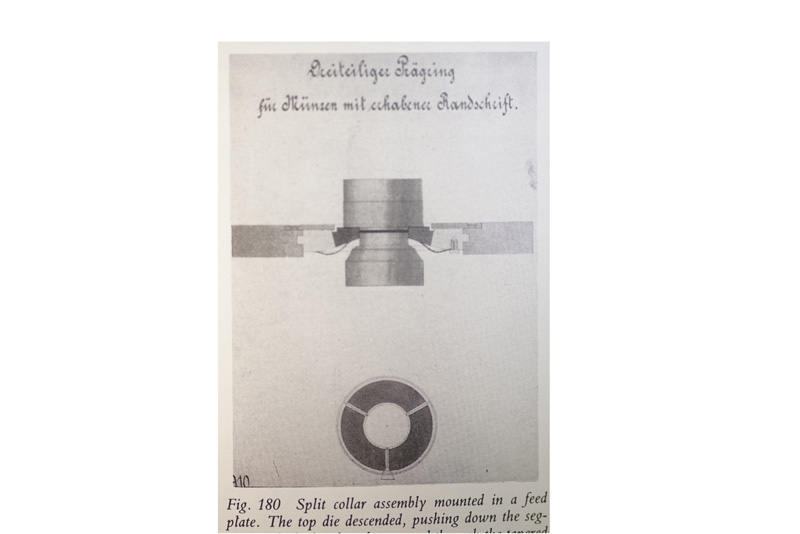 A picture of a 6 segment collar: this should show how the lines are due to normal operation not due to poor press set up.: 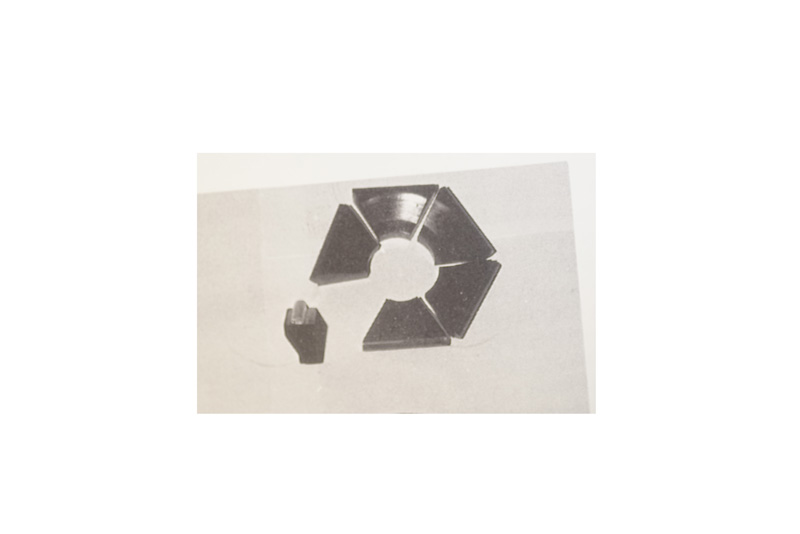 Edited by austrokiwi
01/02/2014 09:49 am
|
|
Pillar of the Community
United States
1760 Posts |
After reading this thread I would be willing to do a free XRF analysis on this coin for you - you just pay for P&H, Some of my previous researchers interested in XRF want certified mailing - you are in the U.S.. So am I ... just E-Mail me privately at johnmenc@optonline.net if you wish to proceed. The average cost with outside testing is only $75 ... perhaps a closer testing company in your own state ... let me know ...
John Lorenzo
United States
|
|
Pillar of the Community
United States
1760 Posts |
Coin being sent for free XRF analysis I will post the results and my interpretation upon receipt and analysis to this thread as requested.
John Lorenzo
United States
|
|
Pillar of the Community
United States
3359 Posts |
Update: John has completed the EDAX testing. The surface of the coin is 93.91% silver with an error of 0.30%. This is far higher purity than a real 90% silver 5F. Consensus is that it is a silver-plated contemporary counterfeit with a lead or lead alloy core to make the weight correct. Thanks John!
"Two minutes ago I would have sold my chances for a tired dime." Fred Astaire
|
|
Pillar of the Community
United States
1760 Posts |
The coin had no real coin ring so with the silver plating and a thud like sound for a coin ring - these possibilities are eliminated under the silver plating: Debased silver alloy with copper, tin or bronze as the debased under layer as these ring with a lower pitch. Coin was not magnetic so high iron was ruled out as is sometimes with Modern Chinese forgeries. So XRF confirmed silver plating with a probable high Pb which is probably alloyed with Cu, Sn and/or Zinc. Pb used to bring up the weight near or at regal. Interesting piece ...
|
| |
Replies: 13 / Views: 2,610 |
|










 Posted 01/01/2014 1:22 pm