Quote:
So did cash coins from many eras and emperors circulate alongside each other for hundreds of years, or were there recalls, hoarding etc.?
For the most part, coins continued to "circulate" until they were too badly damaged to be useful. Remember, a cash coin isn't too valuable just by itself. The vast majority of them "circulated" while tied up in bundles of 100 coins. A coin tucked inside a string of coins isn't going to wear much, but the hole might eventually wear through.
The Ming Dynasty was largely a paper-money-powered economy, with coinage issues fairly scarce. So the cash coins circulating in 19th century China were almost exclusively Qing Dynasty coins. But they could have been issued pretty much at any time during the Qing Dynasty. They tended to be whichever coins had the highest mintages. The Qian Long period (1735-1796) was both long and prosperous, so mintages were very high; those coins tend to be the ones most commonly found, both in China and outside.
Quote:
And what does an chinese coin in the Netherlands? Don't know any trade between the Netherlands and the Chinese in the Past
It could have come to your shores by any number of means. Chinese traders, merchants and fortune-seekers took cash coins with them wherever they went, both as familiar means of currency they could pay each other with, as well as the ritual and religious significance that had become attached to the coins over their 2000 year long history. Cash coins can easily be found in Southeast Asia, India and even the goldfields of California, Australia and New Zealand. Many Chinese merchants made their home in Indonesia and some of their descendants no doubt came to the Netherlands during or after the period of Dutch colonial rule over Indonesia. They, I think, are the most probable source of your coin.
Quote:
Do you also have any idea what the different characters on the coin mean, although I know I cannot ask from you to translate Chinese for me.
Translating isn't a problem. Though I can't speak or read Chinese, I do have books on the subject of interpreting Chinese coins.
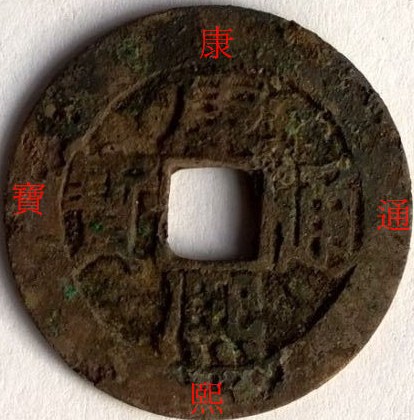
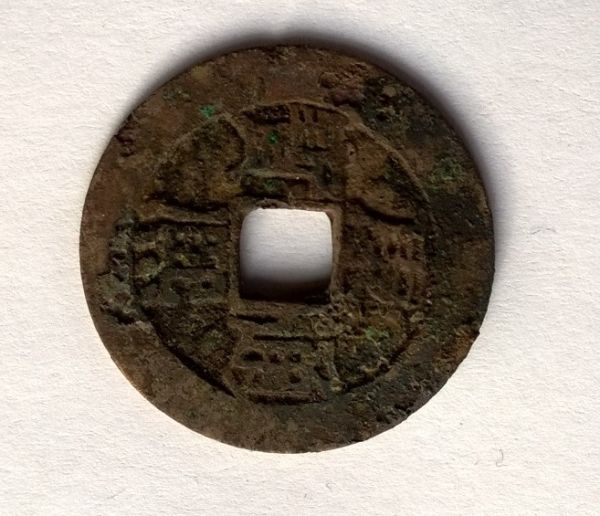
The front of the coin is your bottom picture, rotate it 90 degrees anticlockwise to make the picture "right way up". The four Chinese characters are then read, in the order top-bottom-right-left, as "Kang Xi tong bao". Kang Xi was the reign-name of the emperor; tong bao simply translates to "current coin".
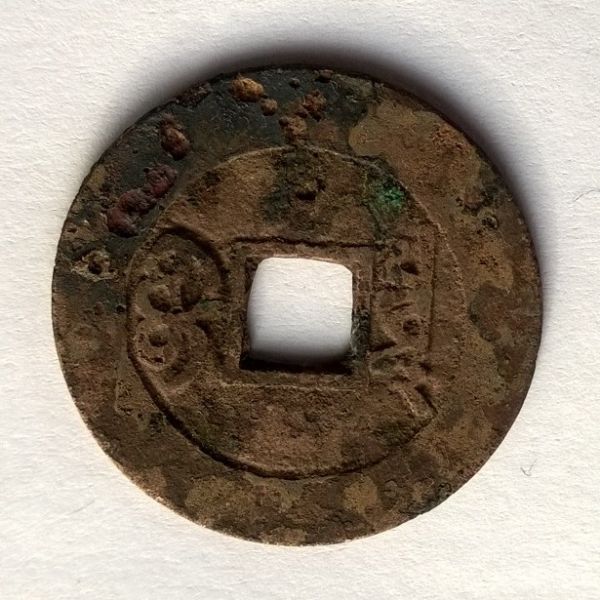
On the back are two words written in Manchu script. The word on the left that looks like 999 written sideways is the word "boo", meaning mint. The other word is the name of the mint, in this case "Chiowan", meaning Revenue, the name of the government department that owned that particular mint.
Don't say "infinitely" when you mean "very"; otherwise, you'll have no word left when you want to talk about something really infinite. - C. S. Lewis









 Posted 01/03/2014 11:41 am