









 Posted 01/11/2014 07:26 am


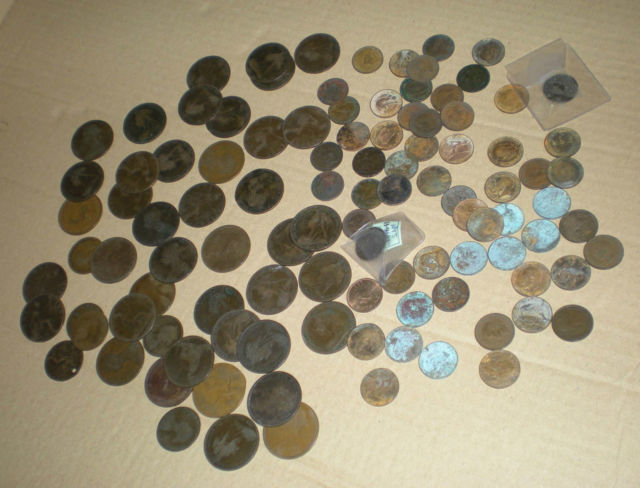
The bluish-green powder is "bronze disease". It forms from a combination of moisture and atmospheric conditions. It is highly contagious; if particles of the green powder jump from coin to coin, they can cause new outbreaks to form on previously uncorroded coins. So do NOT store powdery green coins with any other coins in a jar or box where they can jostle together.
A coin affected by bronze disease will look "cleaned", no matter how you try to clean them. If the bronze disease is old and deep, the resultant cleaned coin will be pitted. Acids (like vinegar or lemon juice) will remove the green but also attack the rest of the coin surface including the brown oxide layer you would prefer not to remove; an acid-dipped bronze coin is entirely pink, and quite ugly. Alkalis (like ammonia or caustic soda) are better at removing the green without removing the brown, but I've found them to cause the areas where the green was removed to turn bright orange, creating a mottled orange-brown pattern which can be even worse than acid-pink. I've found pH-neutral chelating agents (such as disodium EDTA) to be best at removing the green without causing too much further disruption.
Some proprietary compounds, such as BadThad's Verdi-Care, don't remove the corrosion but rather mask over it: they soak into the green powder, rendering it harmless, forming a chemical barrier to prevent further corrosion and making the bright green corrosion by-products darker and less visible.
Unless the damaged coins are scarce dates you can't otherwise buy cheaply, or they otherwise have some sentimental value to you personally, I'd really recommend not adding those blue dudes to your main collection.
A coin affected by bronze disease will look "cleaned", no matter how you try to clean them. If the bronze disease is old and deep, the resultant cleaned coin will be pitted. Acids (like vinegar or lemon juice) will remove the green but also attack the rest of the coin surface including the brown oxide layer you would prefer not to remove; an acid-dipped bronze coin is entirely pink, and quite ugly. Alkalis (like ammonia or caustic soda) are better at removing the green without removing the brown, but I've found them to cause the areas where the green was removed to turn bright orange, creating a mottled orange-brown pattern which can be even worse than acid-pink. I've found pH-neutral chelating agents (such as disodium EDTA) to be best at removing the green without causing too much further disruption.
Some proprietary compounds, such as BadThad's Verdi-Care, don't remove the corrosion but rather mask over it: they soak into the green powder, rendering it harmless, forming a chemical barrier to prevent further corrosion and making the bright green corrosion by-products darker and less visible.
Unless the damaged coins are scarce dates you can't otherwise buy cheaply, or they otherwise have some sentimental value to you personally, I'd really recommend not adding those blue dudes to your main collection.
Don't say "infinitely" when you mean "very"; otherwise, you'll have no word left when you want to talk about something really infinite. - C. S. Lewis


