| Author |
 Replies: 37 / Views: 6,155 Replies: 37 / Views: 6,155 |
|
Pillar of the Community
United States
1761 Posts |
Recent thoughts on this counterstamp is Krause has this counterstamp UPSIDE down. If you turn this 180* with the stop Period) at the right the correct position after the two or three letters it COULD translate to AVT. During the time of Morelos its been recorded that Valerio Trujano assisted Moleros for the cause of Independence. The city of Ames honors this individual - hence AVT? is possible. The time fits for Valerio Trujano as does LVS and the Morelos multiple counterstamp issues.
Reference: Historia Comprendida del Estado de Puebla (p.462).
Thoughts?
John Lorenzo
United States Edited by colonialjohn
01/25/2014 10:57 am
|
|
|
|
Valued Member
Germany
194 Posts |
John, I guess you are talking about this stamp. 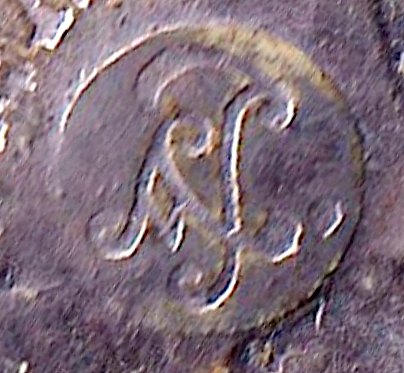 It usually comes with a little dot, which is the reason why many believe that this counterstamp should be read at a 180 degrees angle. Yes, it could be read as T-A plus a small V instead of the vertical bar of the letter A. It could also be read as an abbreviation: Ta. Which is what Ed Fisher did in a small article which was published in the Numismatist in 1994 (if I remember right), where he interpreted this to stand for Tixtla. And Tixtla de Guerrero was a base of the forces of Morelos between 1811 and 1814. A point could be made that there was some production of cast copies of 8 reales there, which were issued with the Ta. monogram and subsequently validated with the counterstamps of the Morelos monogram and/or the one called "Chilpancingo". In order to verify such a theory, one would have to study a greater amount of the cast coins with three counterstamps (Ta. - Morelos - Chilpancingo), to see if any order can be deduced in which the stamps were applied. I haven't done such a study yet, but from the few coins I have taken a closer look at, I don't remember having seen an example in which the Ta. stamp was clearly and definitely placed AFTER the other two stamps. The village of Ánimas Trujano in Oaxaca took the name "Trujano" only after he died in the War for Independence. It is situated at the outskirts of the town of Oaxaca, in the center of the state. I don't know whether a considerable production of cast silver coins would have been possible there. In any case, "AT" would have been the better acronym, as the town did not include the first name of the war hero in its name. Attached a picture of the complete coin, which is one of only two I have ever seen with the LVA or Ta. counterstamp alone! 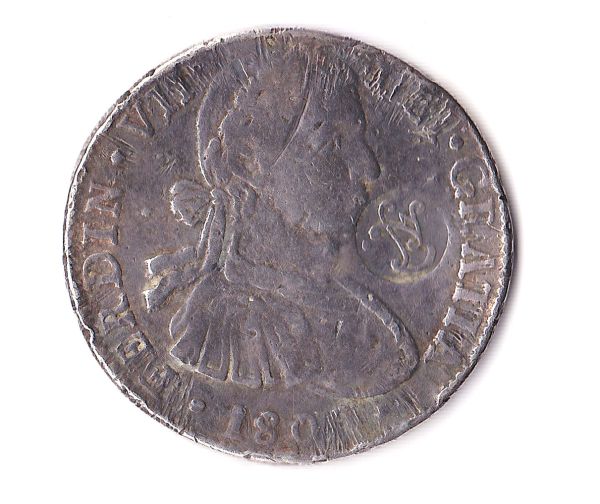 |
|
Pillar of the Community
 United States
1761 Posts |
CORRECT. Dot at END of INITIALS. At this point I should say this was discussed in Max Keech's talk at the second MNA Convention on WOI counterstamps. The idea that the counterstamp really should be turned (180*) so the stop is at the END of the two or three initials depending on how your read this monogram.
After reading your explanation I can see the problem here and with this example which appears on a cast coin dated 1809? and a good period of time before 9/1810 (start of WOI). Of course the counterstamp application process as I am just starting to learn it seems that the counterstamps were applied on random dated cast pieces so this piece seems not to add to the puzzle - But maybe - Since it was added to a so-called early cast this stamp may have been applied first and then the Morelos counterstamp later or together? Its complex. As I am learning from Keech (MCC) and Dunnigan (Texas - Dealer) it seems the only way to answer questions is examining multiple pieces and relating this to a historical time frame as Krause is useless. It seems as I am learning that certain counterstamps or multiple counterstamps only appear on cast or only on struck issues - so this is important for studies like these and to question if some pieces are counterfeits. Complex - indeed!
One thing is for certain this counterstamp belongs in the southern region or with Morelos - the only mystery that remains is to verify its association with Morelos and this sountern region of occupancy during 1811-1813.
I see your point the "A" is illogical and no town in this WOI period has this situation and it could only be "VT" with my guess as all these stamps are self-promoting in nature with the revolutionary leader - yes the "A" does not fit. "VT" seems plausible? But Tixtla is a town location or base fort as you mention unique to this WOI series in terms of being a geographical location and then being a counterstamp? Is it plausible based on all the other counterstamps not bearing this type of signature origin?
John Lorenzo
United States
Edited by colonialjohn
01/25/2014 11:11 am
|
|
Valued Member
Germany
194 Posts |
John, anything is purely speculative, such as the attribution to Tixtla. And indeed, the main argument against this countermark standing for Tixtla would be that monograms usually are the stylized acronyms of people's names, as in the Morelos and Osorno counterstamps or in same hacienda punches. Feel free to attribute it to any Insurgent leader with the letters T, or J, or L, or A, or V, or anything else one might be able to read from it, such as S or C  ! What I do know is that the counterstamp is only found on cast copies of 8 reales of the kind that the Insurgents in the south produced, and that it is almost exclusively found in combination with the Morelos and/or the Chilpanzingo counterstamp (which is why it is not catalogued separately by KM, for example). So I would derive that it is NOT a stamp that was used to revalidate emergency coins made elsewhere or by the Royalist forces (as we sometimes see with the Morelos stamp which can be found on coins coming from elsewhere, most notably Zacatecas). Plus, we can observe (tentatively, as I have not yet done an extensive study) that it usually was placed before the Morelos or Chilpancingo stamps. Which is why I regard it as sort of a "maker's mark" (in its most ideal sense, it could be a mint mark, if there were ever any information found that would place this stamp at a certain place for a certain time, such as the "MVA" stamp in Monclova or the "VB" and "SM" stamps for San Miguel Tenango). Of course it is speculation, but I would not regard it as beyond reason to assume a situation in which Insurgent workers at one place produced larger amounts of cast copies of 8 reales, marked them with this stamp, and had them at a later stage validated by the people carrying the stamps of Morelos and/or Chilpancingo. Let's say (and this, again, is pure speculation) that whoever was in charge at a smelter in a place like Tixtla produced the coins and sent them off to Morelos to wherever he was campaigning at the moment, where he then added his own counterstamp. The person in his camp doing the stamping would have been happy to see the first stamp as a proof that the coins came directly from where they were supposed to come from, which made it faster and easier to revise larger amounts. One has to keep in mind that the coins were not supposed to be of full weight and fineness, it was generally understood and accepted that they were debased, so the fineness didn't need to be checked. But of course the widely used and well known Morelos stamp gave these coins the necessary credibility with the people (or took one argument for not accepting them away from the people, whichever way you want to see it...) |
|
Pillar of the Community
United States
1761 Posts |
Your knowledge of the WOI issues is second to none ... IMO. Even from my naive research whether this stamp is of an individual or geographical insurgent mint location ... these pieces eventually were validated by Morelos ... UNQUESTIONABLY within HIS geographical domain in the SOUTHERN REGION during this period of 1811-1813 or so ... to be continued ... <BG>. Yes ... your 1809 piece is probably not accidental ... if you get my meaning but ... VERY TELLING!
Edited by colonialjohn
01/25/2014 1:43 pm
|
|
Pillar of the Community
United States
1761 Posts |
The Royalist effort to maintain control of the Montana collapsed in the summer of 1811. In early May the Bravo family left hiding to join the insurgency, and later that month Morelos forces took the strategic town of Tixtla. Until August an uneasy balance of power persisted in the area: the insurgents held Tixtla but the royalists continued to control Chilapa, less than 25 km away. The stalemate ended in mid-August when the insurgents crushed a royalist force sent to to recapture Tixtla, and royalist authority subsequently collapsed in the entire area from Chilpancingo east to Huajuapan in present day Oaxaca ... I see your point DOS MUNDOS this was an area controlled by the Insurgents for some time with the most powerful family in the area (Bravo Family). Monies for troops had to come from somewhere ... I like this Tixtla theory ... BETTER.
John Lorenzo
United States
|
|
Pillar of the Community
United States
1962 Posts |
Excellent discussion. Figuring out WOI coinage/validation/revalidation, and fakery thereof, is a complete tangle, and you essentially have to be a Mexican historian to even be semi-competent. And thus, this gringo sticks to regal portrait types of this period.
If nothing else, I'd say to save a photo of EVERY one of these you see in auction or at shows (if the dealer will allow it)... essential for noticing trends, including/excluding theories, etc.
Another thought - it would be worthwhile to look into cursive handwriting standards/conventions in Mexico at that time for more insight into what those letters are most likely to be.
================
SELF-EDIT b4 I post: So I'm staring at the stamp...
A) Does there seem to be any pattern/trend to the positioning/application of the mark across multiple specimens?
B) Indeed, as mentioned, it makes absolutely no sense for that dot/period to be randomly floating to the upper left of that - what possible purpose could that serve?
C) Even if it WAS oriented that way... why is that smaller character a "V"? It has a clear tail to the lower left... when does that ever appear on a "V"? That letter would have to be "Y", wouldn't it? Now, analyzing it as a "Y"... it looks more like a regular print "Y" that was stylized, which doesn't seem appropriate. Still, it COULD be "Y"... but I really think that tail eliminates "V" as an option.
Would a "Y" make any sense in the historical/geographic context?
That said... again, there's the issue of the dot not making sense at the upper left. Considering that... I think visually, my impression is that that letter does seem most like an "A" (in the style of the Atlanta Braves/U. of Alabama). I also don't know that the stuff in the center of the "A" (if it is an "A") necessarily HAS to be another small letter - couldn't that simply be a stylized crossbar of an "A"?
Another random observation - It would seem from the sizing of the characters that the "L", or "T", or whatever that is, is being portrayed as the primary letter. Wouldn't that seem to imply that that letter is the first initial of a SINGLE word? Or, at least, if it was a monogram... that letter is the first initial of a most prominent word/name.
IDK... just throwing ideas out there from an outside perspective.
|
|
Pillar of the Community
United States
1761 Posts |
Moving forward DOS MUNDOS you mention some pieces can be debased - I have come across as you have seen in my 9/2013 MNA Paper that some Chihuahua Cast pieces with proper mint stamps applied during the production process and hence being called mint stamps were debased ... not to sure about silver plating as being a regal operation and more likely a contemporary counterfeit operation ... moving forward I will keep this in the back of my mind ... however as you see in the paper from this small population of Chihuahua cast/restrikes most are good silver ~90%. True ... this is only the beginning in one short series and good silver and debased silver investigations is something I will keep investigating for ALL of the WOI series - particularly these counterstamps and this time period of 1811-1813 into (1814) ...
John Lorenzo
United States
|
|
Pillar of the Community
United States
1962 Posts |
Quote:
in my 9/2013 MNA Paper that some Chihuahua Cast pieces with proper mint stamps applied during the production process and hence being called mint stamps were debased The one thing I've noticed about those is that a lot of well-circulated pieces (that appear genuine) have very deep/dark tone - as if they're high in copper? |
|
Pillar of the Community
United States
1761 Posts |
Its just their individualized environmental conditions of exposure. A good example is when Gurney in the beginning of the GNL Book sent me all these CC8R's for XRF analysis with multiple colors. In the end they were JUST ONE THING ... debased Ag alloy issues either debased with copper, zinc or tin. With these metals being more prone to corrosion it produced all these varied colors thinking we had different alloys and in the end they were just one type of alloy - debased Ag. The 3-6% Cu in a typical 90% Ag issue the toning will vary in color only to the copper - of course. Its tough to put a percentage on color ... the one I recently sold on E-Bay did have 6% Cu so it did appear coppery ... but it was XRF verified ... hope you can follow this line of reasoning ...
Edited by colonialjohn
01/26/2014 7:02 pm
|
|
Valued Member
Germany
194 Posts |
John,
There is a difference between the cast Chihuahua issues, which were made by the Royalist forces and were supposed to be of good silver. Same with the Monclova casts.
Also, I would assume that the Zacatecas provisional issues and the later royal strikes, which are among the crudest struck coins of the whole WOI period, are of good silver as well.
With the cast issues of the Insurgents of the south, it's a different thing. Morelos issued copper 8 reales as fiat money. But not everybody could be forced or coerced into accepting them, which is why we also see silver versions. It would be interesting to see an XRF analysis of several of them, especially of the cast Morelos 8 reales (after weeding out the ubiquitous modern forgeries). Most of them appear to be of close to good silver content, but there are also debased versions, especially the cast copies of regal coins. These were obviously made by the Insurgents with the intent of increasing the number of coins held by them and could be seen as inflation money or (if you were convinced of the ultimate victory of Morelos) as a more solid version of fiat money.
|
|
Pillar of the Community
United States
1761 Posts |
I also find the crudeness and slight deviations of some pieces interesting. See this LVO from Gomez the noted Mexican Collector who makes a terrible error in judgement: http://www.ebay.com/itm/31084039733....m1439.l2649Indeed when he sent me this coin after winning the auction it was different than the picture (not intentional and due to his photography) - very white as in white metal - not this brownish color from the pics which changed the appearance probably after an OLD cleaning. I did brown the coin up a bit by sticking the coin in a oven at 400*F for several hours bringing back the brown and blue overtones from the trace copper in the alloy after I determined it it was regal. It weighed 24.6 grams and had the typical diameter for an LVO 8R - a little lighter than regal weight from other pieces so I immediately knew it could not be a tin (Sn) based white metal alloy CC and the tone was a bit lower with the ring test than silver pieces but not much - more bell tone than a higher Ag pitch. We did an SEM/EDS analysis on the piece and it was 95% silver and 4% copper with no tin,zinc or high lead and its not plated as the piece is VF or so - so plating would be easily detected by Gomez and myself. The higher silver reading being the L.Beck Silver Surface Enrichment Effect. See my MNA 9/2013 Chihuahua Paper if necessary for this explanation again on why sometimes false higher Ag readings above 90% occur. In the end it was real and a few letters appeared a tiny bit mushy but its not cast and it looked as Gomez described as white metal (Sb/Sn/Pb alloy) but its metrology and SEM/EDS proved otherwise as the piece is unquestionably regal (Ag/Cu alloy). My point Mr. Bopple is that this field is wide open in terms of what pieces may be allowed to be debased and which are not and slight deviations need to be considered allowable - in a revolutionary or emergency money situation we SHOULD expect some anomalies or in this Gomez case some costly errors in interpretation based on some minor differences in some issues that need to be allowed or further investigated by the owner. John Lorenzo United States Edited by colonialjohn
01/28/2014 3:09 pm
|
|
Valued Member
Germany
194 Posts |
These Zacatecas pieces are a case of their own. They come in an extremely wide range of quality of strike. Contemporary counterfeits are known, but also good coins which look extremely doubtful, such as yours. There are reports that these coins were received elsewhere (i.e. the port of Vera Cruz) at par to regal coins. Undoubtedly, this would not have applied to yours. I own one which I bought as a possible contemporary counterfeit (but with a valid and rare countermark), which turned out to be good, but with the edges trimmed all around.
My point is that mints like Chihuahua, Zacatecas and Monclova were places where silver from the mines were made into coins, probably with refining and assying issues, but generally with the intent to produce full silver weight coins, as crude as they may have been. Today it might be difficult or impossible for us to tell why coins like the LVO you have fell short - technical problems, neglect, or maybe even fraud by some people involved in the production process - while others from the same series didn't.
The Insurgents in the south, on the other hand, deliberately produced debased silver coins, maybe with the intent to inflate the monetary base, maybe because they really expected the people to accept them as fiat money, but not with an intent to defraud, as they never claimed the coins to be of good standard, and made no effort to disguise it.
Nevertheless, you are absolutely right in that there is no black and white with these issues - coins of supposedly good standard might be underweight or debased, but still original. Insurgent issues may turn out to be overweight or contain higher amounts of gold than needed (as it happened with certain emergency issues from the Mexican Revolution period almost exactly 100 years later). So alloy composition or weight will in most cases not be a definite indicator of a coin's authenticity (a Chihuahua cast found to be heavily debased or a Morelos cast turning out as being made of a "modern" silver alloy are obvious exceptions, of course).
|
|
Pillar of the Community
United States
1761 Posts |
One day and one province at a time ... <BG>. I am not going anywhere soon ... <BG>.
|
|
Pillar of the Community
United States
1962 Posts |
I was simply going to write that regarding John's recent purchase, crude conditions aside, hard to see how that coin and this clearly genuine example shown below were produced in anything close to the same manner. For giggles, working off what Krause notes (I know, I know...), which does appear to verify in searching auction archives... Doesn't your date have the wrong orientation for KM190, which yours purports to be (as opposed to KM189 w/the cartoonish shield)? All the KM190 examples I see have the date the other way (rightside up in relation to the shield) 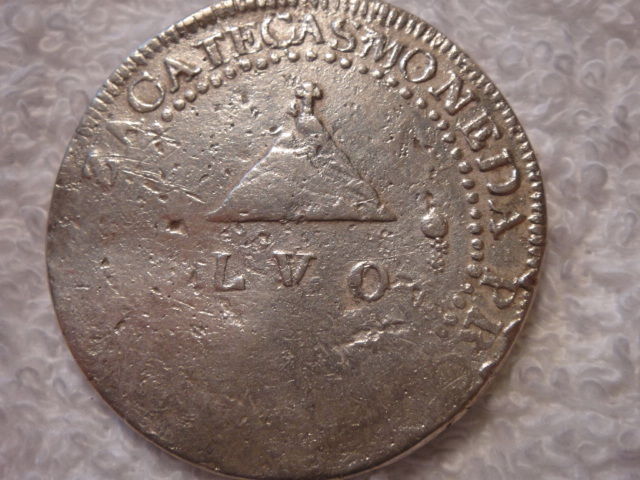 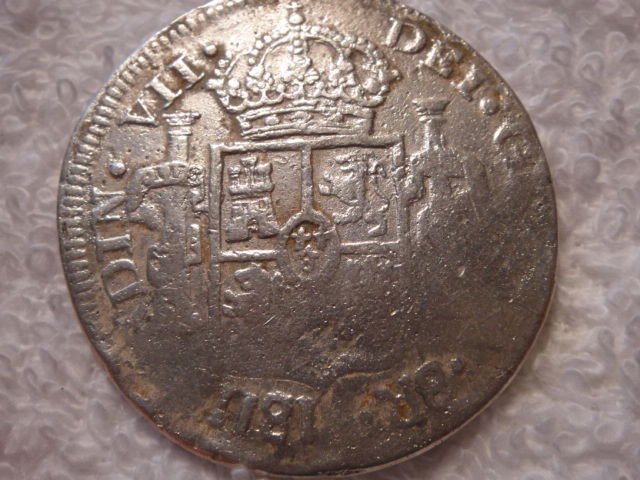  |
|
Pillar of the Community
United States
1761 Posts |
Very interesting ... mine clockwise 1811 instead of 1181 ... realeswatcher ... see Stacks/Bowers November 2012 WOI Collection. See lot 11179 ... in the Bopple Collection from memory ... XRF and SEM/EDS indicated good Ag (90%) and good Pt and Au and yet look at this host coin. I have no current explanations ... Mr. Bopple ... does this piece have a date?
|
| |
Replies: 37 / Views: 6,155 |










 Posted 01/25/2014 10:56 am


