| Author |
 Replies: 16 / Views: 5,596 Replies: 16 / Views: 5,596 |
|
Valued Member
United States
110 Posts |
Okay, this token, a Richardson's Sagendorph's Battery, looked like a good candidate for cleaning, so I bought it plus a bottle of Verdi-Care. 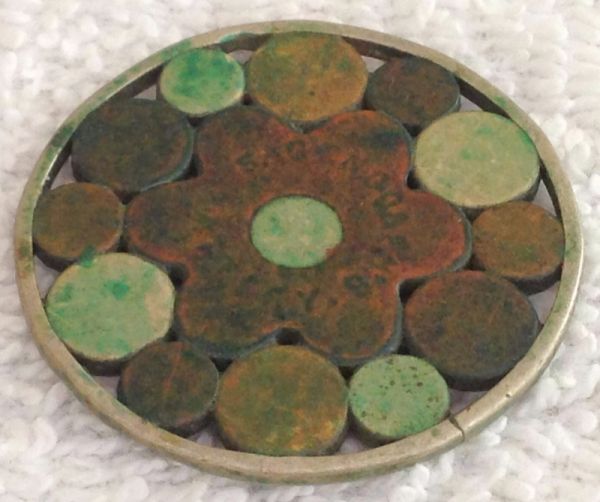 When it arrived, it was apparent that it had also been clear coated with lacquer, varnish, or whatever. So that needed to be stripped off before trying the Verdi-Care, so it received a couple short soaks in acetone, which would've been done first anyway. A few sharpened toothpicks were used to pick out the crud in the crevices, but my vision is no longer good enough to effectively do that. 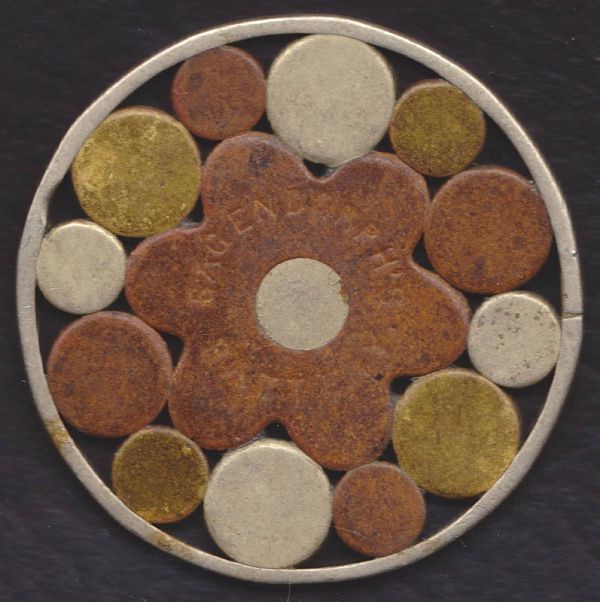 The acetone did a good job so the Verdi-Care was not used. A similar more common token, Boyd's Battery, is catalogued and extensively described by Rulau as NY-NY 33. On ebay in the Coins category, a Boyd's sells for perhaps $50, but when listed as a quack medical device they often sell for quite a bit more. There is almost always at least one Boyd's Battery listed on ebay. This Sagendorph Battery is less common, as is another similar Richardson's Battery. There were quite a few other makers, but the three mentioned are the more common ones. These tokens were intended to be worn on a chain, usually close to the user's heart, and a tiny electrical field generated by the dissimilar metals was supposed to purify the blood. That same combination of metals has a tendency to create some galvanic action and corrosion, so many of these are cleaned, often harshly cleaned and highly polished, which doesn't seem to hurt their resale value at all. No doubt some are worn as conversation pieces. When I evaluate these online, one thing I look for is the color of the silver discs. They must be nickel, because they are most resistant to discoloration and they age nicely to a white color, like an old nickel plated faucet. When these tokens are aggressively cleaned, those parts are unfortunately often polished so they look like chrome, and of course the brass and copper lose their patina too. They seem to retone fairly well with age, and I look for that white nickel color as a clue to how long ago they might have been cleaned. -Duncan Edited by Duncan_Doenitz
02/05/2014 6:01 pm
|
|
|
|
Rest in Peace
United States
4078 Posts |
Nice clean up. Although I never heard about these I'm curious about the history/dates these came out. Duncan thanks for the show and tell.
Edited by bpoc1
02/05/2014 3:14 pm
|
|
Valued Member
 United States
110 Posts |
Many are dated (patent dates), typically 1878-1880, often in the US, Canada, or England.
|
|
Rest in Peace
United States
4078 Posts |
Quote:
Many are dated (patent dates), typically 1878-1880, So this is the years they came out 1878-1880? Sorry if I'm reading this wrong. |
|
Pillar of the Community
United States
9811 Posts |
I would still give the token a coating of Verdi-Care as it will prevent more surface deterioration over time. From my understanding it adds a protective layer on the surface. I may be wrong but BadThad could answer that better as he developed it.
"Buy the Book Before You Buy the Coin" - Aaron R. Feldman - "And read it" - Me 2013! ANA Life Member #3288 in good standing since 1981, ANS, Early American Coppers Member (EAC), Colonial Coin Collectors Club member (C4), Conder Token Collector Club member (CTCC), Civil War Token Society (CWTS) member, Liberty Seated Collectors Club (LSCC) & Numismatic Bibliomania Society member (NBS), USMex, Member in good standing, 2¢ variety collector. See my want page: http://goccf.com/t/140440 |
|
Valued Member
United States
110 Posts |
Yes, bpoc, those dates are when the tokens were first introduced and ads and promotions from that era confirm their distribution during that era.
The Boyd's batteries were patented in both America (1878) and England (1879), and Richardson's, patented in the US Feb 3, 1880 and registered in Canada Feb 9, 1881.
Boyd claimed in ads that the Sagendorph's Battery was a worthless ripoff by an employee, but the two tokens look alike except for the stamped names.
And yes, Westcoin, I'll try an application of VerdiCare, since these creatures are likely to continue their galvanic action no matter how they are stored.
-Duncan
|
|
Valued Member
United States
110 Posts |
Here's a Richardson's token, purchased in November... 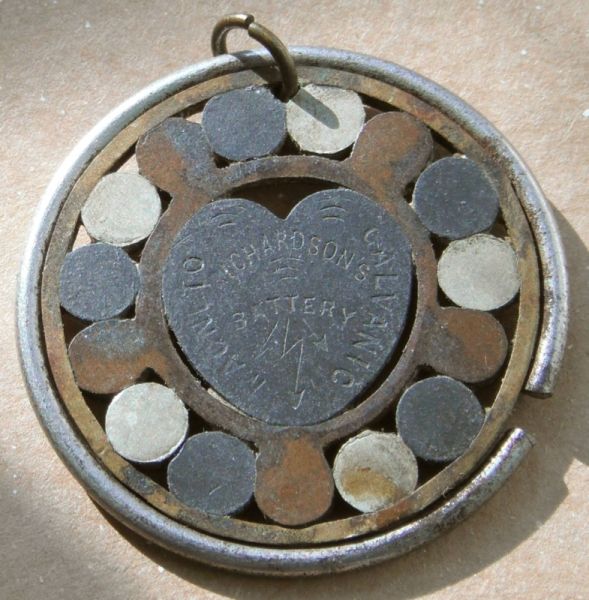 And the reverse, with dates... 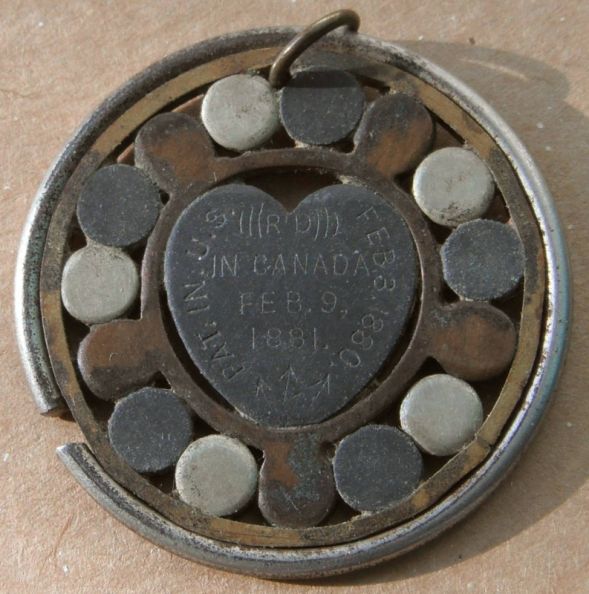 This is larger than the Boyd's or Sagendorph's Batteries, the size of a silver dollar. It also was made and marked in a child's size, and in another design with a cross instead of a heart. -Duncan |
|
Moderator
 United States
23522 Posts |
I would totally wear one of those.
|
|
Pillar of the Community
Canada
2805 Posts |
Wow! That went from a green piece of crap to an awesome-looking piece in your photo - the varnish must have kept it pristine underneath and it's a very unique kind of "token". I hope you made some money on this deal  |
|
Valued Member
United States
110 Posts |
To put these into perspective, 1879-1880 was the time period when Edison was perfecting his incandescent light bulb.
The first neon signs in America wouldn't be built until 1923, by French inventor Georges Claude.
-Duncan
|
|
Pillar of the Community
United States
8534 Posts |
Oregon coin geek.....*** GO BEAVS ! ! ! ***
|
|
Valued Member
United States
217 Posts |
It definitely cleaned up really nice. Those are some really cool tokens with a pretty interesting story behind them. Might have to put one on my list of cool stuff to buy one day haha.
|
|
Valued Member
United States
110 Posts |
Well 52raymo, that one was on my watch list (certainly above average condition) but I just lurked, hoping someone here won it - did that happen?
An better example at an average price, so someone did OK on that one.
-Duncan
|
|
Pillar of the Community
United States
8534 Posts |
No I didn't bid on it but was tempted. I love it.
Oregon coin geek.....*** GO BEAVS ! ! ! ***
|
|
Bedrock of the Community
United States
20753 Posts |
Fantastic clean up. Now how are you going to protect it from further problems?
|
|
Valued Member
United States
110 Posts |
Just Verdi-Care and storage in a 2x2.
Some of the roughest ones sold online have obviously laid in the bottom of a metal container or possibly in a junk collection of metal coins and other conductive materials.
In a dry environment the galvanic action should be quite weak. In fact the basic idea of how these were supposed to work was, they would be activated by moisture from a person's body when worn next to the skin.
I started collecting these in 2006, but after tracking sales of about 200 of the Boyd's variety, I have only acquired five of them. The one in 52Raymo's link was definitely a good one, but being a bottom feeder I don't bid on most of those offered, and some are priced too high and don't attract any bids.
Of course, it is possible that the protective solvent in Verdi-Care might cause some electrolytic action, so the token will require some observation, but so far the tokens in 2x2's are looking good. Thanks for asking.
Edited by Duncan_Doenitz
02/07/2014 3:10 pm
|
| |
Replies: 16 / Views: 5,596 |







 Posted 02/05/2014 3:22 pm





