| Author |
 Replies: 19 / Views: 2,819 Replies: 19 / Views: 2,819 |
|
Bedrock of the Community
United States
11951 Posts |
I have few of these now, I am hoping I did better on this one. Please respond with any opinions. 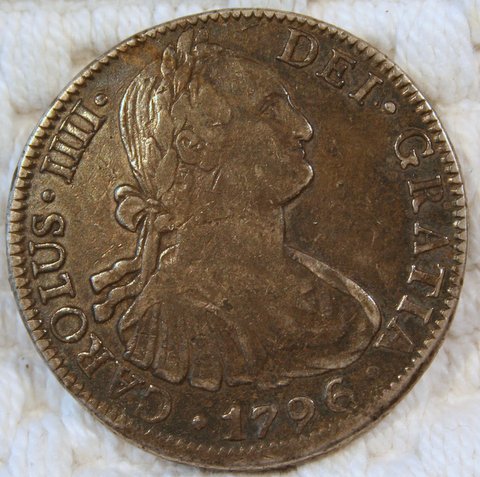 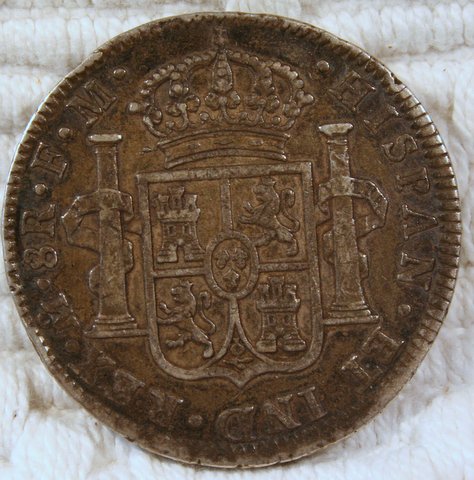 |
|
|
|
Pillar of the Community
United States
865 Posts |
Looks like a fine coin to me. I don't see anything that puts up red flags. A lil dirty but that's how I like my coins.
|
|
Bedrock of the Community
 United States
11951 Posts |
looking like this coin is not interesting enough to get many responses? Was hoping for more than one, that might post if it is real or not. It would be nice to know if it was a real reale  |
|
Pillar of the Community
 United States
3098 Posts |
I own several 8 reales and the style looks fine to me. How does the edge appear?
Paul Bulgerin
|
|
Pillar of the Community
Austria
566 Posts |
This one looks suspicious to me, as it seems to have been cleaned/polished and then re-toned.
If the tone (or dirt) is real, than this coin must have been for a long time in circulation.
The area near the rim (below the date) is very unusual.
I think, that this might be actually a modern forgery.
A rim picture might help. What is the weight?
|
|
Pillar of the Community
United States
1962 Posts |
Quote:
This one looks suspicious to me, as it seems to have been cleaned/polished and then re-toned.
If the tone (or dirt) is real, than this coin must have been for a long time in circulation. Such a dark tone need not necessarily come from lots of grubby hands touching it in circulation, but of course could simply be a product of how it was stored. I can sort of see what you're thinking about how the tone may be artificial... as it's very uniformly chocolate. I think, however, that is just reflective of a long period of storage in a reactive environment... with the brighter areas just indicating some friction from physical shifting over the years. Quote:
The area near the rim (below the date) is very unusual. You handle some Colonial portrait reales material... never noticed that effect in the denticle area? What EXACTLY causes that, I couldn't tell you, but it is seen on Mex mint pieces of all denominations. |
|
Bedrock of the Community
United States
11951 Posts |
I will try to get some edge pictures and weight tomorrow
|
|
Bedrock of the Community
United States
11951 Posts |
Doctors .. have been keeping me busy this week. Just now had time to take some pics. 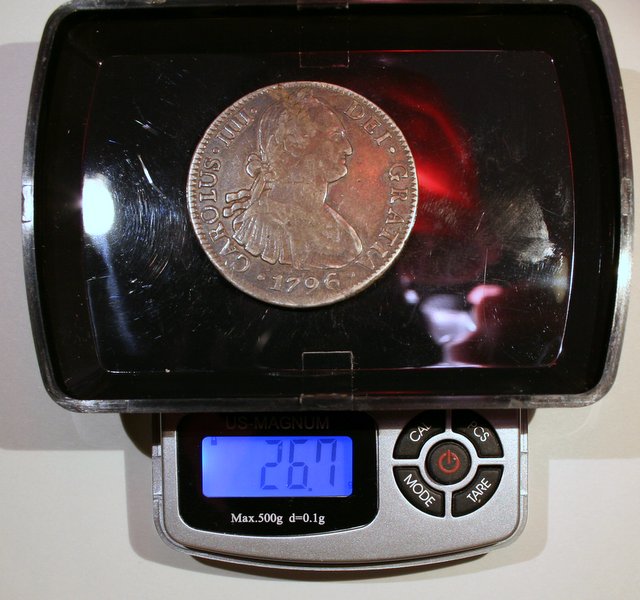 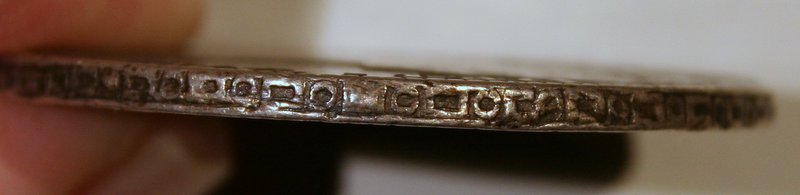 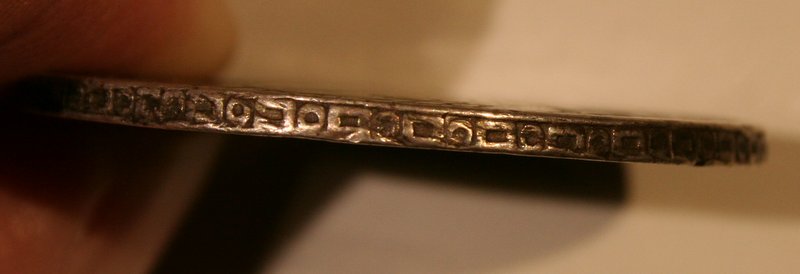 |
|
Pillar of the Community
United States
5362 Posts |
It looks fine to me. I would believe that it is a silver coin of the correct weight for an 8R. The alloy is likely correct within 5 points. I think the Elephant in the room is when was it struck? An XRF test might disclose that this coin was actually made long after 1800 and then again it might not. Either way, when all is said and done, it will most likely be worth the same price. The more of the Class 2 Silver restrikes that are positively verified as being made after 1870 - the more I realize that they are so common that they may never all be identified. Perhaps there is no reason to do so?  The simple fact that millions of restrikes were made without obvious clues to their identity is why these coins (Portrait 8 Reales in general) remain relatively common and relatively low in price. When I was a beginning collector back in 1957 there was one old time coin dealer who knew about the silver restrikes of the 8Rs that were made in my hometown area and his opinion was that if an 8R contained the correct amount of silver - it was real. He did not concern himself about whether it was struck in 1820 or 1920. As long as you couldn't tell the difference - his opinion was who cares? How does that sound to the average collector? |
|
Pillar of the Community
United States
1674 Posts |
It's a philosophical issue Bob. I mean if you have to spend $100 to have an advanced analysis done on a $50 coin to maybe tell the difference between genuine or type 2, it's just not practical.
|
|
Bedrock of the Community
United States
11951 Posts |
Thanks for the interesting reply swamperbob
I am curious what the XRF would tell me?
I may have access to a IR-X-ray ... I think that's what they call it.
If they would do it, I think it would tell me what metal is in the coin.
What sort of information would help tell when this coin was made?
|
|
Pillar of the Community
United States
1761 Posts |
As many forum readers already know we have a new book coming out in early 2015 or so (maybe - earlier) from the American Numismatic Society on these Portrait 8 Reales in terms of determining between regal and counterfeit. All the attribution tools you need will be in this book even XRF analysis interpretations. John Lorenzo United States |
|
Pillar of the Community
United States
5362 Posts |
GR58 The XRF tests if properly done to an accuracy level that is fine enough can reveal trace contaminants in the metal which in some cases provides positive dating information. The level of accuracy needs to exceed most commercial XRF devices. A laboratory set up that can isolate 20 ppm of BOTH gold and platinum is critical. Twenty parts per million is 0.00002 or 0.002%. The typical apparatus estimates levels below 0.01% or 100 ppm. That is 5 times too inaccurate to be of use.
Numismat You are precisely correct about the test being too expensive to test every coin out there. That is why I started to identify die features associated with coins that have positive XRF test results for a late date. My theory was that once a specific die feature (like a broken die punch) is matched with a post 1870 date of origin or a post 1910 origin - that it follows logically that all other coins sharing the same dies or punch are also late restrikes. However, just review the anomalous porthole/keyhole discussion begun by D0ubl3Eagle on Feb 21, 2013 https://goccf.com/t/142623&whichpage=1 and you will see that some people just won't accept a test unless EVERY coin is tested and proven to be a restrike. This gets even more difficult when the SG tests correctly so that we can presume the coin is a full weight silver restrike. In that case only XRF is left - but do we have to do every darned coin before it will be accepted? Here is a second thread same subject. https://goccf.com/t/147410
Edited by swamperbob
03/08/2014 7:14 pm
|
|
Pillar of the Community
United States
1674 Posts |
I believe having to test every coin is overkill. Die features that match are solid evidence and I think the majority of people would agree with you on that.
|
|
Pillar of the Community
United States
5362 Posts |
Numismat You say: Quote:
Die features that match are solid evidence and I think the majority of people would agree with you on that. You know - I agreed with you and thought that same way - until the threads I referenced above. It is now apparent from the discussions we had here, that some individuals will not even consider such proof and reject the conclusions reached unless tests are done on EVERY example. That is why I now doubt that enough collectors will ever reject these coins as genuine and treat them like the restrikes that they actually are.
|
|
Pillar of the Community
United States
1674 Posts |
Seems like that was mostly the one guy speaking in defense of coins they were selling. I have faith that once the book comes out it will be a game changer in this regard. Too much effort has been put in to lose hope in the final stretch :)
|
| |
Replies: 19 / Views: 2,819 |










 Posted 03/05/2014 5:36 pm


