| Author |
 Replies: 16 / Views: 4,731 Replies: 16 / Views: 4,731 |
|
Pillar of the Community
United States
4883 Posts |
Bought today on the basis that it's probably a forgery. Of course, the obvious tip-off is the drilled hole which suggests it was once "canceled" as such. A lot going on with this. Weight's about right at 26.8 grams, and it's nonmagnetic, but many details are suspicious. The "8" is the date is misshapen, the "1" incomplete, amd the "3" has an appendage on its lower loop, while some of the letters in "Republica Mexicana" are really malformed, and there are places where it looks like the surface has delaminated. In addition, there's a bead of extra material along eagle's tail where it meets the field, and something funky going on along the lower edge of the wing that I'm not sure I can even properly describe. The rim doesn't inspire confidence, either. Nor does its ring. Looking in the hole, I don't see any sign of there being a base metal core, and that reinforces my thinking that this is a casting, most likely of a substantially debased silver alloy. 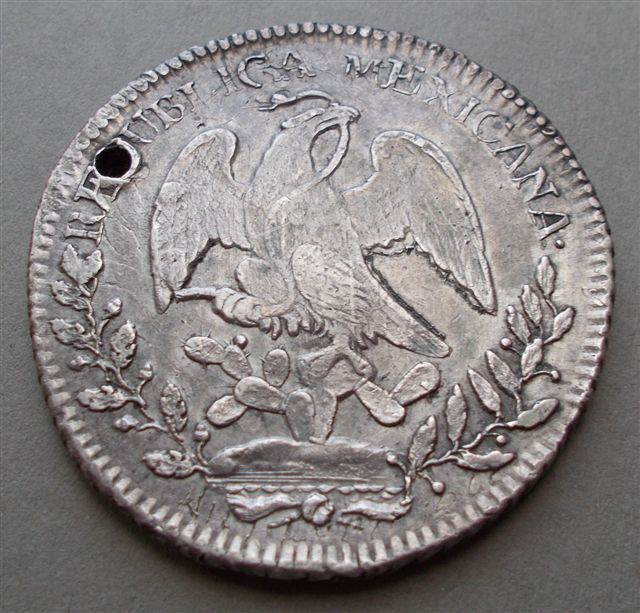 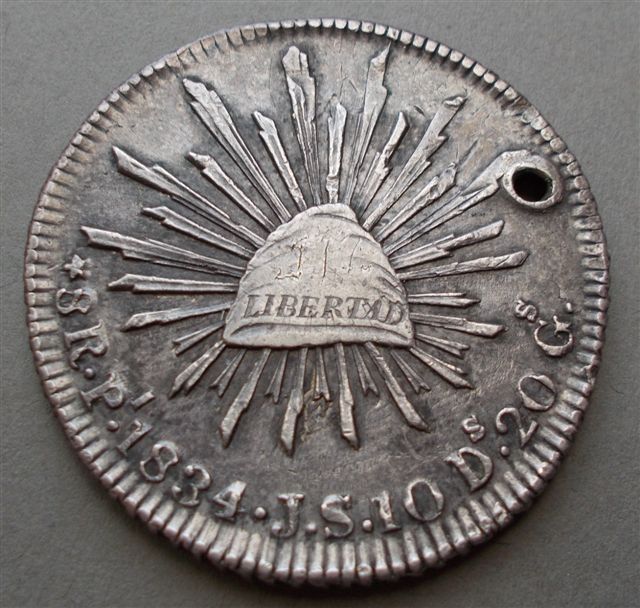 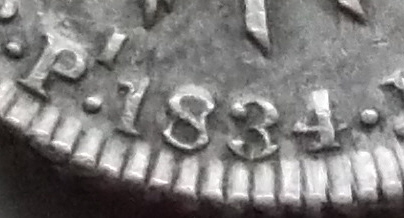 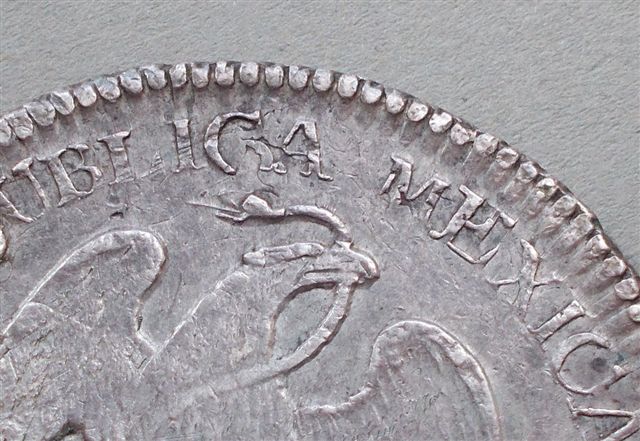 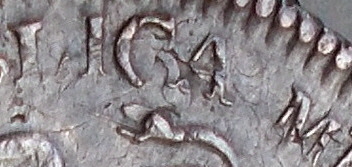 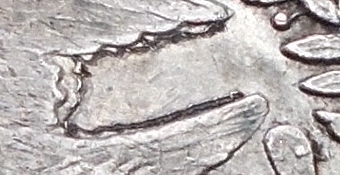 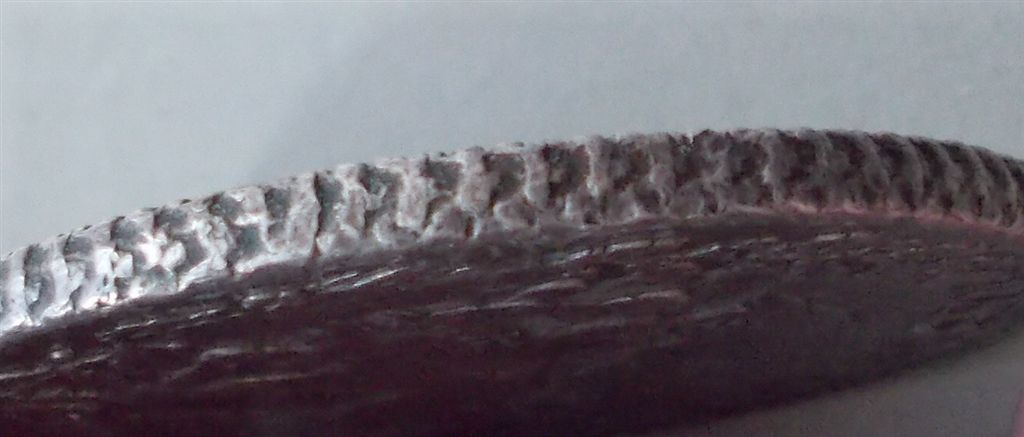 Colligo ergo sum
Edited by Lucky Cuss
03/17/2014 11:14 am
|
|
|
|
Pillar of the Community
United States
1674 Posts |
Almost looks like it's a over-strike, some faint details appear to be of a host coin.
|
|
Pillar of the Community
 United States
4883 Posts |
I forgot to mention that there is a large "JIZ" (or so it appears to me) hand inscribed shallowly into the Phrygian cap, as well as perhaps ten other mostly indistinct letters near the bottom rim of the obverse.
Colligo ergo sum
|
|
New Member
United States
22 Posts |
looks genuine to me but double die Rev.
|
|
Pillar of the Community
United States
1674 Posts |
That's what I'm seeing too, either overstrike or some kind of double something on rev, but the coin otherwise appears legit.
|
|
Pillar of the Community
United States
4883 Posts |
It's hard to capture in photos all the subtle aspects that when I'm examining it in hand give rise to my general impression that it's a phony, but whether it's authentic or a fake may not make a lot of difference (except in the latter case it couldn't be sold on ebay). It's not a rare variation, so even If genuine, its altered condition precludes its commanding any huge numismatic premium over its bullion value. It might actually be more desirable for inclusion in a "cap and ray" collection if determined to be a contemporary counterfeit. Colligo ergo sum
|
|
Pillar of the Community
United States
1758 Posts |
Can't be a cast because you have die clashing? and the lettering it TOO CRISP.
Swamperbob will be here shortly ... <BG>.
John Lorenzo
United States
|
|
Pillar of the Community
United States
4883 Posts |
Well, John, I can appreciate your rationale for its being a struck piece, but some of the "slag" (for want of a better characterization) I see here and there wjere the devices abut the fields is what had me thinking it was cast. Now I'm less sure. The more I scrutinize this coin, the more I'm confounded by it.
On the cast versus struck issue: I'm not seeing any isolated raised lumps in the fields, and the dentils do look correct for a striking. But there are some areas on the reverse where it appears someone ran a small tool over the fields. And beneath the middle short ray beneath the cap, there's a rough spot that doesn't seem right.
On the obverse, I'm seeing what almost look like flow lines, but which, as I mentioned above, have a lamination aspect to them, too. There is residual luster in one part of the field, with barely detectable yellow-blue toning there as well. So I'm still convinced there's some silver content.
Then there's that hole. It's offset from top dead center and shows no wear whatsoever that would be consistent with it being used to suspend the coin from a chain or such. It still suggests to me a flagging of the coin as being not genuine, or at the very least the result of a test to see if it was.
One last thing that I just noticed - the "3" in the date is a round topped style as opposed to a flat topped one as is usually seen on other issues from this era. But delving into that, I discovered that San Luis Potosi minted coins do exhibit the round topped "3" so that detail actually goes towards authenticating this coin.
I'm hoping swamperbob will give his opinion here, I understand he's an authority with respect to the early "cap and rays" fakes, which I am not (although I've just ordered a copy of Riddell's monograph to try and expand my knowledge on this topic).
Colligo ergo sum
Edited by Lucky Cuss
03/18/2014 10:12 am
|
|
Pillar of the Community
United States
1758 Posts |
Yes ... this series is his baby ... his professional opinion will be forthcoming ... you are right ... most hold pieces when surfing E-Bay is a good first indicator its a counterfeit due to hole being a cancellation just like the (X) marks on the coin ... I look for that when actually purchasing holed or (X) marked counterfeits on foreign E-Bay sites as in Spain and France.
John Lorenzo
United States
|
|
Pillar of the Community
United States
1962 Posts |
I believe this is "regal", not a contemporary counterfeit.
First, regarding the hole... a hole NOT at 12 o'clock IS a hint, but not as much a slam dunk as cancellation cuts, nor as reliable a hint as a defined test cut - particularly on Latin Amer. coinage where suspension/wearing was fairly common (though some countries/regions more than others). It's something to note, but not an automatic tell.
Also. note that if we assume the hole to be for suspension, and the cap & ray side to be the side intended for display (NOT the eagle)... the design is such that placing the hole off of what would seem to be "due north" doesn't make the piece look TOO off-kilter. In fact, the design itself is a bit goofy in terms of symmetry, as there is more legend writing to one side than the other (with LIBERTAD being straight being the rough guide for correctly aligned display).
In fact, in this case, the hole is directly across from the date, which certainly could have been intended, no?
Aside from that, Potosi 1830s pieces have some weird quirks.. one of which is certainly lamination issues, also weak strike and sometimes some funky metal flow around the periphery. 1830 is really weird, with the planchets almost always being out-of-round. The surfaces on this piece look struck overall, the patina looks proper... John suggested the presence of die clashing - not sure if it is that that or just a combo of laminations and some graffiti around the periphery.
Can't speak to the odd ring sound you're detecting, though the hole could be affecting that.
At the least, the first step, even if you don't know anything else about the date, the mint, etc. - look at some other 1834 Potosi pieces and compare.
|
|
Pillar of the Community
United States
4883 Posts |
Well, I checked this coin's specific gravity (as best I could, as my scale does not weigh down to hundredths of a gram as would be ideal, but I did do it in three different modes to see how well the results agreed with each other), and it does appear to be more or less where it should be for 90.27% silver, in the 10.33+ range. So my thought that it was a debased alloy seems to be unsupported. Maybe against the odds for a holed example this is the real deal, just crude, damaged, and altered.
Still hoping swamperbob will soon give this thread his attention.
Colligo ergo sum
|
|
Pillar of the Community
United States
5362 Posts |
The 1834 Pi in my opinion is an overstrike of what may have been a very weak (insufficient) initial impression. It would be interesting to work up a map of the impressions to view it overlayed.
The strike was made with a rather worn cap die having the normal distortions of the lettering by wear. The same wear level is not clear on the eagle side however.
I see virtually no chance that the coin is a contemporary circulating counterfeit. Why the coin was had a hole drilled in it is anyone's guess but perhaps someone else thought it looked bad.
|
|
Pillar of the Community
United States
4883 Posts |
I was rereading the introduction to the Buttrey/Hubbard Mexican coin guide, and ran across an interesting factoid that I hadn't really taken notice of before. According to them, up to 1850, the San Luis Potosi mint was casting its flans. So some of the irregularities I'd noted in this coin that I initially took to be evidence of its being cast may well be just that, albeit it was a blank casting that was actually struck (and perhaps restruck).
Colligo ergo sum
|
|
Pillar of the Community
United States
1758 Posts |
HMMM ... this is the first time I had heard of such a thing ... so what else is new ... but the way these mint people make cast coins it may be difficult to tell them apart? Struck and cast. Will investigate ...
If anybody ELSE can confirm this ... Bob Gurney ... sure real easy comparing a cast and struck with a SEM device of the microstructure of these pieces comparing dendritic (cast) with non-dendritic (struck) SEM microgrpahs ... but in the REAL WORLD ... are there tell tale signs with things like a coin ring and a jewlers loop on the coin's surface?
John Lorenzo
United States
Edited by colonialjohn
04/08/2014 2:01 pm
|
|
Pillar of the Community
United States
1674 Posts |
Nice informational find Lucky, definitely an important factoid and makes perfect sense
|
|
Pillar of the Community
United States
5362 Posts |
As John indicates in Mexican coinage it is the exception to the rules that keeps us on our toes.  The idea of a cast planchet is really not so far fetched. At least not a planchet that may show some symptoms of possible casting. The "normal" process consisted of planchets cut from silver strips that were rolled and laminated to the proper thickness manually. The starting block of silver referred to as a fillet ingot was not some 4 inch thick behemoth of an ingot but a rather small and THIN ingot to begin with. It was made to produce a strip of silver adequate to punch a line of planchets perhaps 4 or 6 from one strip. The labor saving principle involved in making fillets was that less rolling effort was the objective. So how thick were the fillets to begin with?  I have never found a good answer in a reliable source but consider the possibilities.  A very thin fillet just a few mm thicker that a planchet might be rolled and still show some trace of the cast surface. A bubble or two might even survive lamination. When struck - is there really much difference between a thin cast ingot or a molded individual planchet? Just food for thought. |
| |
Replies: 16 / Views: 4,731 |










 Posted 03/16/2014 10:50 pm


