| Author |
 Replies: 13 / Views: 1,751 Replies: 13 / Views: 1,751 |
|
|
Pillar of the Community
872 Posts |
This is more informative and head scratching than a definitive variety. After doing about 1/3 of a bag of 1964-P, I was in need of a change (no pun intended). So, I pulled out a large plastic Folgers Coffee container (which holds 4500 cents) and decided to do a few handfuls of these coins under my smaller microscope. I stopped on a coin like the ones pictured below because I seen a rather definitive halo around the "6" in 1960. I then noticed there was a very, very, very mild depression of a ghost "6" there. The Obverse die is in EDS quality shape, all the way around, and I thought to myself - They have to be trying to cover up something ! Again This die more than likely is not worth more than the MS grade it would receive, as a matter of fact, due to the number of scratches on the Obverse alone - it may be considered distracting and lose some points during the grading process because of it. This coin is more neat and head scratching than anything else. Let your eyes go wild with imagination of the coin I like to call the 1960-P cover up.   I see more of a depression on the "6" from the top left of the "6" to about the closest point between the "6" and "9". This type of condition is easy to see under a microscope, but VERY difficult to shoot with a DSLR camera.    Edited by Collector-Corner
03/27/2014 10:52 pm
|
|
|
|
Pillar of the Community
 872 Posts |
If you look really closely at the entire obverse of the coin, nearly all the way around the outer bust of Lincoln are the same TLC scratches. I don't see many Lincolns dies that have a ton of scratches of the same caliber all at once unless they have had an issue they want to get rid of. On this particular die, they did a pretty good job of covering up the issue, but to me, left "evidence" that something went amuck. = )
|
|
Pillar of the Community
United States
2624 Posts |
Just a thought: when the worker was rubbing the die with the abraision device it rounded the edge of the 6 creating the "ghost" you are seeing. As to what they were removing check the reverse for clashing.
|
|
Pillar of the Community
872 Posts |
yeah its tough to say... I'll add one more picture for effect. I ran upstairs and borrowed my son's double barrel Mighty Bright from his bookshelf. I tried to disperse an even amount of light across the coin, so it can show the impression. Mind you, this is probably not to best focused and clear picture, but its intent is to show the possible reason for the cover up. The coin is set about as dead center below the microscope lens as I could get it. The lighting is almost dead overhead and tilted very slightly towards the bottom of the coin to avoid the whiteout effect. In any event, its something neat to think about. Once I get at least a roll of these - and at this rate it will not take long - I'll look for some potential issues on the obverse, but a quick look didn't reveal any obvious clashing.  Edited by Collector-Corner
03/28/2014 12:06 am
|
|
Bedrock of the Community
United States
62064 Posts |
Gary, the last image show the best. If those lines are really on the coin, it looks like metal striation. Metal striation is cause by die movement from the die sliding again the showing the edge of the device rubbing on the planchet. I've seen this before on a coins I have. 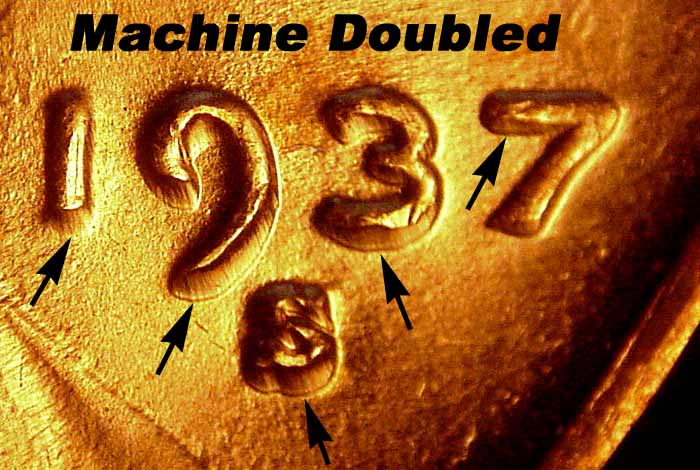 The only problem I see with your coin is that the lines appear to be on the rest of the device as well. So keep that in mind, (If that is not what I'm seeing) the ghost image is the lighter yellow color. The die polishing may have reduced the die in the area you are seeing. We do see die scratches to cover a polishing. So if the field is reduced more in an area (localized polishing) then it might make the coins show a raised area. 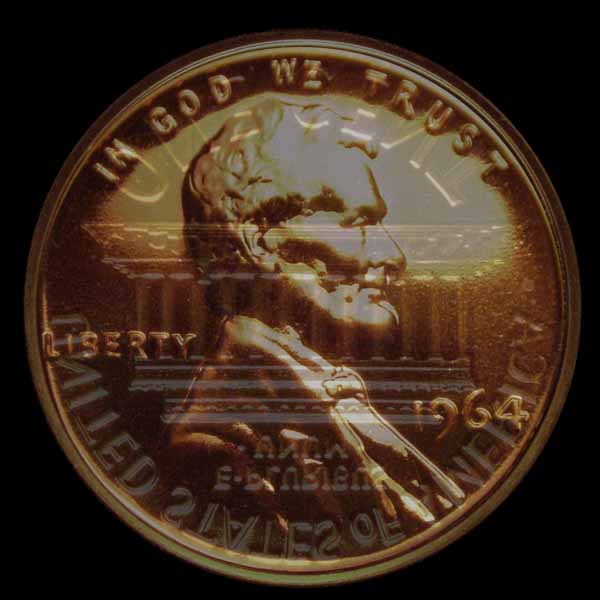 A clash would cover that area, so it may have been over polished to cover the clash. |
|
Pillar of the Community
872 Posts |
nope, not even close to the 1937 example. The lines on the coin taken with the double barrel Mighty Bright is shadows, due to me focusing on the field and not the devices.I wanted to bring out the halo of the semi indented areas, and the only way to do so, was to unfocus until the affected area would come forward.
I'll take a few more pics later. Its probably due to covering a clash, and I'll get a roll of these and compare for any part of a clash. Of the front of the coin, its probably 50-70% covered with "newer" looking die scratches.
|
|
Bedrock of the Community
United States
62064 Posts |
You might note a transition of fading die scratches in that area. But the halo should remain.
|
|
Pillar of the Community
872 Posts |
OK, Last set of photos for this post. I want to get through a good portion of the 1960-P bag this weekend. I'm looking for a total of 3 unique markers for a total of two varieties. Yes, die scratches should typically fade as strikes continue, that's not an issue. So they scratch the die for a cover up and then over time, traces of the cover up and scratches fade with time. = ) So this should go fast - as long as I am not shooting pics !  Remember, these are RAW untouched photos... The FIRST photo looks interesting, as there appears something that looks like a "T" on Lincoln, and there is a even height line that travels SW to NE in orientation. The "T" SHOULD be raised not incused (hammered in), so I am not sure what that came from. First 3 pics from an LED light housed on the other microscope. The last 2 are from a double barrel Mighty Bright. Again Mighty Bright is used to show this double or triple dent into the surface of the coin. Its weird because it shows all numbers shifted left, even through the "0"       Edited by Collector-Corner
03/29/2014 7:49 pm
|
|
Pillar of the Community
United States
2624 Posts |
Could we see the reverse, with a close up of the upper left quadrant?
|
|
Pillar of the Community
872 Posts |
Edited by Collector-Corner
03/29/2014 10:34 pm
|
|
Pillar of the Community
United States
2624 Posts |
Please look at the area I circled in this photo. 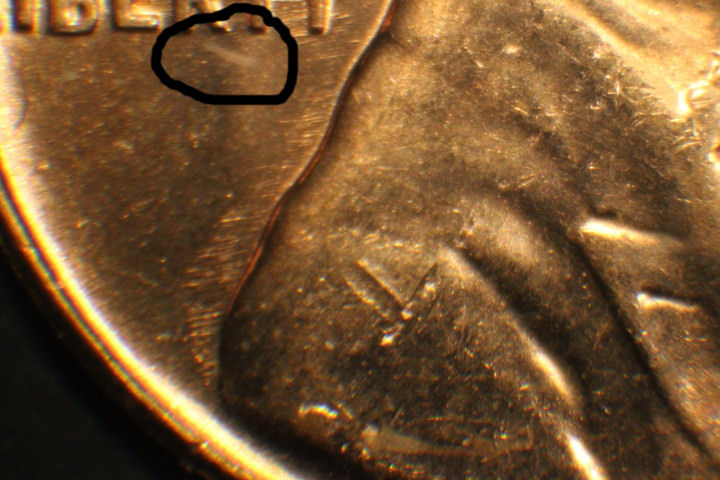 Is that mark raised? |
|
Pillar of the Community
872 Posts |
No, it is not. There might be a "home plate" shaped area under the scratches, between the "T" and "Y" in LIBERTY. The strongest looking horizontal scratch between the TY is the top of the "home plate".  |
|
Pillar of the Community
United States
2624 Posts |
The mark look close to the shape of the lapel. I thought it might some weird MAD counter clash but I think it would need to be raised for this.
|
|
Pillar of the Community
872 Posts |
Its probably just an over zealous, highly caffeinated worker that wanted to keep the dies as nice looking as possible. I'd have to take months to figure out what exactly what they were trying to cover up and that would mean potentially finding a coin that snuck through before the die polishing began. I am slowly but surely going through the container, and should it produce anything, I will let you know. Thanks for the comments. = )
|
| |
Replies: 13 / Views: 1,751 |
|





 Posted 03/27/2014 11:32 pm





