| Author |
 Replies: 14 / Views: 4,761 Replies: 14 / Views: 4,761 |
|
|
Formerly nancyc
Australia
5385 Posts |
I believe it to be a genuine error coin, but I'm no expert, so any and all comments welcome. I bought it off ebay in 2011. I admit it has the appearance of having been 'heated' or 'burned' at the top of the Rev split, even so, I just can't figure how a coin could be cracked in half like this and both pieces still remain perfectly flat. Aust 1947 Ha'penny â€" Cracked in two - Rev 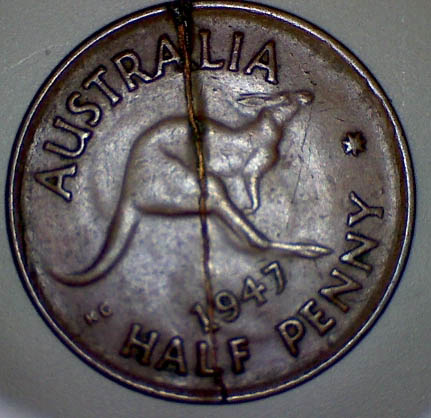 Aust 1947 Ha'penny â€" Cracked in two - Obv 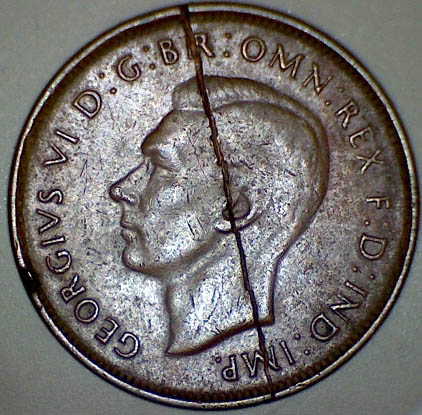 Aust 1947 Ha'penny â€" Cracked in two â€" Obv & Rev Together 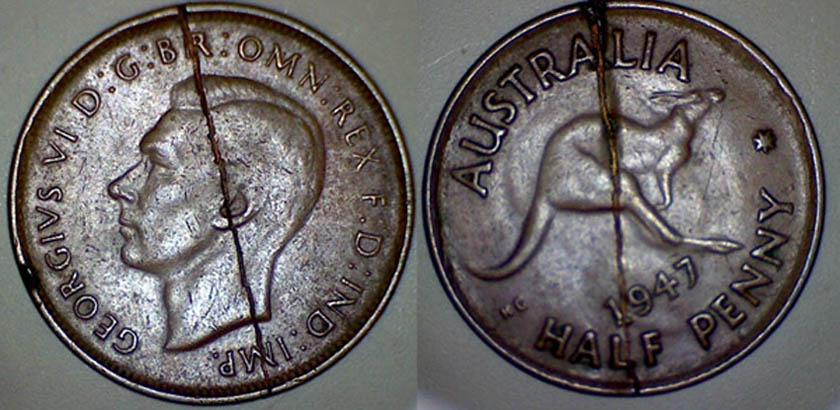 Aust 1947 Ha'penny â€" Cracked in two â€" Side on Top & Bottom 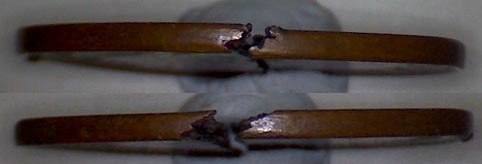 Aust 1947 Ha'penny â€" Cracked in two â€" Top section of Rev 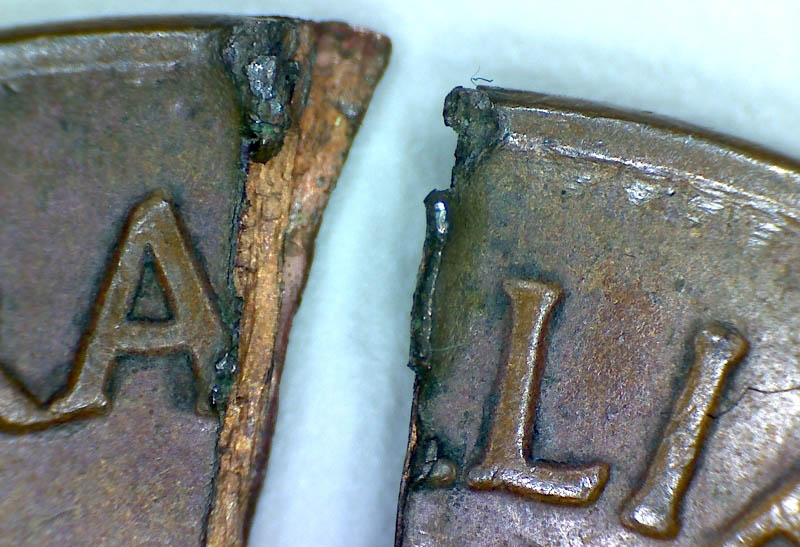 Aust 1947 Ha'penny â€" Cracked in two â€" Bottom section of Rev 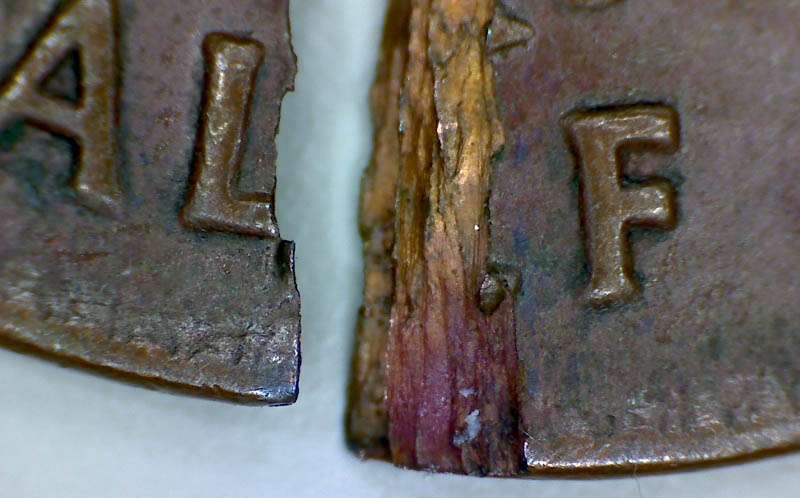 Aust 1947 Ha'penny â€" Cracked in two - Top section of Obv 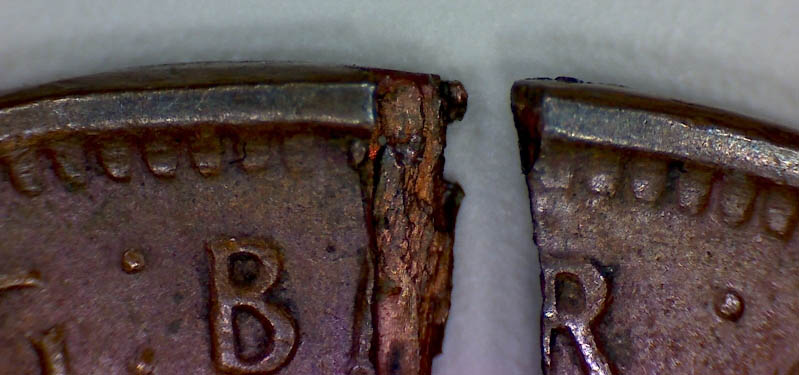 Aust 1947 Ha'penny â€" Cracked in two - Bottom section of Obv 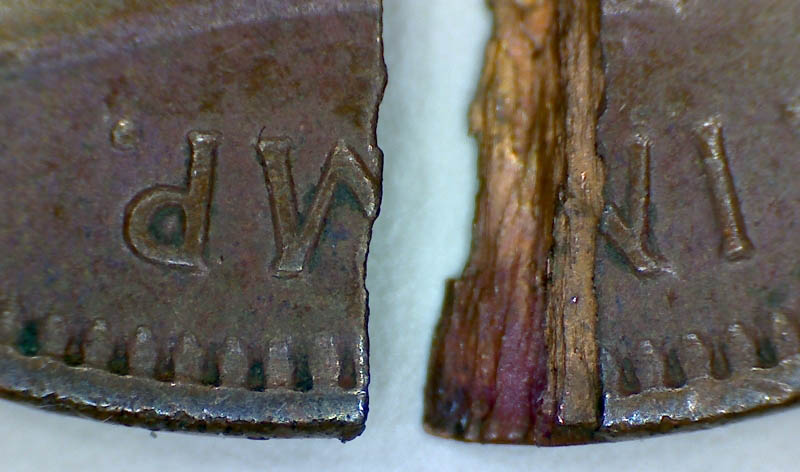 Aust 1947 Ha'penny â€" Cracked in two â€" Edge views of both halves 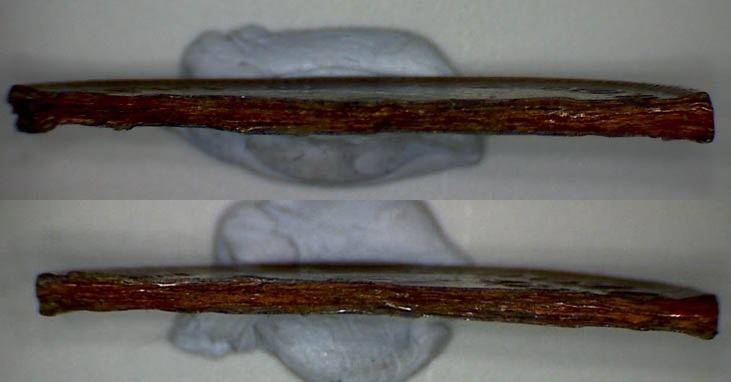 life is a mystery to be lived not a problem to be solved
|
|
|
|
Pillar of the Community
Australia
7096 Posts |
I have often wondered if this could be achieved with the use of liquid nitrogen of something similar to super cool the metal so that it would snap like a twig without bending the coin ?
|
|
Pillar of the Community
Canada
4911 Posts |
Lol now you have 2 quarter cents:-D ,
Sorry I couldn't resist
Feel free to call me Will.
|
|
Pillar of the Community
Australia
7096 Posts |
Quote:
Lol now you have 2 quarter cents:-D ,
Sorry I couldn't resist That would be 2 Farthings  |
|
Pillar of the Community
Australia
539 Posts |
would running a heavy electrical charge through a coin on an oblivious planchet flaw do this?
|
|
Pillar of the Community
Canada
2632 Posts |
The reverse shows heavy design transfer be it from a clash or hard strike, I can see the kings head clearly.
The planchet may have had a small crack and the (hard) strike opened it up. The reverse looks like it had both sides pulled inwards towards each other and the obverse dosnt, leads me to think somebody did the final break themselves.
No matter how it happened its really cool and appears authentic to me. IMO
|
|
Valued Member
Australia
236 Posts |
It is a great error.
Anyone else surprised by the apparent multiple laminae of the planchet? I would have expected a more crystalline appearance. [not sure if that's the correct word]
Was this an early experiment with "layering" that didn't work perhaps?
Anyone heard of any experimenting taking place then?
|
|
Pillar of the Community
Australia
852 Posts |
Could Trout be on to something with the liquid nitrogen?  Anyone have access to the stuff and the opportunity to see what happens? Might shatter metal like the liquid metal terminator in Terminator 2. If you do it then post some images to compare the results to Nancy's coin. |
|
Formerly nancyc
 Australia
5385 Posts |
Quote:
Anyone else surprised by the apparent multiple laminae of the planchet? Not really. Have a close look at any coin that has had a Laminate peel, the layers are quite thin and I imagine there are quite a lot of layers that make up the final sheet of metal. I've got heaps of coins where part of the top layer has peeled, and speaking thickness wise, it's barely noticeable that a layer is missing.  life is a mystery to be lived not a problem to be solved
|
|
Bedrock of the Community
United States
10045 Posts |
That's really interesting! What are the odds of finding the two pieces? One thing I notice--do the edges of the break appear to be flared? It almost appears there was some bending happening--but not bent until the coin failed while in a vise--there would be obvious tool marks, right? That dark area may simply be a large area of bad alloy or slag...and the defect continued across the coin. It may have been 'helped' to break in two? Just guesses here.  |
|
Valued Member
Australia
236 Posts |
"Not really. Have a close look at any coin that has had a Laminate peel, the layers are quite thin and I imagine there are quite a lot of layers that make up the final sheet of metal.
I've got heaps of coins where part of the top layer has peeled, and speaking thickness wise, it's barely noticeable that a layer is missing."Hi Nancy I wonder if the laminae effect you see on your coin and on planchet peels and flaws is actually the cause of these errors. I cut a 1947 halfpenny just to look at the crystalline structure of the copper and it is distintly different from yours. I believe the one I cut will be more like the typical crystalline structure that results from a smelted metal and the striated, layered structure of your halfpenny will be the anomaly. Just my humble opinion of course. 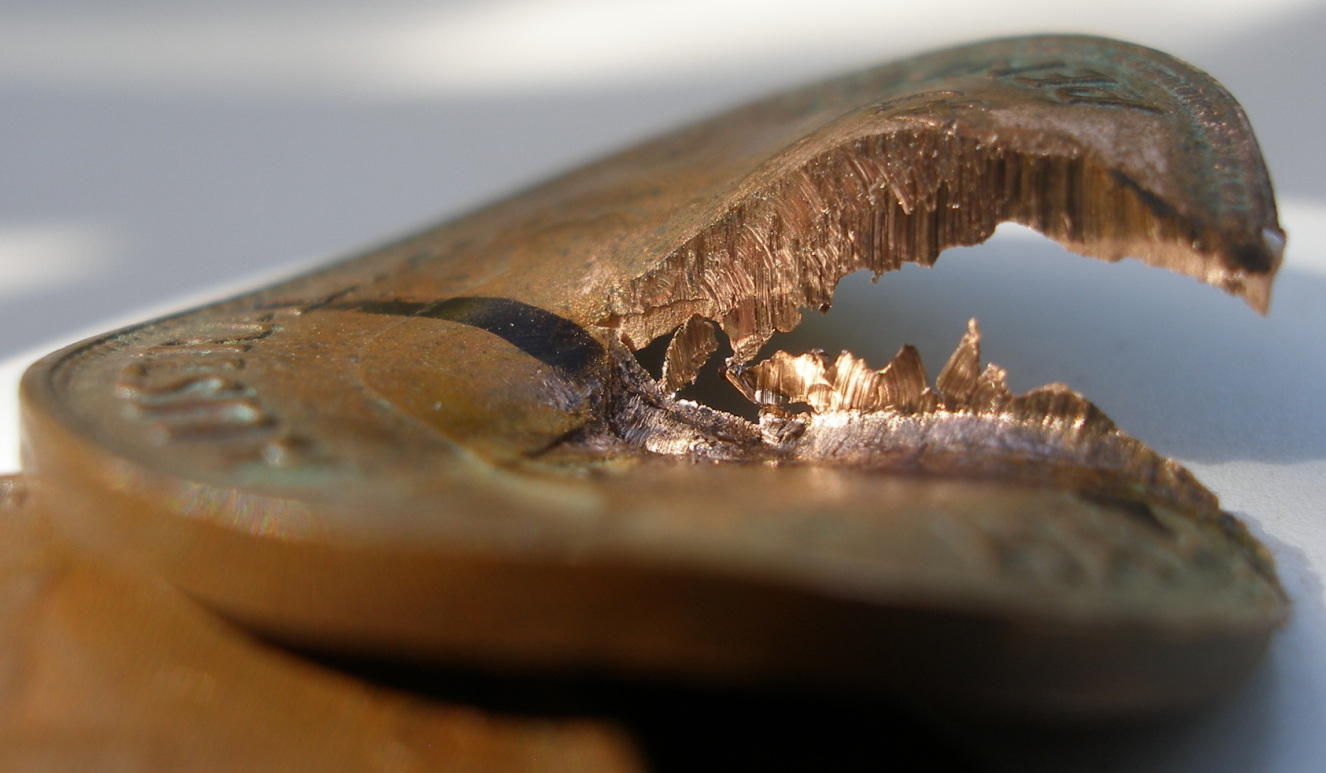
|
|
Formerly nancyc
Australia
5385 Posts |
I would not expect metal that that's been cut through to look the same as a piece that's split apart due to a fault. JMHO. life is a mystery to be lived not a problem to be solved
|
|
Valued Member
Australia
236 Posts |
You sound perfectly humble like me Nancy.  "I would not expect metal that that's been cut through to look the same as a piece that's split apart due to a fault." "I would not expect metal that that's been cut through to look the same as a piece that's split apart due to a fault." Why not? I am not suggesting having laminae means your coin isn't genuine, au contraire, I am suggesting that this makes the error in your coin completely plausible. It is the reason there are delamination errors and fractures. With multiple laminae like a piece of sedimentary rock, shale etc, as in your coin, it is entirely understandable for there to be fractures along the planes. With a molten material, as in igneous rock, basalt eg - there are no planes. Again, only in my very humble opinion. |
|
Formerly nancyc
Australia
5385 Posts |
So basically, we humbly agree to agree.  life is a mystery to be lived not a problem to be solved
|
|
Valued Member
Australia
236 Posts |
Essentially - Yes.  |
| |
Replies: 14 / Views: 4,761 |
|





 Posted 04/08/2014 8:42 pm





