|
Pillar of the Community
United States
1531 Posts |
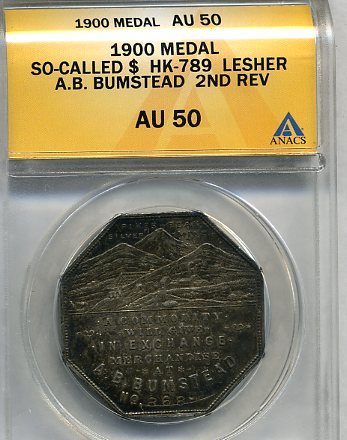
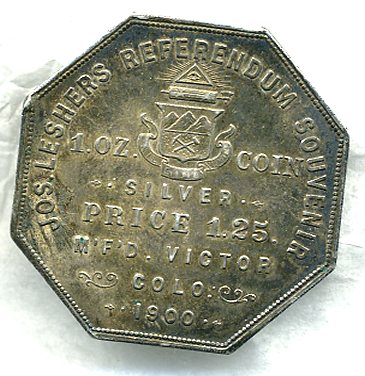
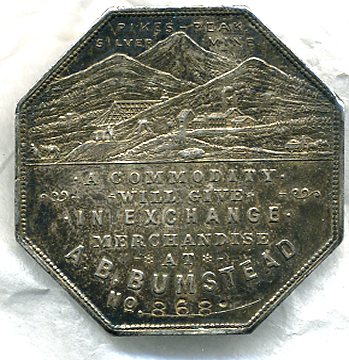
Edit: OK, well I know what this is now. It is a Lesher or Referendum Dollar, appears to be type 3: Bumstead type, second reverse. http://www.so-calleddollars.com/Eve...Dollars.html"Joseph W. Lesher (1838-1918), a native of Ohio who for 20 years was Colorado silver camp worker, silver-mine owner and real estate investor, began an issue of silver "Referendum Souvenirs" in his home town of Victor, CO, in November, 1900.
Lesher, an advocate of greater use of silver, believed that if that metal, then depreciated, were to enjoy unlimited coinage, increased business and general prosperity would result. Others, including Davis H. Waite, Colorado governor, and E. O. Wolcott, U.S. senator from Colorado, also held this view, but it remained for Lesher to put theory into practice. He was owner of a silver mine near Central, CO, so perhaps his motive was not altogether unselfish.
An advocate of free coinage of silver in both 1896 and 1900 national elections, even though both times the issues lost at the polls, Lesher still believed in unlimited metal dollar coinage. His own state had endorsed it, and he was convinced that people generally favored it.
He decided to issue silver dollars, which he named "Referendum Souvenirs." He called them "Referendum" because they were referred to the people for acceptance or rejection. No one was forced to take them.
According to a dispatch from Victor to a Chicago newspaper on Nov. 13, 1900, "Mr. Lesher proposes to demonstrate that the 'intrinsic value' theory is a delusion and a snare. His silver at the present quotation costs 65 cents per ounce, the expense of coining is 15 cents--80 cents in all--but he values dollars at $1.25 and intends to keep them above par. Although he is confident that the silver alone is really worth $1.29 an ounce, he admits other people may be prejudiced. Therefore he promises to pay $1.25 in United States money on demand for each 'referendum' dollar. In order to avoid any entanglement with the Government Mr. Lesher makes his dollars eight-sided."
Lesher did sell the first 100 medals himself at their $1.25 face value. He intended to issue and redeem them himself, but when this proved impractical, he arranged with A. B. Bumstead, a local grocer, to use the Referendums in his store and to redeem them in merchandise or cash. Bumstead sold 700 specimens and only three pieces were returned for redemption. It is believed that about 1,000 pieces (including both varieties) of the Bumstead pieces were made.
In late 1900, six die trials were struck for a piece to be used and redeemed by banks, but the bank idea was shelved. Had it not been, Lesher no doubt would have experienced further trouble from the federal government.
Most accounts of the Lesher Referendums state that the dies for the first issue were seized by federal agents, but Dr. Philip W. Whiteley, one authority on the pieces, believes the seizure took place after issue of the Bank Type. He has called attention to the fact that with this variety, Jos. Leshers • Referendum • Souvenir was changed to read Jos • Leshers • Referendum • Silver • Souvenir • Medal •
Dr. Whiteley, who has reported a variety unknown to Zerbe, believes that Lesher, who applied for a trademark Feb. 14, 1901, thought it necessary to submit a piece along with his application. The piece referred to has same reverse as the second Bumstead type. Obverse. Near edge, around, Trade-Mark Applied for; in six straight lines, A / Commodity / Will Give / in Exchange / Merchandise / at; space for imprint; No.
Lesher patented the design of his pieces April 16, 1901 (No. 34,359), and registered his trademark (No. 36,192), "Referendum," April 9, 1901. This was done to forestall counterfeiting of his pieces, which he had pledged to redeem at face value. As Charles E. Briggs, another authority on the pieces, stated in 1920, "This would seem to belie the motto, 'In the People We Trust,' which appears on all of this (1901) issue."
Lesher is believed to have designed the pieces himself, at his residence on W. Victor Ave. Frank Hurd of Denver made dies for the first type; Herman Otto, also of Denver, all other dies. The dies cost Lesher $60 a pair. All Referendums were struck for Lesher by a private Denver firm.
All Lesher pieces are octagonal and have plain edge. The medals dated 1900 are 35mm. across center and weigh one ounce. Those dated 1901 are 32mm. in diameter and are of same weight as a standard silver dollar, 412 1/2 grains. The 1900 pieces bear $1.25 price, while those of 1901 have price $1.00. Their composition is silver .950 fine, alloyed with copper.
Serial numbers were hand punched or engraved. No system-atic numbering system was employed, so numbers bear no relationship between series, to series as a whole, or to number of pieces issued. Some pieces have period after number; some have not.
The Imprint Type comes without merchant's name entered; also, with and without serial number. Lesher himself said, "Coins with imprint space were supplied to anyone requesting them. Imprint stamps were at the merchant's expense."
The Bumstead pieces come with ornamental scrolls on reverse at sides of State Seal, and without scrolls.
There are other minor varieties in the Referendum series.
The 1901 pieces, like those of the Bank Type, left field blank on lower portion of obverse. The merchant user stamped or engraved his or his firm's name in this space, or had his pieces stamped to order, Average price to merchants was 80-85 cents each.
Merchants who used the Referendums: A. B. Bumstead, Victor, CO, grocer; J. M. Slusher, Cripple Creek, CO, grocer; Sam L. Cohen, Victor, CO, jeweler; David W. Klein, Pueblo, CO, retail liquor dealer; George Mullen, Victor, CO, shoemaker; Boyd Park, Denver, CO, jeweler; W. C. Alexander, Salida, CO, jeweler; Goodspeeds & Co. (L. C. Goodspeed), Colorado Springs, CO, jeweler; J. E. Nelson & Co., Holdrege, NE, clotheirs; W. F. White Mercantile Co., Grand Junction, CO, clotheirs; H. Stein, believed to be a Canon City, CO, clotheir; H. H. Rosser, Victor, CO, stationer and confectioner; and C. W. Thomas, Florence, CO, jeweler. Thomas is reported to have used the pieces, but none has been found with his name imprinted on it.
The Stein and Rosser pieces, which have names engraved, were unknown to Zerbe. Believed to be unique, they may have been engraved by or for Stein and Rosser or by someone else. John J. Ford, Jr., student of the Leshers, has written, "A limited number of business people cooperated with Joseph Lesher. Most of them issued only a few pieces, and others merely played with them, imprinting or engraving only samples. The Referendums were accepted as money in Cripple Creek, Colorado City, Colorado Springs, Victor, and most likely, even in Denver. They also had a limited circulation in Pueblo, but in some places their only use was as trade premiums, or as items for sale as novelties."
Lesher abandoned the plan when he concluded that it would not be a financial success."Edited by Cruisinfusion
05/18/2014 12:49 am
|









 Posted 05/17/2014 11:31 pm





 .Joke...I do love your Piece...