| Author |
 Replies: 24 / Views: 5,179 Replies: 24 / Views: 5,179 |
|
Pillar of the Community
Canada
5417 Posts |
This question has been asked before but... Well, I'm trying to maximize the use of my money by buying appealing Vicky Coinage in Mid to high grades. Prices are all over the place and while I try to pay only about 50%-70% of trends, I'm always wondering whether my coins are the rarest (I'm so much into conditional rarities as actual rarities). This problem is easily solved fr US coins as PCGS has survival rates available (I know they are very rough estimates and a lot of people just dismiss them but I like them). So my question is... Are there any such population estimates available for Canadian Coins? If so, where can I find them? I read a very interesting article a while back about the speculative survival rates of the 1858 20 Cent and it was very informative. Any such thing available for other denominations. I'm only looking for Victorian/Edwardian and Possibly Georgian if available. Thanks. |
|
|
|
Pillar of the Community
Canada
618 Posts |
I may have the rarest variety of them all in the circulated grade range EF/AU :
Canada 20 cent---Blundered I in Gratia.
My estimate is that there are between 1 and 4 that exist.
I expect to be challenged about this.
|
|
Pillar of the Community
Canada
2366 Posts |
Blundered I in DEI is the one I haven't been able to find. I've had 4 Blundered I in GRATIA over the years and still have 2 in hand at the moment. An unattributed ICCS EF40 and a raw VG10. I believe the 2 I got rid of were in the VG-F range but I don't remember for sure. I've also got another PCGS AU58 that has an extension of the stem of the I sticking out below the bottom serifs so it's not the traditional Blundered I. The most valuable Victorian coin I have is an 1893 10c PCGS EF45 Obv 6 RT 3. Sorry, nothing useful to respond to the OP's original question :-)
|
|
Pillar of the Community
Canada
618 Posts |
I also have never seen a blundered I in DEI. It also is not a traditional blunder --- it has only a portion sticking out to the left of the bottom of the I----My theory is that it is not a blunder but a clash under the I---I have seen a similar mistaken blunder on the right hand side of the I---and seen quite a few coins with heavy clash marks in the area of DEI.
So---Until I see an example or photo of a blundered I---I do not believe they exist.
|
|
Pillar of the Community
Canada
3234 Posts |
 ...In coins and their varieties..Nothing beats a photo ..and to the OP's question..I would think that ICCS would have the best guessimate of #'s on specific rarities .. . . . Edited by DEVLEC
09/23/2014 10:41 am
|
|
Pillar of the Community
Canada
2366 Posts |
Unattributed Blundered I in GRATIA ICCS EF40 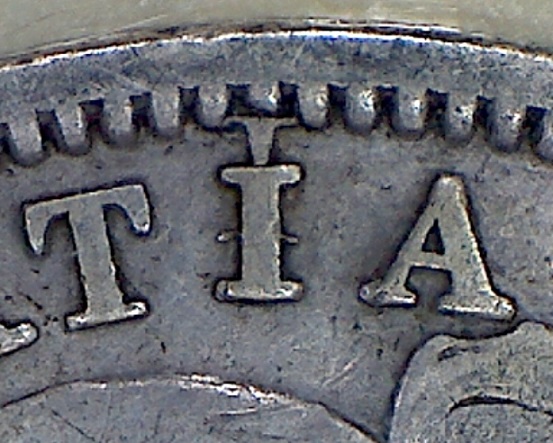 Not a Blundered I in GRATIA PCGS AU58 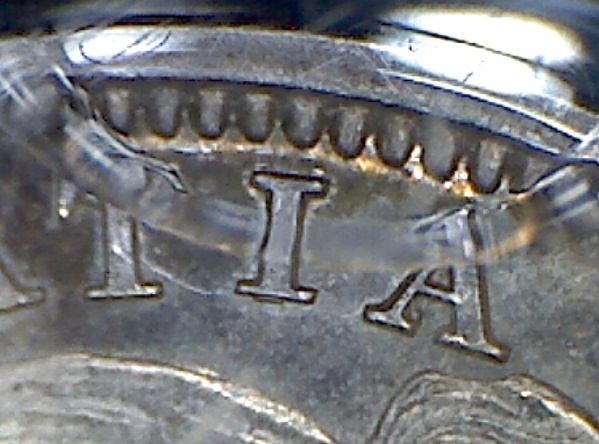 Blundered I in VICTORIA raw F15 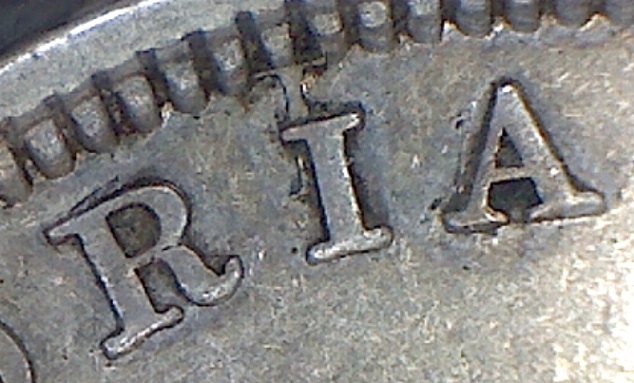 Edited by kuh_85
09/23/2014 2:15 pm
|
|
Pillar of the Community
United Kingdom
2139 Posts |
I've been wondering about modern British silver coin survival rates, ever since a guy at my local auction told me that after he retired he's been going round auctions, buying silver coins and sending them for melting.
He told me that he's sent 2,200 ounces for melt so far, but he doesn't keep records of dates or denominations.
I phoned a major silver smelter who told me that they have records of total ounces of coins at each level of fineness melted (but they wouldn't tell me - commercially sensitive) but I was also told that someone does a quick scan of the coins just in case there's something more desirable than melt.
How do PCGS (or anyone else) estimate survival rates ?
|
|
Pillar of the Community
 Canada
5417 Posts |
Quote:
How do PCGS (or anyone else) estimate survival rates ? By adding the number of coins that comes to auction with the number that are said to be in private collection and cross-referencing with any known melting of coins and comparing with various experts about current estimates. These estimates are ofcourse much more accurate for rarities as these are much easier to keep track of than coins that are available in mass quantity since they're much harder to slip under the books. For example, common date morgans are all slapped with a 10% survival rate as most experts say that 7%-15% of all morgans survive to date. It's not really a definite value, just a general value to go upon. The thing is that the US market is much more concentrated and advanced compared to the Canadian Market which is in a sort of slump right now. So not many values of how many actual example of each date of every coin that exists today is available. There are special studies into key dates and type coins. For example 20-Cent Coins. -zx |
|
Pillar of the Community
 Canada
5419 Posts |
Since the Canadian series has never been extensively researched until quite recently (last fifty years) we are at a distinct disadvantage to our American and British cousins when trying to figure survival rates for Canadian collector pieces. For example no one is reasonably sure how many 1921 fifty cents and five cents coins still exist. Or the precise story of the dot coinage of 1936. There just were not enough numismatists that interested in the Canadian series before the middle 1950's, to be of help. Even the Royal Mint reports ( London and Ottawa ) are of little help. |
|
Pillar of the Community
1844 Posts |
@lamb... with all due respect I think I might have the rarest of all varities. We all know of the 1858 8 over 5 ... I have an 1870 8 over 5 dime certified by CCCS.... Even Brian said it was 8 / 5 but at that time would not certify it until Charlton aknowledged it in a book... So far I have not seen another..... if you want to see it here is the link... and yes Its got a rediculous price because I want others to search and hopefully or not  find another ... I just wish they would attibute this in the book and more collectors would look closer at their coins |
|
Pillar of the Community
Canada
618 Posts |
@ Artdio--- you have me trumped!--- THAT is the rarest I have heard about. I think it is rarer than the '36 dot because I think it was a inside theft.
|
|
Pillar of the Community
1844 Posts |
[quoI think it was a inside theft.te][/quote]
@ lamb....
Im confused ? what do you meen by that
|
|
Pillar of the Community
Canada
3234 Posts |
I think he feels (from what he's heard or read) that the 36 dots were purposely taken aside and walked out of the mint..
...rather than "bagged" out like the rest of the coinage..
I thought that they appeared in the bottom of the pix box.
I'm also sure that some mint masters had their way around some special extractions on some occasions ...
|
|
Pillar of the Community
1844 Posts |
Hi Dev,,, I'm sure you are correct about that, I have heard some great stories.
The 36 dot has a great history. There was an old timer who worked for the mint and stated that after the the dot thing they simple rotated the die and kept minting the 36 .. We all know of the 36 por mans dot, well in fact according to that old timer it is the same coin.. I had a MS 64 36 dot and when you rotate the dot to the center of the bow it lines up exactly as where the famous dot goes... So Ya I'm sure those guys manipulated many coins for kicks
|
|
Pillar of the Community
Canada
3234 Posts |
artdio..You say that "you had" a 36 dot...! (even if it's the "other one") You're never supposed to get rid of such a coin..it's too much fun,.. and look what you'd just explained to us..I love it.. |
|
Pillar of the Community
1844 Posts |
Dev, I have had at least 10 of the poor man dots over the years... They are not that hard to find and yes they are a cool coin for sure. But I'm not into varieties or errors, I love to own them for awhile but then I flip them and use the profit to get what I really want ...
I once also owned the only other example of the token LC 31 B2
The only other was in the BOC Museum I think its called.. I sold mine to a guy from BC ..I wish I would have kept that one today.. Oh well the hunt is on for more rare ones as usual...
|
| |
Replies: 24 / Views: 5,179 |








 Posted 09/23/2014 02:06 am


