| Author |
 Replies: 17 / Views: 27,423 Replies: 17 / Views: 27,423 |
|
Pillar of the Community
Israel
2420 Posts |
Edited by supgog
07/09/2014 03:34 am
|
|
|
|
Valued Member
294 Posts |
if I'm not wrong, the 20 balboas of panama were struck for circulation but weren't because of their cumbersome size and heft quite obviously. they're fine pieces to collect though and possible to get a little over 1 1/2 of their BV by today's prices. weighs in at 130 grams and 61mm wide.
other than that, the popular 1797 2p, 2 ounces of copper, although much smaller at either 40 or 42mm, according to various sources online. don't think they circulated well either
|
|
Pillar of the Community
 Canada
9900 Posts |
Is Swedish plate money considered a coin? They could weigh up to 15 kilos.
"Dipping" is not considered cleaning...
-from PCGS website
|
|
Pillar of the Community
Australia
3839 Posts |
|
|
Pillar of the Community
United States
1158 Posts |
Edited by tkbslc
07/09/2014 12:18 pm
|
|
Valued Member
United States
78 Posts |
And don't forget the canadian gold 1000 kg maple leaf
|
|
Valued Member
United States
183 Posts |
"circulated" , get ya reading glasses on boys.
|
|
Pillar of the Community
United States
2368 Posts |
The largest coin I have actually seen in circulation is a quarter... 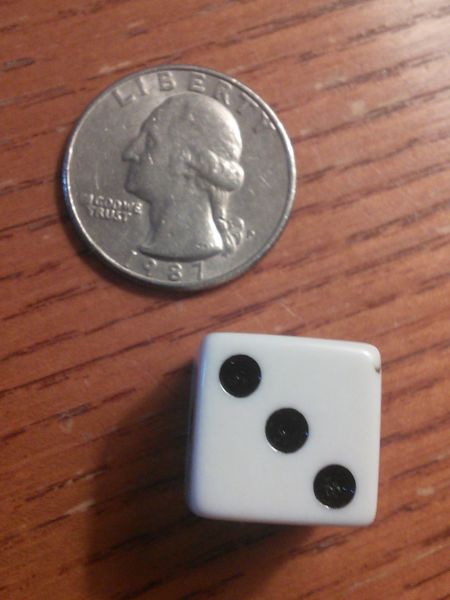 Behold, even larger than a die! Pfft, "Rai stones". Try carrying a few of these things in your pocket every day!  |
|
Moderator
 Australia
16963 Posts |
As can be seen above, the answer does in part depend on your definition of "coin". If you have a somewhat liberal definition such as "an object made specifically for use as money", then the Rai stones are clear winners. Although the really big ones were rarely physically moved, their ownership did change hands so in that sense they "circulated". If you include "made of metal" in your definition, then Swedish plate money takes the crown. These large copper ingots were government-issued but not made specifically for circulation - they were supposed to stay nice and safe in the bank while one of Europe's earliest paper money circulated in substitution. But people didn't trust the paper money so they'd go down to the bank, withdraw their copper slabs and use those for money instead, no matter how inconvenient they were. If you insist that coins have to be "round" or at least "rounded", then there are several contenders. The ancient Roman Republic's first round coins were giant cast copper coins known as aes grave, with an "as" originally weighing 1 roman pound, around 320 grams (11.5 av ounces, for you North Americans). The dupondius (literally "two-pounder") was not introduced until later, by which time inflation meant it too only weighed about 320 grams. Don't say "infinitely" when you mean "very"; otherwise, you'll have no word left when you want to talk about something really infinite. - C. S. Lewis
|
|
Pillar of the Community
Russian Federation
5186 Posts |
To slightly elaborate on the last post: a few decades yet later in the "aes grave" era (sometime around 215 BC), there was a brief issue of coins of even larger denominations - up to the decussis (10 as). That last one is known in, I believe, four examples; one of them apparently had been measured as 1075 grams, which makes it the largest (reasonably) round copper coin ever, and, if it was indeed made for circulation (that appears to be disputed), also the largest round metal coin in that category. Another large copper coin was the 1771 Sestroretsk ruble; as far as I can tell, it was never intended for circulation but only as a pattern. It is occasionally referred to as the "largest round copper coin" (I have to admit that I myself also did that once); I suppose the answer could depend on what dimension counts, but as far as weight goes, while there are several varieties with wildly differing weights, the largest of these is 1025 grams, so the 215 BC decussis is still slightly larger/heavier. ...On the (surprisingly) still unanswered second OP question, I have no idea, really. I know the Eisenhower dollars still circulate occasionally; I've no idea whether the British 5-pound coins do (they're a fraction of a millimeter larger in diameter, and several grams heavier). For all I know, however, there's some obscure place somewhere still using coins yet another millimeter or two larger (and/or another gram or two heavier). |
|
Pillar of the Community
United States
2643 Posts |
Quote:
I've no idea whether the British 5-pound coins do (they're a fraction of a millimeter larger in diameter, and several grams heavier) My daughter spent one at a fair in Belfast when visiting this past May -- I had pulled it out of a junk box at 6/$1. She bought a scarf for 4 pounds, and received a pound change back. However, the vendor expressed some amusement when agreeing to accept it. |
|
Pillar of the Community
United States
2244 Posts |
When I think "largest" coin, I think size, not weight. Most of these answers talk about weight. The Kennedy half is the first large coin that comes to mind. |
|
Pillar of the Community
Russian Federation
5186 Posts |
Quote:When I think "largest" coin, I think size, not weight. Most of these answers talk about weight. The Kennedy half is the first large coin that comes to mind. I also think size first and weight second, but then we get bogged down in almost imperceptible fractions of millimeters (the difference in diameter between the Ike dollars and the British crowns is less than 2 percent). It didn't help that the OP only gave weight figures (which, I have to add, are not very useful for comparing diameters, particularly for older coins which can vary wildly in thickness). As for the Kennedy half, it is beaten slightly by the Australian 50 cent coin (which also circulates much better), and apparently if we slightly relax the definition for "still in circulation" much larger coins come into consideration (such as the US large dollars). |
|
Moderator
Australia
16963 Posts |
Quote:
When I think "largest" coin, I think size, not weight. Most of these answers talk about weight. This is true, and it actually does make a difference to the answer to the the second question: The 50 francs coin of the French Pacific franc, versions of which have been made for New Caledonia and French Polynesia, are 33mm diameter - 2mm bigger than the Kennedy half. The 50 vatu coin of Vanuatu (the vatu was originally on par with the French Pacific franc but has drifted slightly downward since) is also the same size. The largest circulating coin in Costa Rica is the 500 colones, also 33mm. However, these coins are pure nickel and only weigh 15 grams. The Australian 50 cents is slightly smaller, 31.5mm across at its widest (it is 12-sided so its "diameter" is variable) but weighs 15.5 grams. Don't say "infinitely" when you mean "very"; otherwise, you'll have no word left when you want to talk about something really infinite. - C. S. Lewis
|
|
Pillar of the Community
United States
6370 Posts |
I would love to see this coin in circulation.  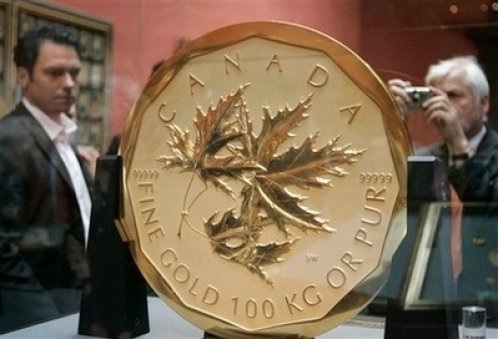 |
|
New Member
United States
33 Posts |
Could you imagine have to use a wheelbarrow to bring in the coin to buy something at the grocery store! I'm sure there isn't cash registers that have a slot for coin of 100 KG
|
| |
Replies: 17 / Views: 27,423 |










 Posted 07/08/2014 05:13 am





