| Author |
 Replies: 57 / Views: 6,727 Replies: 57 / Views: 6,727 |
|
Valued Member
Canada
281 Posts |
Hi everyone, I got this ratty devil's face but I noticed the bottom right corner in the back of the bill is actually blue. Is that normal? Is it worth anything more? 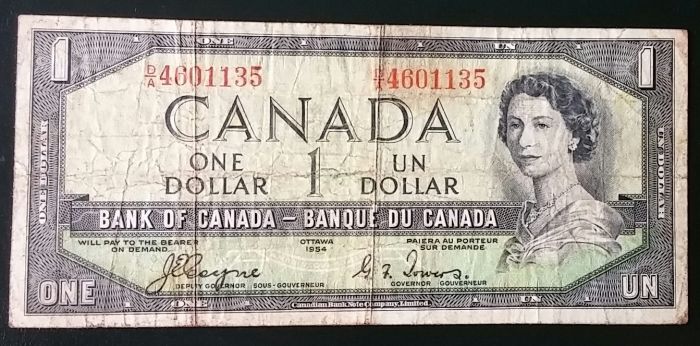 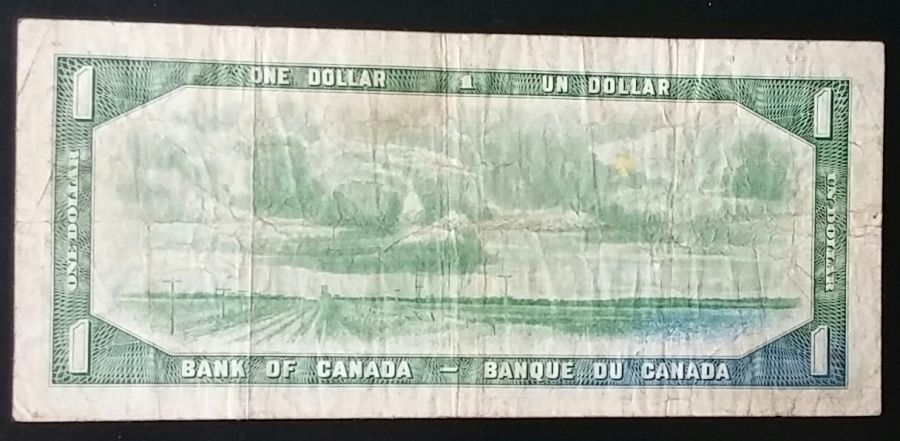 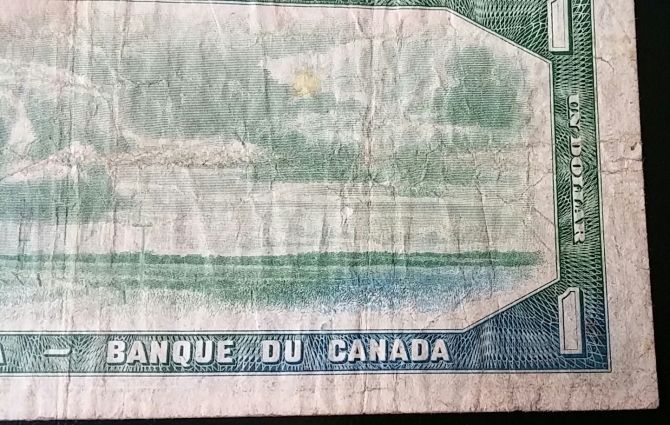 |
|
|
|
Pillar of the Community
Canada
2366 Posts |
Does it look or feel like water damage in that area?
|
|
New Member
Canada
48 Posts |
ive never heard of this, I found this with a little research... your could be one of the first printed so its only partially or this is completely fake (which I believe is) but I thought was worth a look http://www.ebay.com/itm/CANADA-CANA...em43d0d077cd |
|
Pillar of the Community
Canada
3049 Posts |
That bill has been washed out... not an error.. Your note looks like environmental damage
|
|
Valued Member
 Canada
281 Posts |
I don't see any other signs of water damage though, wouldn't it show on the same corner of the front side of the note if it was water damage? and why would the colour change so distinctly to blue?
|
|
Pillar of the Community
1844 Posts |
I have heard of people using bleach to try and clean thr white edges, so if it touched the green area maybe it turns it blue?
|
|
Moderator
 Australia
17006 Posts |
Plain "water" wouldn't change the colour. It's been hit with a chemical of some kind - changing the pH with something acidic or alkali (like ammonia) can cause some inks to change colour.
Don't say "infinitely" when you mean "very"; otherwise, you'll have no word left when you want to talk about something really infinite. - C. S. Lewis
|
|
Valued Member
Canada
281 Posts |
I still don't understand how any process such as that we allow such a perfect blend from blue to it's normal colour. Couldn't this be a print error where some of the ink of the 5 dollar note was mistakenly placed on the 1 dollar? this is bizarre
|
|
Pillar of the Community
Canada
1747 Posts |
Back in the 80's I remember seeing this on dollars, I can't remember dates , but either 70's or older.
|
|
Pillar of the Community
Canada
3049 Posts |
Kooks... if this note was UNC.. then there may be some merit and it would be worth investigating a bit more... but given the condition of the note...I already suspect it's been washed, environmental damage or chemical alteration.
|
|
Valued Member
Canada
403 Posts |
Could also be a ink/toner issue at press where there might have been low yellow levels to create the green colour, thus the cyan (blueish) colour prevailed at press...
|
|
Pillar of the Community
Canada
1505 Posts |
Please note: due the issue here, this is going to be a long post!
Back in 1953/4 when this series was printed, the printing process was different than in the 70ties and 80ties, and 90ties. The ink and paper were completely different.
Printing presses did not have any electronics. it was all mechanical, some pneumatic and mostly electrical controls via mechanical relays and mechanically actuated switches. I know for sure, because my company was specialized to service these printing presses all around Canada and part of the USA.
The ink had to be poured into the ink wells across the large Cylinders which held the mechanically and manually produced printing plates.
when a certain color printing job was finished, all press parts in contact with any ink, sometimes up to 4 different colors, each color in its own ink well, had to be removed and manually cleaned with chemicals etc. There were also small hoses and small pipes involved. If any area of these ink bearing parts was not perfectly cleaned, the remaining ink on these parts was carried over to the next printing job and affected a certain number of first run sheets, until the old "foreign" ink was washed out and the new ink combination was perfect. This was a known issue.
Until this rest ink was "washed out", and the result was perfect, slightly , and sometimes very noticeable results were visible on the finished printed sheet being OFF-Color. The actual production run and count was not to be started until these imperfections were eliminated.
There were usually 2 men at the finished stack acting as Quality control. they individually and manually pulled finished pre-production test sheets of the stacker to inspect for proper register, correct color and a few other markers. These sheets were laid on a light table for inspection, with a certain light spectrum lamp behind it. If imperfections were found, register adjustments and ink-flow and other corrections required were made. This process was repeated until the end product was perfect and acceptable.
This process was then repeated for the other side after the required and counted quantity of sheets was printed on one side. this quality control process, assuming the presses were operated by experienced pressmen and operators, did not take long at all.
Then the numbering was re-set to the proper sequence, but obviously, sometimes a bit too soon.
ALL pre-production test sheets , as well as rejects discovered during the printing process, were supposed to be accounted for and effectively destroyed!
However, it is very possible and highly probable that some sheets just simply "slipped through the cracks". For whatever reason! Use your imagination and compare it with the 1967 double and triple reverse struck Goose silver dollars.
I actually own one of these $1 bills for the last 20 years. It received it in change. One side in perfect blue. So, some years back I had a chat with 2 older press men I still knew then. Both , independent from each other, suggested that, despite "rigid" quality controls, there was never a guarantee of 100% perfection. They explained that everything was manually done by humans, not computers. And to make mistakes is human. They also both suggested that in these times printing companies were usually working 2-3 shifts and the side doors were just possibly not only used to go for a smoke or get some fresh air. Wives brought lunch during night shifts friends dropped by to "see" the huge printing presses etc, etc.
Some of you suggested, this blue color is caused by bleaching. Look at it carefully, not on a posted picture on here. If bleaching, or another chemical influence caused this, it would not be perfectly clear and sharp. And it would affect all colors, including the paper. If chemically treated, the other side would probably also be affected.
Just try it yourself and let a bill, or any OLDER paper sit in the sun for some time and see how the UV will affect it. ALL of it. Lift a carpet on a wooden floor. What do you see?
Think chemical for a second and try to explain a chemical reaction on, in and with ink and paper used at that time. Or just look at a coin that has been chemically treated. Just try some Ketchup on a cent, and see what happens. It is a chemical reaction. etc, etc)
I think you all came to the same conclusion.
|
|
Pillar of the Community
Canada
5420 Posts |
This is a played with junker in my less than humble opinion. Look at the right hand serial number it is obvious that someone was trying to rub it. I will bet that some blue cheer or ammonia was used on the so called blue part of the back. Someone having fun in the kitchen is my bet. Send it in for certification and see what happens.
|
|
Pillar of the Community
Canada
627 Posts |
|
|
Valued Member
Canada
281 Posts |
Tfred what are you referring to please?
|
|
Valued Member
Canada
281 Posts |
Nvmd lol just Figured it out. Thanks 47P7
|
| |
Replies: 57 / Views: 6,727 |










 Posted 10/18/2014 5:58 pm


