| Author |
 Replies: 12 / Views: 3,578 Replies: 12 / Views: 3,578 |
|
|
Pillar of the Community
United States
5196 Posts |
11 mm diameter, 1 mm thick,0.8 gr weight. 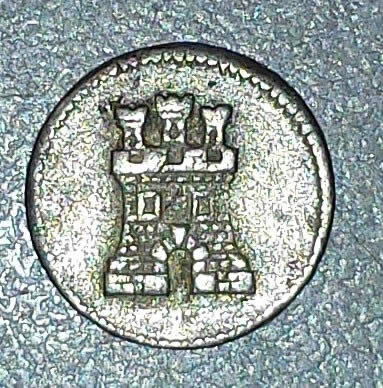 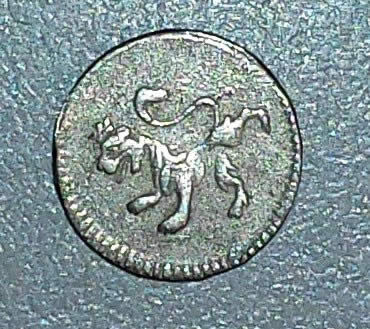 Identified - moved to World Coins forum - Sap Identified - moved to World Coins forum - Sap |
|
|
|
Pillar of the Community
United States
1391 Posts |
|
|
Valued Member
United States
172 Posts |
With no denomination or date, your item is probably a token of some kind rather than a coin. I'm not sure why you think this token is from Argentina but the designs, showing a rampant lion and castle, make me think of many places other than Argentina, such as Scotland.
|
|
Pillar of the Community
United States
1391 Posts |
Looking at the catalog I'm pretty sure it is this coin. It the weight is with in tolerance.
Country: Colombia
KM# A30
Year: 1756
Value: 1/4 Real (1/4)
Metal: Silver (.833)
Weight: 0.86 g
|
|
Valued Member
Spain
108 Posts |
Well, I dont know where that references are from ( http://en.numista.com/catalogue/pieces34684.html ). I think is 1/4 real, silver, but without mint or date and it is (as similar coins with mint and date) from Fernando VII (SEVENTH) struck from 1808-1825 in several mints (Santiago, Lima, Guatemala city, Potosí, Mejico city and Santa Fe de Bogotá). Any way, I think is better say "spanish-colonial" instead of "colombian" because when it was minted, Colombia or Bolivia ... didnt exist as states and those coins were struck under Viceroy authority (on behalf of the spanish king). v. Edited by Veton
03/06/2015 10:42 am
|
|
Moderator
 Australia
17005 Posts |
Quote:
Any way, I think is better say "spanish-colonial" instead of "colombian" because when it was minted, Colombia or Bolivia ... didnt exist as states and those coins were struck under Viceroy authority (on behalf of the spanish king). While I personally agree with you, you will find many collectors, particularly in America, who file these coins under "Mexico", "Peru", "Bolivia" or "Colombia" or wherever, because that is how the Krause world coin catalogues currently file them: the city of Potosi is currently situated in Bolivia, so Potosi-minted coins are filed under "Bolivia", even though no such separate country existed under Spanish rule. English-speaking collectors will continue to follow suit until the Krause catalogues reorganize the Spanish-colonial section properly. Don't say "infinitely" when you mean "very"; otherwise, you'll have no word left when you want to talk about something really infinite. - C. S. Lewis
|
|
Pillar of the Community
 United States
5196 Posts |
agreed that is a colonial coin that circulated on any of the colonies from 1801 to 1819.Bolivia had one similar to mine but it was used from 1794-95.
|
|
Valued Member
Spain
108 Posts |
Interesting concern, Uruman. It may be from Carlos IV reign. In this link http://www.catalogodemonedas.es/?q=...s/25/108/238 (online catalog) the only difference between Carlos IV and Fernando VII issues (this type of coin) is 11 gr. for the first and 10 gr the second (one point for Charles and 1802-1808 as possible issuing date). But 1/4 by Charles is without mint ("sin ceca") but with date (1802). Fernando,s quarter is without both (mint and date), so one point for Fernando. I think is Fernando VII but.... The second question, Kraus It is wrong. In the same way a coin minted in Roma by emperor Claudius is an Italian coin. Other from Constantinople by Heraclius is an turquish coin, and an iberic coin from Castilo is an spanish one. v. |
|
Valued Member
Spain
108 Posts |
Taken advantage that you are sleeping, there is a second point for Charles IV, Guatemala city mint and 1794-1795 (in opinion of Victor Hugo Sandoval http://www.monedasdeguatemala.com/indexIN.html ) because tower and lion design are similar to later coins ("cuartillos")of Guatemala city (he says that those from other mints are differents). v. |
|
Moderator
United States
14463 Posts |
|
|
Pillar of the Community
United States
5196 Posts |
Veton, Good morning.Thanks for your help.
I found some reference to it on "Calico & Trigo" numismatica espanola ,They have it on their catalog as # 1299.
|
|
Valued Member
Spain
108 Posts |
Not at all, Uruman. I havent that catalog, I use Castán-Cayón (1981, a little bit out time, but...).
This type "cuartillo" was created by 4/30/1789 act. (Sandoval) In 1794-1795 Guatemala city minted "cuartillos" without mint and date, from 1796 with mint-mark "G" and year but without assayer or edge ("cordoncillo"). He attributes them to Guatemala city mint because castle and lion design are similar to those one dated from Guatemala, not so for cuartillos from other mints.
"Por real orden del 30 de abril de 1789, se crea la moneda de plata de 1/4 de real "cuartillo", en la serie de monedas americanas. En1796, se acuña en Guatemala la primera pieza fechada de 1/4 de real, con la marca de ceca "G" y sin inicial de ensayador ni cordoncillo, por el tamaño tan reducido de la moneda. Piezas "anepígrafas" (sin fecha, ni ceca) fueron acuñadas en Guatemala entre 1794 y 1795. Como se puede observar en las fotos de arriba, el tamaño y el diseño de los punzones del castillo y del león, son identicos a los utilizados posteriormente en las piezas ya fechadas de Guatemala y distintos a los utilizados en otras piezas tambien anepígrafas de las demás cecas americanas."
v.
|
|
Pillar of the Community
United States
5196 Posts |
thanks for the information. I went to e-bay and under Bolivia there's one like it for buy now and They have it as a bolivia 1794-1795. I will take or input and put it as minted in Guatemala.
|
| |
Replies: 12 / Views: 3,578 |
|










 Posted 03/05/2015 9:33 pm


