| Author |
 Replies: 12 / Views: 1,796 Replies: 12 / Views: 1,796 |
|
|
Pillar of the Community
United States
609 Posts |
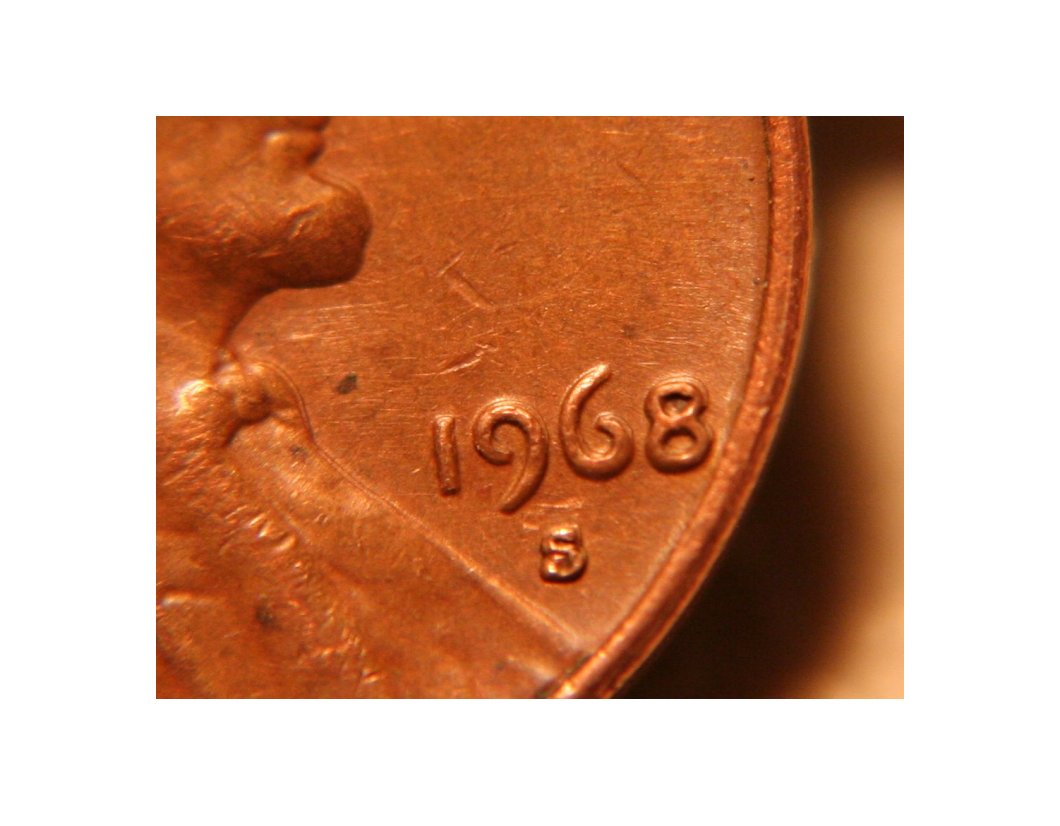
I thought I would post this picture of a 1968-S Lincoln. The date, mint mark, chin and bow tie area show a very strong doubling. Thought it might have been a repunched date but looks too flat. oh well, will keep looking for the big one,,,,lol Image:  1968.jpg 1968.jpg99.96 KB |
|
|
|
Pillar of the Community
United States
2254 Posts |
Hi wrongalot, I copied this from another thread, and it is straight from Chuck: quote:
In fact, there is no such thing as a repunched date or over date in the Lincoln Cent series because they simply are not possible.
Not sure if you care or not, but it seems that the dates were fixed and not punched separately on Lincolns in general. So I guess the best you will find is doubling in it's basic sense and no a re-punch. Hope this helps. |
|
Pillar of the Community
United States
936 Posts |
Tights,
I think you are misunderstanding Chucks statement and Wrongalots question. A repunched mint date would have an 7 over an 8 or something along those lines, Wrongalot is correct with his coin, I have one of those to where the coin was hit twice and moved a little bit so you get 2 sets of devices.
|
|
Pillar of the Community
 United States
609 Posts |
You would think that with the first strike being so off kiltered, that it would be a variety coin, it sure looks cool, and if it wasn't flat, it would be considered a double die, sometimes I wonder......
|
|
Bedrock of the Community
United States
62064 Posts |
There is a difference between doubled struck and doubled die. On a double struck/triple struck the coin either didn't leave the camber or as in the case of proof coins it was stuck several times for more detail. On a doubled die, the die is doubled thus each coin struck from that die has the same separation on each coin struck with that die. thus the term double strike and doubled die. Usually one a doubled struck coin you see two obverses and two reverses struck on the coin. With Machine Doubling you see the shelf like distortion on the devices of the coin. On a doubled die all coins made from that die are doubled. The reason errors are called errors that they happen only once or a few times. Not every coin has the same error that is made from that die pair. Striking/die cracks/die gouges/wrong planchets/off center/MAD/Brockerage/ETC happen to just one or a few coins. Doubled dies/RPMs happen to every coin struck with that die. |
|
Pillar of the Community
United States
609 Posts |
Thanks for that explanation. I understand the difference between the doubling, I guess I should have said error, not variety, hence my name.....wrongalot.....so are double strikes very common? I have not seen one that is so seperated. In fact I don't see many at all, so when I do find one I keep it so I can compare.
|
|
Bedrock of the Community
United States
62064 Posts |
Here is an example of a double striking. It sold on ebay a few years back. (Sorry to the owner, but I copied the image for educational purposes.) 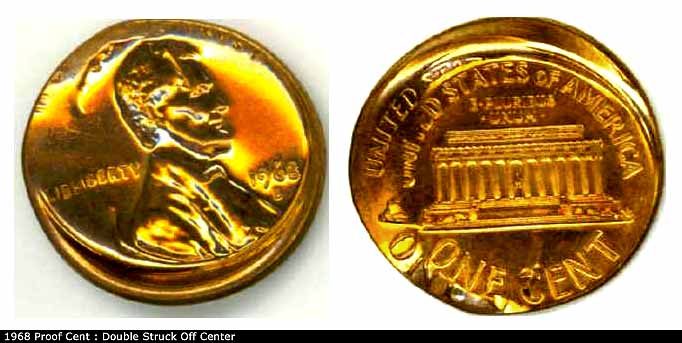 I've seen different examples on ebay for sale. It just only happens to be the one image I saved. Sorry. Edited by coop
10/19/2007 4:47 pm
|
|
Pillar of the Community
United States
2254 Posts |
quote:
A repunched mint date would have an 7 over an 8 or something along those lines, Wrongalot is correct with his coin, I have one of those to where the coin was hit twice and moved a little bit so you get 2 sets of devices.
Now I'm confused.  Maybe I misinterpreted what Chuck wrote. I thought what he was saying was that the date's on lincolns are on the hub and not punched at a seperate time, so there would never be a "repunched" date. Only a double strike or die. Oh well, looks like I should change my name to Wrongalot too....... |
|
Bedrock of the Community
United States
62064 Posts |
what Chuck is saying the coins made from a glavino won't have an over date on them. Not sure when they starting using this. But the ones purported are just that claims from experts in their day. But the older earlier coins were made from a punching of individual numbers can have a doubled date. Again I don't know when they stopped using that method. But the large Cents/ Two Cents / Three Cents/ Indianhead Cents do have examples of them. I did have a 1900 Cents that had one, but new than that I'm not sure when they stopped punching the date as separate numbers. But the 1968 Cent posted above is Machine Doubling. Happened a lot in 1968 & 1969. |
|
Pillar of the Community
United States
2254 Posts |
quote:
I did have a 1900 Cents that had one, but new than that I'm not sure when they stopped punching the date as separate numbers.
Thanks coop. I did include the fact that chuck stated all Lincolns specifically, so I guess to answer you're question would be they started at the Lincoln Cent. I do understand what you are saying though, so thank you. |
|
Pillar of the Community
United States
7629 Posts |
Wrongalot's coin is a case of Machine Doubling, which is excessively common on 1968 cents. He stated that at first he thought it could be a repunched date - which is not possible on Lincoln cents. Punching date digits on cent dies ended with the Indian Head cent. No coin series that had its start in the 20th century can exhibit repunched or over dates. All of them had the date in the master. The few cases where two dates are known on one coin in the 20th century are actually doubled dies....the 1918/7D Buffalo nickel is a class 3, design hub doubled die. It occurred in the exact same way as the 1960 large/small date proof cents. Two different hubs exhibiting two different designs were hubbed into the same die. Same is the case with the two 1942/1 Mercury dimes, the Standing Liberty quarter, and the 1943/2 Jefferson nickel. NONE of these are technically overdates. Furthermore, even if a 1958/7 cent did exist, it would not be a repunched date - repunched is just that - "re" punched...same digit over itself. A coin exhibiting two different dates is an "over" date. Same principle as a repunched mintmark (D/D, S/S, O/O, CC/CC) versus an over mintmark (D/S, S/D. O/CC, etc.). An overdate is specifically a hand correction or hand edit to reuse a die from a different year. All of the bust half dollars, large cents, and similar coins known with two different dates are indeed overdates, but these occurred in a completely different manner from the 20th century doubled dies showing two dates. Another thing just to be completely clear...double struck is a coin that was struck twice - two strikes, hence the use of "double". A doubled die is one single die with the design doubled, hence the use of the DIFFERENT word "doubled". If it were a "double die" we would be talking about two dies that struck the same coin, and that's not the case. We call it "Doubled die" because the design on the one die used for that side is "doubled". One of the first ways a seasoned die variety hunter picks out the rookies is because the rookies call them "double die" incorrectly. Using correct terminology not only gains respect but shows you understand the principle of what you're collecting. |
|
Pillar of the Community
United States
3507 Posts |
Chuck,
I am glad that you re-explained all that. Prior to your post there were so many invented terms and words incorrectly used and or spelled that I just didn't have the heart to mention them. With your post, I hope it has all become clear:-)
Thanks,Bill
|
|
Pillar of the Community
United States
2254 Posts |
Thank Chuck. I sure don't mean to beat a dead horse here, but it's great to have you and the other Lincoln experts on this site to explain things in layman's terms. I think my initial understanding and my initial post was correct, although it could have been worded differently. I apologize for the confusion, but in a way, I'm glad I confused myself because it elicited another explanation out of you.  Having said that: quote:
I have one of those to where the coin was hit twice and moved a little bit so you get 2 sets of devices.
In reading your post, Chrisb is explaining a " double die" here and not a " doubled die", because the "doubled" would mean that it was struck once and the actual die that was used contained the doubling, not a multiple strike scenario? |
| |
Replies: 12 / Views: 1,796 |
|








 1968.jpg


 Posted 10/18/2007 1:46 pm


