| Author |
 Replies: 22 / Views: 3,960 Replies: 22 / Views: 3,960 |
|
New Member
Australia
17 Posts |
Hi folks, I refer to this thread for background info.. https://goccf.com/t/20404I have given the coins a soak in olive oil for a couple weeks in an attempt to halt the verdigris. As I said in the other thread, these coins are not valuable coins but they do have significant historical value due to where they were found and how they got there - the plan is to have these coins on display in a public area - in a glassed picture frame. With the verdigris problem though, obviously the coins will just continue to deteriorate. I have seen all over the web, a method using power adaptors and aligator clips/stainless steel, I'm sure you all know what I'm talking about - will this do anything for the verdigris? Otherwise, I'm thinking of encasing the coins in epoxy resin - will this stop the verdigris from destroying the coins or will the reaction continue within the epoxy? Thanks for your time! :) The ParkRat |
|
|
|
New Member
 Australia
17 Posts |
|
|
Member
United States
3242 Posts |
I only clean new clad lincoln's I steam them with a hand held steamer it work well
|
|
Bedrock of the Community
United States
14454 Posts |
I know I am kind of new to collecting but I have never seen anything like this before so I couldn't say whether it would work well for copper verdigris or not. Like I said I have never even heard of this being done until now so I have absolutely no input that would be helpful in your quest about finding out about these electrolysis machines. I have heard some people on this forum say they have also put their copper coin inside a potato to help get the verdigris off of the copper coin as well but I haven't ever tried any method like this either
|
|
Valued Member
Australia
161 Posts |
Steam/water will only help promote verdigris. You will need to pick away at the vergigris to lift it off as best you can after the coins have been soaking in the oil. I wouldnt leave the coins in it for too long though. I might have to try out some sump oil to see if that helps  |
|
Pillar of the Community
 United States
2703 Posts |
After you pick it off carefully, soaking in a solution of sodium carbonate (aka washing soda) can be used to halt the progression of the verdigris. This stops the formation of copper chlorides. Also heating the coins in an oven can be used to drive out the water which helps promote the verdigris. Embedding in epoxy resin is not a good idea. The British Museum developed a product called Renaissance wax which you can use to safely seal the coins after removing the verdigris and halting its progression.
|
|
New Member
Australia
17 Posts |
Gulp...
There's over 70 coins... picking it out by hand on them all isn't really an option - some just have general greening and others the entire surface is covered in lumps and bubbles.
I threw a couple into amonia today for an hour or two to see what that would do, it has helped, especially on the coins that only had surface greening and were not pitted. The more pitted coins are improved but not verdigris free. The resulting orange/red colour of the coins is very disapointing though. Can Renaissance Wax be used with success if the coin still has some verdigris on it?
|
|
Pillar of the Community
Australia
655 Posts |
You won't be bored for some time then. Actually I have a copper 2 cent I want to clean up. It's really bad, tried ammonia and toothpaste with little effect. Resorted to the electrolysis method mentioned above and it helped a bit. It didn't have a verdigris problem as much as a stain from something. The electro helped a little. I think it needs more though. Maybe I should increase the voltage.  Tried a 12v battery, then a battery charger. Mmm, there's a storm on the way. Maybe a lightning rod and.... insert evil Frankenstein laughter here. Nice Milo drink anyone?  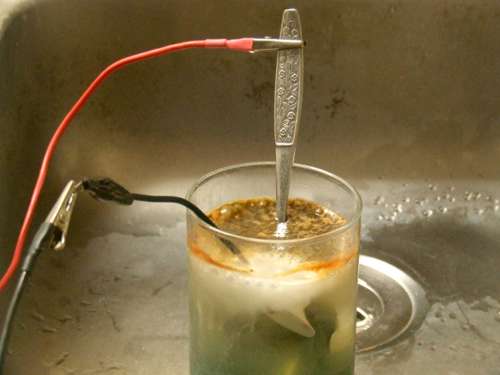 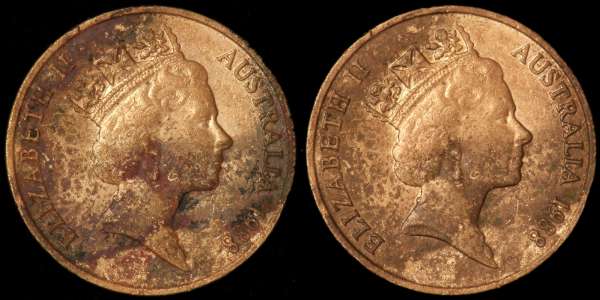 |
|
New Member
Australia
17 Posts |
ok.. so this is gonna sound stupid but..
How safe is that electrolysis method? Like, if I stick my fingers in the water, will I electrocute myself? :)
|
|
Pillar of the Community
Australia
655 Posts |
As long as you just use one of those plug packs, a battery charger or a battery, basically anything that outputs low voltage, say 24V or less, you are not going to get electrocuted. Don't go using 240V on it!
You don't want to stick your fingers in it anyway, cos A.) it's disgusting, and B.) the brew gets hot.
|
|
Pillar of the Community
United States
914 Posts |
I use electrolysis a lot on my really bad coins, and not really that happy with the outcome. Most of them rust up like an old bucket once I'm done.
|
|
New Member
Australia
17 Posts |
I've given up on the verdigris, there's just too much of it to clean on too many coins!
So I'm just gonna frame them up as they are and hope they last a few more years! :)
|
|
Pillar of the Community
Australia
652 Posts |
The elctrolysis won't electrocute you, but it might do some funny things to your pacemaker |
|
Pillar of the Community
United States
914 Posts |
I'm going to bet that electrolysis will work wonders on that coin. Make SURE to use distilled water. Also, don't use the lemon juice/salt that they're recommending. Go to Walmart and find Arm & Hammer Washing Soda. |
|
New Member
Australia
17 Posts |
I'm scared that I might stuff it up and somehow electrocute myself! :)
|
|
Pillar of the Community
Australia
655 Posts |
You won't electrocute yourself with a plugpack or low voltage. What is in this washing soda? I don't really feel like travelling 12,000 miles to the nearest Walmart. Just sodium carbonate? |
| |
Replies: 22 / Views: 3,960 |






 Posted 11/04/2007 06:36 am





