| Author |
 Replies: 16 / Views: 3,112 Replies: 16 / Views: 3,112 |
|
Pillar of the Community
United States
5155 Posts |
I figured it out, I worked all day for a Penny. I have been looking for some affordable Viking era coins. I was hoping to some day add a coin of a ruler of my most ancient ancestors. I was looking at museum photos of the rare, crude and early Scandinavian coins all very fascinating and struck from Unobtainium. I have mentioned in several other posts my love for the very small manual "Reading Medieval European Coins" by Ralph S. Walker, with this coin I put it to the test. The coin was mis-attributed on the 'bay. It was previously attributed as Derby mint and an unspecified moneyer. I have read the manual several times cover to cover (44 pages). It has a chart with all the different Anglo letters that do and do not exist in our language proper, and outlines some important abbreviations. I am sure there are better texts and catalogs for Anglo-Scandinavian pence, but these 44 pages was extremely helpful. I was able to determine the mint and moneyer with some relative certainty. The key that broke the whole legend wide open was the first letter to the right of the Maltese Cross. What to everyone thinks looks like a D followed by V is actually not a D or P with a faint line perpendicular to the spine, but rather a symbol or letter used on coins for "TH" sort of like a Theta. (Uber Interesting.) The other letters are well formed an completely legible as the moneyer Thurston of Stamford. Notice "ON STA" There are some odd "extra pellets" on the reverse....can an penny guy make comment? Also appealing to me is the use of the pointed Viking helmet used on this penny. This penny was most likely struck after AD 1021. The coin was modeled on Late Roman coinage, although many centuries afterward. Again rather than butchering the history Ill just sum it up real fast. Cnut was a Danish Viking whom was the first king to unite all of England. He was proclaimed King of England, Denmark, Norway and some of Swedes. Any additions or corrections are much appreciated. Any information on the extra pellets would be awesome. Feel free to comment and pile on your pence. North Sea Empire Stamford, Anglia Cnut the Great (r. AD 1016 -1035) AR Penny 18.2 mm x 1.00 grams (c. AD 1021-1035) Obverse: The helmeted bust of Cnut left holding a scepter with 3 lobes.+ CNVT REX A Reverse: Short cross with 4 pellets and 2 extra opposing pellets. + THVRSTAN ON STA Note: EF 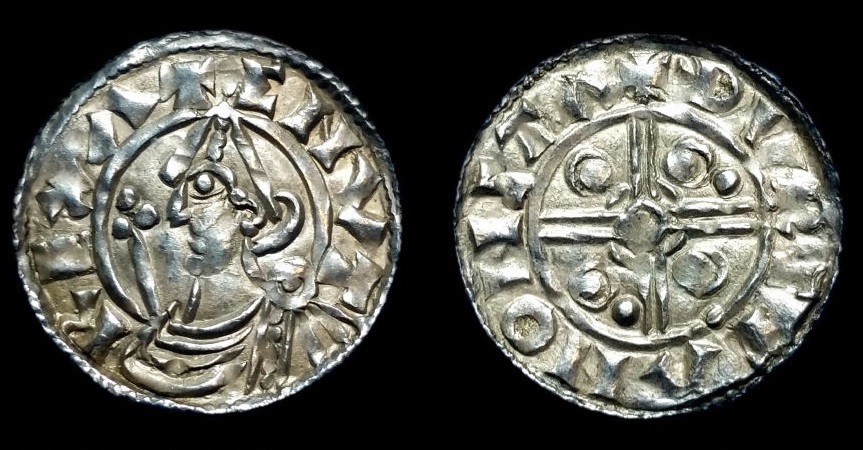 Edited by Ancientnoob
04/01/2015 12:41 am
|
|
|
|
Valued Member
United States
129 Posts |
Very nice coin, congrats. This is well outside my small comfort zone, so please pardon if this is a simplistic question. Is there any symbolic meaning to the scepter with three lobes on the obverse, as you mentioned the united rule over multiple areas? 11th century Northern Europe is a blind spot for me.
|
|
Pillar of the Community
United States
4778 Posts |
With your recent medieval coins you have been doing a good job lately of making me envious! Great catch!
|
|
Pillar of the Community
 United States
5155 Posts |
Captain-
I am traveling where I have not before. I am currently reading about the coinage of Cnut. I wonder if the 3 lobes are really a floral cross or something equivalent. I'm still learning about the coins of this period, and applying what I know about coinage of earlier periods.
|
|
Pillar of the Community
United States
5155 Posts |
@VK - I think I am going to make it my avatar!!!  |
|
Moderator
 United States
23731 Posts |
Excellent coin in beautiful condition, I for one would be interested in learning more about this type.
|
|
Valued Member
United States
129 Posts |
Very nice to undertake a new direction in collecting. That 'aha' moment as you described with the pseudo theta on the reverse is quite satisfying.
I suppose I was wondering if the triple clovers represented temporal supremacy over particular kingdoms, or Christian trilogy symbolism, or some other reason I'm ignorant on. Can you provide any references for more information for these coin types, aside from the Walker you mentioned? The style is quite appealing to me.
|
|
Pillar of the Community
United Kingdom
4208 Posts |
An interesting coin.
That Theta is probably the character that we call 'thorn' - Þ. When moveable type arrived in England, they replace it with the letter Y for ease - thus, Þe (The) became Ye, a usage which persists (Ye Olde Shoppe etc).
Also, long before Cnut, King Aethelstan united England and conquered Scotland and Wales - he even issued coinage proclaiming himself Rex Totius Britanniae (The King of All of Britain). He's usually considered the first to unite the Island, in our histories - though the lack of surviving documentation of his reign has undeservedly resigned him to the back bench in history.
|
|
Pillar of the Community
United States
5155 Posts |
Great addition to the thread Ben. Thanks. Its always amazing to see how many great people in the histories of the world have fallen into obscurity.
|
|
Pillar of the Community
United States
513 Posts |
Great coin. The history of Britian is something I'm just now getting in to. Too much of it is often brushed aside as 'the dark ages' and so much interesting stuff went on.
|
|
Pillar of the Community
United States
5010 Posts |
|
|
Valued Member
United States
72 Posts |
Awesome coin, I'd love to get some medieval coins when I have the extra money.
|
|
Pillar of the Community
Canada
1118 Posts |
Wasn't there a special letter for the "th" sound that looked close enough to the "Y" letter that they just used that in the printing press or something? I have been reading up on British history and since we are talking about the language and pronunciation of the era I have to ask, how do you say Cnut? In my head I just say sea-nut but I am pretty sure that is wrong. Edit: Sorry Ben, didn't see your post  Edited by Harmonica
04/02/2015 1:28 pm
|
|
Pillar of the Community
United Kingdom
4208 Posts |
Well, it may be more clear from a variant spelling - 'Canute'. Kah-noot. However, some people pronounce it 'Nut' or 'Newt'. Ive no idea which way is the most correct, but all seem accepted (dictionaries seem to allow all 3).
|
|
Pillar of the Community
United States
5155 Posts |
I don't know which is most correct, but C-Nut is funny. I call him Kah-Noot.
|
|
Valued Member
United States
87 Posts |
That's a very nice Kah-Noot. Definitely like the helmet. Pre Wagner Opera style. Some time back I got lucky on the 'bay and won a Northumbrian styca from the Ainsbrook Viking site. Northumbrian rulers issed these debased little coins in large numbers, and they were definitely around when the Great Heathen Army invaded and put an end to their production when the last Northumbrian king to issue them, Osbert, died along with Aella in battle against the invaders at the city of York. Once the Northmen had established their rule, they began to issue their own series of coinage, the Cunnetti and St. Eadmund types being the most prevalent today, largely due to the finding of the Cuerdale treasure hoard. The early coinage of Norway, Sweeden and Denmark is hard to find, but they do show up on the market occasionially. If you are willing to trade a pretty penny for a pretty penny, rulers like Sven Estridsson, Olof Skotkonnung, and Olav Kyrre can be had. Kings of Northumbria. Osbert. York Mint. Moneyer Eanwulf. 849/50-867. Æ Styca. OBV: OSBRLHT RCX (partially retrograde) around crude Chi-Rho. REV: +EANVVLF (partially retrograde) around cross. 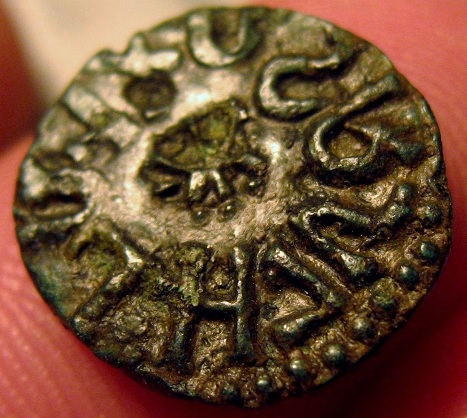 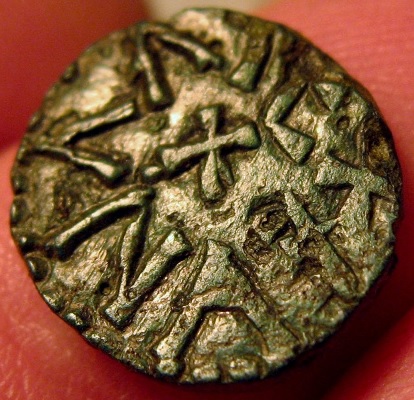 |
| |
Replies: 16 / Views: 3,112 |






 Posted 04/01/2015 12:32 am





