| Author |
 Replies: 12 / Views: 2,425 Replies: 12 / Views: 2,425 |
|
|
Pillar of the Community
United States
5318 Posts |
Seeing how it's only a matter of time before "enterprising" individuals begin forging slabs of the top TPGs and selling overgraded or fraudulent coins, what can be done to verify their authenticity beyond reasonable doubt? Given the growing volume of online auctions, will auction houses have the resources to discern between an authentic slab and a close fake? Holograms can be easily faked from an original, and registry/barcodes or any other visual device can be taken from auction photos to create a fraudulent slab with questionable contents. Certainly authenticity can not be verified from visual diagnostics when printers can duplicate nearly anything. In online transactions, a TPG-slabbed coin could assure the coin is reasonably genuine, accurately graded, and not otherwise tampered with to augment its value. However, if slab forgeries run rampant through the marketplace, the value of even highly trusted TPGs comes into question. It is therefore incumbent upon these TPGs to provide a failsafe verification of their graded slabs. Below, I have illustrated a schematic of a process whereby the TPG would provide a secret PIN with the graded slab they return to the owner. In this process, the true owner of the coin retains a coded PIN whereby its authenticity can be verified against the TPGs database. Additionally, the TPG could archive a high-resolution photo of the coin for added visual confirmation. Then, when the coin is sold, at some point in the process the buyer could request the PIN, and verify the coin against the TPG database. No longer would forgers be able to copy barcodes and numbers, insert an overgraded coin, and seemingly sell a "genuine" TPG slab. In this model, only the owner, the TPG, and buyer would have access to the PIN, which would transfer ownership with the coin. Taking the security further, an escrow could be used that would confirm funds, coin, and PIN before transfer to each party. 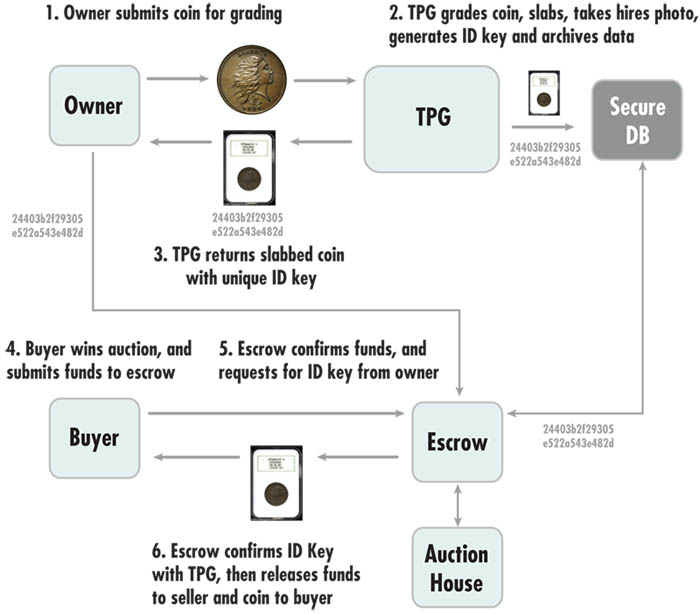 Edited by KurtS
12/02/2007 11:46 pm
|
|
|
|
Moderator
 United States
6563 Posts |
As long as someone can fake a slab and sell it on ebay to an unsuspecting buyer....the TPG Utopia you describe will not work.  |
|
Pillar of the Community
 United States
5318 Posts |
quote:
As long as someone can fake a slab and sell it on ebay to an unsuspecting buyer....the TPG Utopia you describe will not work.
Perhaps...there are no utopias, especially on ebay!  Yet, after the auction closed, if the seller would provide a PIN as described, and the buyer verified, that would weed out the forgers. If the seller didn't have the proper PIN, the auction winner could decline payment, state the reasons in feedback. This could work even @ ebay. |
|
Moderator
United States
6563 Posts |
Then a mass educational project would have to be implemented...which we kinda do here on this forum but in a smaller fashion. It's not really about the fact that there are fake NGC slabs. It's the fact that people will pay 10x what something is worth based solely on the fact that it is entombed in plastic.
|
|
Pillar of the Community
United States
5318 Posts |
Yeah...I agree with you: people attach too much value to TPG slabs and grading instead of educating themselves. The blind trust of slabs could prove to be their downfall. As one who collects older coins, I've had to educate myself on detecting possible cleaning, retooling, and forgeries. To that end, a truly verified slab could help, but it sure doesn't replace knowledge. |
|
Bedrock of the Community
United States
17884 Posts |
Step 5.5 widow of collector says "ID code? I don't have any ID codes!" All deals fall through and entire collection has to go back to grading services t e regraded and put in new slabs. at a cost of thousands of dllars that widow doesn't have. Widow dumps deal to local dealer for pennies on the dollar.
Alternate. Scammer has genuine coin slabbed receiving coin back an PIN# Then creates dozens of fake slabs with the same serial number and sells them providing the PIN# to each buyer. Since serial number and PIN match in database deals go through. Scammer cracks coin out and resubmits for new serial number and PIN# then repeats the process. Now if you want to ownlaod the photo and carefully scrutinizes the coin and the photo to make sure they match that might work to catch this scam. So now you are back with what ANACS was doing in 1972, only ANACS had better images. (Digital is nice and easy but doesn't come close to the resolution possible with film.)
|
|
Pillar of the Community
United States
5318 Posts |
Thanks for pointing out the possible holes in this system. Obviously, it's a bit more involved than my Sunday afternoon brainstorm. |
|
New Member
United States
34 Posts |
Hardly foolproof, but a helpful tool might be if the TPGs maintained a "present ownership registry." When ownership of a TPG graded coin changes, provide a mechanism for the new ownership to be registered in an ongoing data base. If the serial number is fictitious or a duplicate, warning bells would go off to trigger further investigation. |
|
Valued Member
United States
499 Posts |
With a "present ownership registry" I could go online to see what you own before I break into your house to look for it. You may or may not keep your coins in your house but knowing what's in your collection might make it too tempting for me to look and see!
Richard
|
|
Pillar of the Community
 United States
2703 Posts |
I am thinking of starting a professional service company to certify slabs and put them into tamper-proof plastic cases.
|
|
New Member
United States
34 Posts |
Such a "present ownership registry" wouldn't be accessible by looking under a person's name, but by searching under the serial number. Makes researching your burglaries a little more difficult.
|
|
Bedrock of the Community
United States
17884 Posts |
quote:
Hardly foolproof, but a helpful tool might be if the TPGs maintained a "present ownership registry." When ownership of a TPG graded coin changes, provide a mechanism for the new ownership to be registered in an ongoing data base.
Once again we're back to the original ANACS model from 1972. ANACS did register the coin to the person who submitted it and when the coin was sold there was a mechanism by which the new owner could change the registration over to himself. So each certified coin was registered to a specific person. Problem was no one cared about the registration, so very very few people ever bothered to get the registration changed. (This is why ANACS Transfer certificates are so rare.) Still it is interesting that so many of the suggestions about how to safeguard the slabs seem to rely on techniques that ANACS started with in 1972. |
|
Pillar of the Community
United States
2443 Posts |
quote:
Yet, after the auction closed, if the seller would provide a PIN as described
Hallo! Thank for much pleasant inteweb transaction. With much sorries >:( you coin is placed in insertion for mailage. No worries! :-] You coin come much quickly!11 What pin? I was only selling a coin and not a bank account. I HATE IT HOW YOU SCAMMER DO THIS YOU HAVE BEEN REPORTED TO ebay FOR TRYING TO GET INTO MY BANK ACCOUNT AND I HOPE YOU DIE! Yes, it comes with coin. Here's the pin: AU58 I think with any hobby there are going to counterfeits out there. People need to educate themselves and learn not to buy anything from ebay unless they know what they're doing. Other than that, I like your plan. Edited by Amazon99
01/08/2008 10:36 pm
|
| |
Replies: 12 / Views: 2,425 |
|










 Posted 12/03/2007 12:09 am


