| Author |
 Replies: 13 / Views: 1,962 Replies: 13 / Views: 1,962 |
|
|
Pillar of the Community
United States
3229 Posts |
|
|
|
|
Pillar of the Community
United States
1156 Posts |
The coin has some obvious damage, perhaps repaired. I don't think it is worth $200 in that condition. Also, the seller has not provided the coin's weight. Take your time and focus on coins with less problems. Most experienced collectors would prefer a VF with good eye appeal to a damaged XF.
|
|
Pillar of the Community
Austria
566 Posts |
|
|
Pillar of the Community
United States
1801 Posts |
I have to side with jgenn, this coin has issues and there are so many others out there, hold out for a nicer coin with a better look. Are you collecting 8 reales by date with no concern for mint or are you collecting Potosi mint coins by date specifically? Either way ...what a great collection to be forming. The plentiful over dates, over assayers and transition coins make for a very interesting series to collect and study. share some more of your coins, would love to see them.
|
|
Pillar of the Community
France
1591 Posts |
Agreed, for that price you can get much better coins, unless you have some specific needs (Potosi, particular date, or something else - and even in that area this one is expensive)
The coin looks OK, the seller is known to be serious.
|
|
Pillar of the Community
United States
5362 Posts |
The coin is clearly overpriced and I agree that a better looking copy should be able to be located for the price. Notice that the coin was originally posted on June 28, 2014 - almost a YEAR ago. If this was a good price it would have been gone long ago.
The other issue is that this is a use of the "broken Castle Punch". In my book I explained that I have discovered several examples of coins made from dies with this same punch that were very badly debased some were similar to Sheffield Plate with copper centers. I have spent about a year assembing a group of photos of all of the "Broken Castles" that have appeared - many are in PCGS and NGC holders. But the problem with these coins is that the development of the die break does not match the date sequence on the coins. I will have to go back and find those pictures (and resize them for this forum) so it will take a little time. Bear with me.
|
|
Pillar of the Community
United States
5362 Posts |
Here is a comparison of a few dates. All are supposed to be genuine. Yet they do not sequence by date. 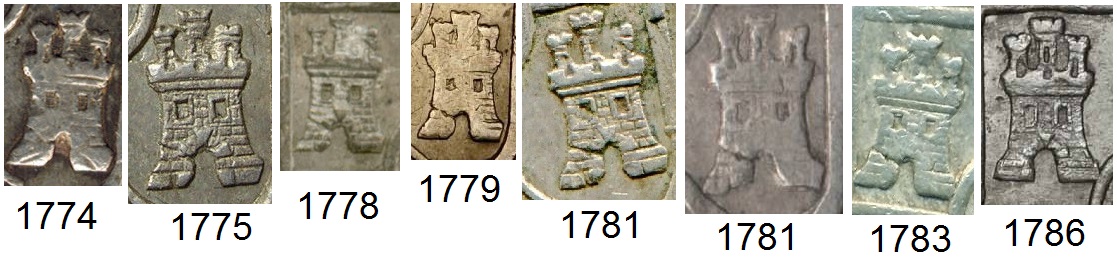 I also noted that for each date there are also other castles that also appear in TPG holders yet these are different designs. |
|
Pillar of the Community
France
1591 Posts |
Robert : the broken castle wasn't on Mexican coins only ?
|
|
Pillar of the Community
United States
5362 Posts |
The Broken Castle was a feature of Potosi coins only.
|
|
Pillar of the Community
United States
5362 Posts |
I was out until after 11PM so I only found 3 dates of the alternative castle for Potosi - these are also graded. 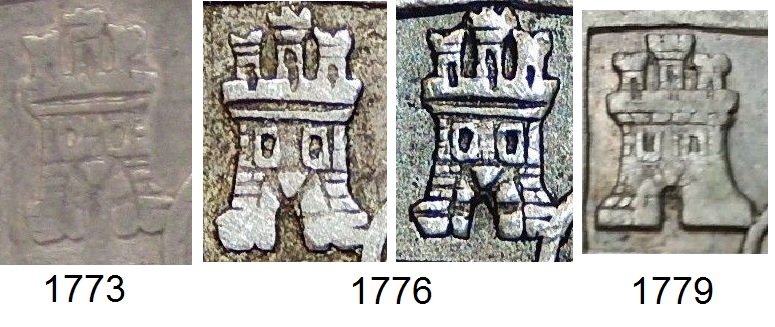 |
|
Pillar of the Community
Hong Kong
1270 Posts |
Hello, please also comment my Bolivian 1775 8R, it looks different in some features with the coin posted in ebay. Is my coin okay? 27.05gr, S.G.10.162 US$120 in Jan 2015 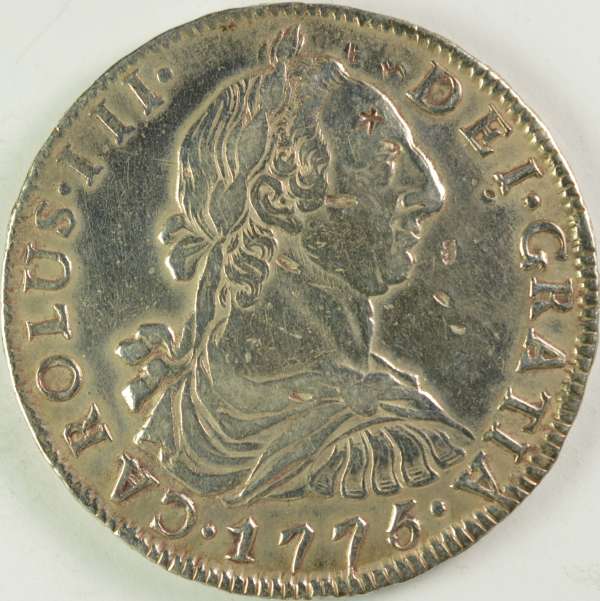 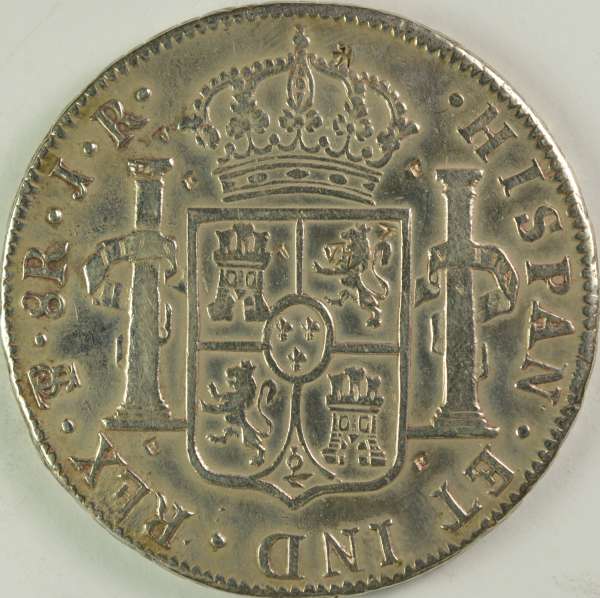 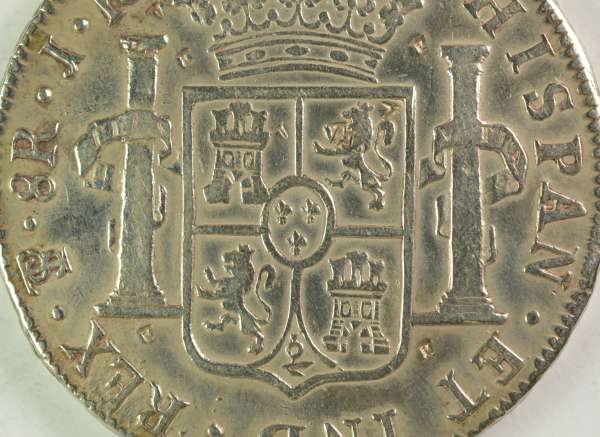  |
|
Pillar of the Community
United States
5362 Posts |
wonghinghi Your coin is the second alternative castle the one I picture above - the 1773 and pair of 1776 coins. The 1779 is what I am referring to as the first alternative castle because it is by far the dominant variety. I am working to classify the dies by type something I have not done for Bolivia before. I did Mexico City for the book. It also made Class 2 counterfeits much easier to isolate by looking for slightly incorrect punch types. Because Bolivia had far fewer counterfeits that found their way to either China or the US I had never done the matrix block reconstruction completely.
There are at least three castles in play from 1773-1779. The broken castle is so far the only one I can positively associate with contemporary circulating counterfeits because while I own several of that type I have never owned one of the other two castle varieties. The "broken castle" is the scarcest die type. I have presumed the others are genuine (because of their substantially higher numbers in PCGS and NGC holders), but have never proven that to be the case. Very few of the alternative castle types are drilled or otherwise cancelled. Badly damaged coins often are the key to discovering counterfeits because that is how they were stopped from circulating.
In 1775 there are very few examples in the Heritage archives so there is no clearly "predominant type" for that year. There are 2 Alternative II castles and one each of the Alternative I and Broken Castle types. Not enough to prove anything.
In other years like 1774 the second alternative castle is unknown compared to the first alternative with 26 and broken castle 2.
The study is very incomplete at this point but should not take too long to complete if the results stay as simple as they are right now. Once I finish the castle comparison I will compare other key punch features to see if there are supportive patterns or not.
|
|
Pillar of the Community
France
1591 Posts |
Robert : ok, my bad, I'm mixing everything (and am not at home with my books :D)
Hum, those broken castle, as on your first picture - are they all related to CCF ?
In the picture above, you say that "they are all genuine".
Couldn't the matrice used have had a break issue, but still be useable ? (metal weakness, causing it to have a fracture there)
I suppose matrices were not changed that often, compared to dies.
|
|
Pillar of the Community
United States
5362 Posts |
If the matrix block itself broke - it would definitely result in a large number of working punches with the image of the break. As the matrix block itself deteriorated the punches would themselves degrade. BUT HOW? You postulate that the break in the castle was a copy of a break in the matrix block. Is that possible?
First consider the fact that the matrix block is actually itself a die. The details cut INTO the block are identical to the image that would be seen cut into the working die. What actually happens if the block breaks is in fact the reverse of what is seen here on these coins. Any punch made after a break in the matrix block would have a positive RAISED feature on the punch. A die made using such a punch would have the OPPOSITE feature a recessed feature. A coin then struck from that die would have a raised crack NOT an incuse crack as we see.
Therefore it was not the matrix block that broke - it had to be a master punch made from the master block that broke. Then the question is "Would such a defective master punch be retained to create more defective working punches?" It is possible of course but why would a mint do that in practice in 1774 which was the second year of production? Would such a defective master be used for over a decade? How then did the regression occur? Without any positive facts this seems no be an unsustainable theory advanced to plead that the coins "could" be genuine. Something of this nature while theoretically possible begs the real question of do the coins we see actually fit that theory?
There are far more coins struck from dies made with undamaged punches that those bearing the defect.
Occam's razor seems to apply here - the simplest answer is usually the best answer. To sustain a complex hypothesis only to support the possibility of an alternative is not really scientific.
The simplest answer is that a counterfeiter possessed a defective punch (perhaps a genuine scrapped master punch). There are cases where dies or punches were sold as scrap only to be used to make nearly perfect counterfeits. This theory fits well with the fact that the appearance of the crack covers over a decade.
Someone is now saying well then it may be the case of similar fractures occurring at an obvious stress concentration point on a die punch. That is a possible theory but in the many hundreds or thousands of dies I have handled over 5 decades - I have never seen a Mexico City die with the same kind of break. None of the branches other than Potosi have the break. Why only one mint? Why only Charles III coins when the same castle was used until 1825? Is this location actually a stress concentration point? I do not believe it is.
|
| |
Replies: 13 / Views: 1,962 |
|




 Posted 05/01/2015 04:33 am





