| Author |
 Replies: 17 / Views: 4,467 Replies: 17 / Views: 4,467 |
|
Pillar of the Community
United States
3229 Posts |
I think I am seeing overlaps but the lack of gold points to it being a Class 2. What do you think? As a side note, the guy at the shop said it would not have any gold. The table top machine he used measures to 100th of a percent. 1788 Carlos III, 8 Reales. 26.71 grams; 28.75 mm; Specific gravity = 10.27 Silver=92%; Gold=0.0%; Copper=7.4% 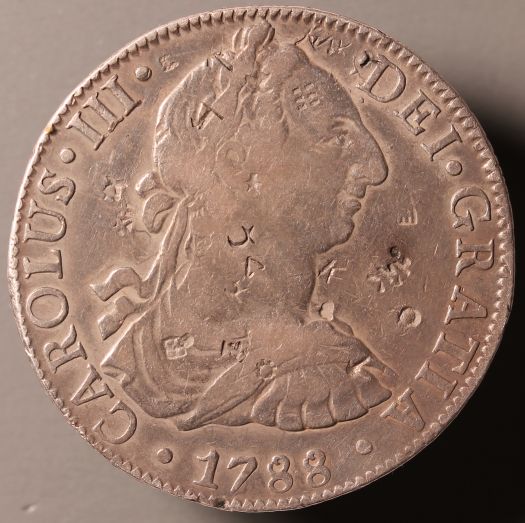 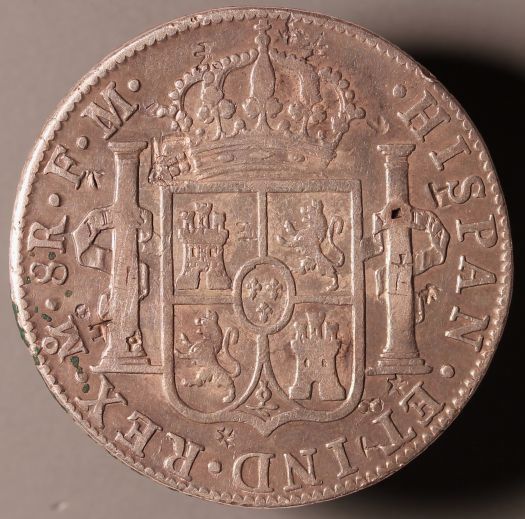 1. Overlap?  2.  3.  4.  5. Overlap  6.  7.  8.  Edited by TJsCoins
06/14/2015 09:54 am
|
|
|
|
Pillar of the Community
United States
6370 Posts |
Chopmarks are a good sign for these.
|
|
Pillar of the Community
United States
6478 Posts |
 I think legit. |
|
Pillar of the Community
United States
1801 Posts |
Chop marks mean nothing in trying to determine the legitimacy of an 8 reales coin. Fake coins are chopped to fool collectors just like fake coins are toned. Weight, specific gravity test and careful visual examination are the keys. I would be concerned about this coin because I do not see two clear overlaps on the edge that are 180 degrees apart.
|
|
Moderator
 Australia
16898 Posts |
Quote:
Silver=9% I assume there's some numbers missing, there. If not, then it's definitely fake.  Don't say "infinitely" when you mean "very"; otherwise, you'll have no word left when you want to talk about something really infinite. - C. S. Lewis
|
|
Pillar of the Community
 United States
3229 Posts |
Quote:
I assume there's some numbers missing, there. If not, then it's definitely fake. Thanks for catching my error. It is 92% silver. |
|
Pillar of the Community
United States
3229 Posts |
Quote:
I would be concerned about this coin because I do not see two clear overlaps on the edge that are 180 degrees apart. Edge photo #1 is 180 from edge photo #5. One of the rectangles (just rt of center) in photo #1 looks like a possible yet certainly questionable overlap. Photo #5 I think shows a clear overlap, but it looks like a circle over a circle. I do not yet have enough experience to fully judge overlaps. I am not sure how distinct overlaps should be. |
|
Pillar of the Community
United States
2543 Posts |
If it is a contemporary counterfeit, it seems to be a good one. These coins were edged by rolling them through parallel dies, while the overlap is slight, the odds are that every once in a while, the coin will be edged so that the pattern lines near perfectly.
|
|
Pillar of the Community
Hong Kong
1270 Posts |
IMHO, the chop marks looks antique and not a new addition on the coin definitely so modern forgery must be ruled out.
It is either a 2nd CC or real piece.
I tend to believe the chop marks are real so, if it was a 2nd CC (probably made between 1830-1930), Chinese chop marks were not popular for that era as the money assayers were capable of determining the coin had sufficient silver or not.
The edge circle-rectangle pattern still looks good so I think this coin is more likely to be genuine.
Henry
|
|
Pillar of the Community
United States
4883 Posts |
Based on the data/images, it seems likely that it's neither genuine (in the sense of its having been struck in Mexico in 1788), a contemporary counterfeit, nor a modern forgery. That would seem to leave only its being a 19th or early 20th century "restrike" - but that's just my relatively unlearned opinion, swamperbob is obviously the person who needs to see this one.
Colligo ergo sum
Edited by Lucky Cuss
06/16/2015 6:26 pm
|
|
Pillar of the Community
United States
5362 Posts |
I agree with Lucky Cuss.
The statement that the XRF apparatus measures to 1/100 percent is sufficient to indicate that the coin was not made in Mexico during the patio process / cuppellation era.
Because there has been a lot of well intentioned push back on my gold theory I have been assembling a factual defense. There are some key points that were not raised in the book. The most important of these is that gold is soluble in silver and silver is soluble in gold. The "alloy" of gold and silver is NOT a suspension or a mixture - it is in fact a solution. When heated to a liquid state gold does NOT completely sink to the bottom even if a centrifuge could be used!
The XRF tests of all of the mines that contributed to the Mexico City output (several hundred of which have been published to date) indicates that there was both gold and silver in the ore. The amount varies but is never so low that the "gold must be present theory" does not apply.
In Mexico City the primary source of silver used for coining 8Rs was the Vallenciana mine located in Guanajuato. Over 60% of all silver coined at Mexico City during the 1780-1810 era came from the Vallenciana.
Lets say typical silver refined at the Vallencia mine was used to make coins in Mexico City (2.8% gold being average for that output) - lets even say that a ratio of 50% silver from other sources was melted into the mixture before parting at the mint. Even presuming the added silver had NO gold at all - the final melt would still have 1.4% gold. The cuppelation process used in parting gold from silver could reduce this contamination to roughly .02% but no lower because the gold and silver were soluble in one another.
The processes needed to finally achieve 999 fine gold and silver were not developed until nearly 1880. So the only reason a Mexico City silver coin would not test for gold is that it was NOT made in Mexico City before 1880.
I believe that case is settled to the point of a reasonable doubt at this point. Anyone caring to dispute the claim really needs to come up with some scientific or historic facts to back up their position.
Other mints will need more research to be as sure but the XRF tests I have located so far all show contamination above 0.02 gold.
Numismatics needs to become a more science and history based undertaking. Opinions based on nothing have no validity.
|
|
Pillar of the Community
United States
5362 Posts |
A couple follow-up comments.
There is clearly an overlap between the 7 and 8 of the date. It is about 2 segments in length.
The point where an overlap should occur (center of the laurel leaves) does NOT match the very short overlap between the laurel leaves and D.
The coin also has an SG close to Sterling silver. I would postulate that it is a Class 2 coin made with scrap English Sterling for the China market at a point in time when silver prices had fallen below monetary levels. This would place the production date at approximately 1870.
|
|
Pillar of the Community
United States
3229 Posts |
Thank you all for your replies.
Swamperbob, thank you for the detailed information.
|
|
Pillar of the Community
Hong Kong
1270 Posts |
Thank you swamperbob your detailed information and the underlying principle.
I have no intention to suspect your theory is wrong or not. But as a general reasoning, why did the money user/assayers applied chops on the coins? Any chops on the coin would depreciate its nominal value.
It is also crazy to imagine at the era of 1870, people in China would use the money of the year 1788 (one century ago)? Is it logical? At these years, Mexican eagle dollars was overwhelming in the money markets at most parts of China.
Henry
|
|
Pillar of the Community
United States
5362 Posts |
Henry - what you say may seem logical - however, based on actual written records from the time period it is simply NOT what actually happened. It may sound crazy to you but the preference for old Portrait coins is very well documented until 1900 and even after. Why chops were applied is always a guess and it is really not critical to my argument. Perhaps the coins left the area where they were preferred and were traded as silver. I do not know - but that does not make the theory crazy. Regarding the circulation of a coin 100 years after it was issued - that happened many places and at many different times. In England during the War with Spain 1796-1804 it was commonplace to see coins of Elizabeth I in circulation. That was not 100 years but 200 years or longer. Portrait 8Rs of the Charles III and IIII type were preferred by SOME BUT NOT ALL merchants until 1930-35. That is a very well established fact. The preference was regional. Without written factual proof to the contrary history must stand. You are providing only speculation that has no factual support at this time. If, as you seem to believe, the Mexican Eagle Dollar was the standard in China in 1870 why were there weekly quotations in San Francisco, London, New York and Shanghai for BOTH Eagle and Portrait dollars? These printed records were thoroughly documented by Bailey and Zhao in 2009. http://papers.ssrn.com/sol3/papers....t_id=1424070 What is the basis on which Bustman dollars traded for 15-20% more than Eagle dollars if they were not still actually being used? Who in their right mind would document prices weekly for commodities that did not circulate as money. If the Portrait dollar was simply an accounting tool not tied to the actual coin as some experts have maintained - why did the ratios change? You can make theories but until you find proof you have nothing but stories that "SEEM" logical. What I am advocating is a new way of looking at authentication that relies on science and history. A method that relies on facts not on unsubstantiated statements. When we submitted the book to the ANS we got a rejection based on numerous incorrect assumptions. They even had the gall to tell me that my cover coin was GENUINE! |
|
Pillar of the Community
Hong Kong
1270 Posts |
I know I have my own limitations, I am unable and also un-want to topple your theory. The theory of "Contemporary counterfeits" is awesome in fact. It helps to explain a lot of discrepancies in many Spanish colonial portrait 8 Reales. I have about 50+ of these coins. Though some of them are well-struck, ancient-felt, surely not modern forgery, have different silver (other metals) contents even just by a simple ring test. Coins of same year, same mints shows different rings. How come the difference? That's the beautifulness of your theory tells contemporary counterfeits present behind the originals. Bob, you have built up a theory, though you are so confident you are right. I think there's still time to go, to be "tested" and confirmed by more collectors. What I disagree with you is this 1788 8 Reales. You seems to use the XRF results as a coffin nail, you jump to your conclusion too early. There is my own 1788 8 Reales here. There are very nice Chinese merchant chops on it. Though I can't find two exact opposite edge overlaps there, I still have confidence it is an original. The overall of the coin is good and the chops are also the good time identification. How do you think my coin, Bob? 26.92grams, 38.3-38.7mm, S.G=10.193 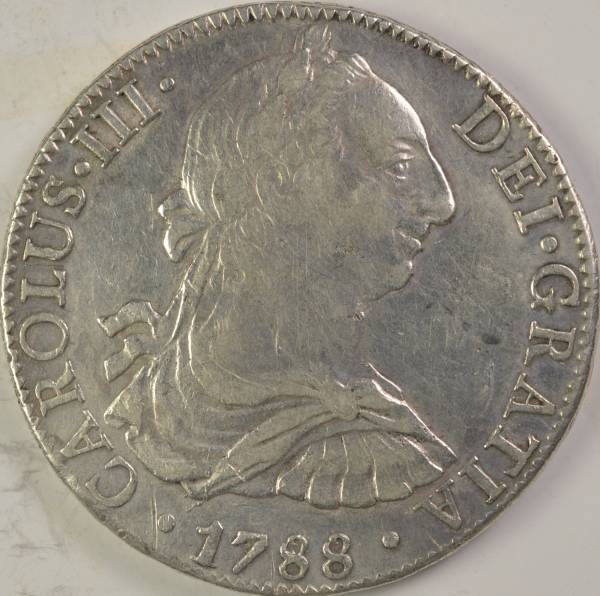 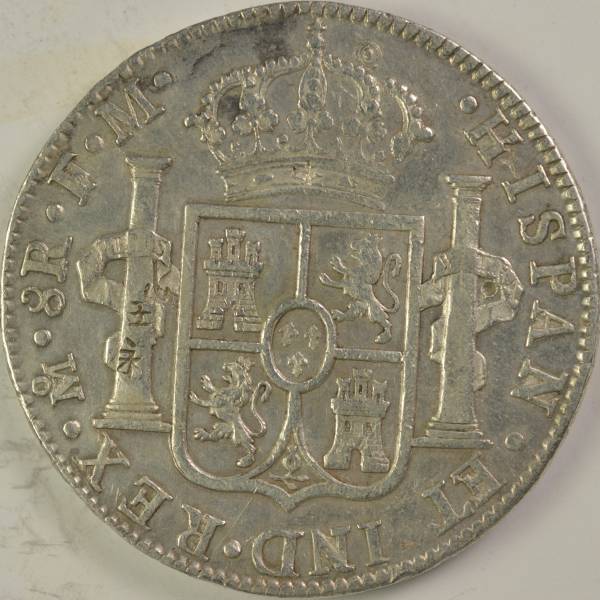           |
| |
Replies: 17 / Views: 4,467 |







 Posted 06/13/2015 8:00 pm





