| Author |
 Replies: 18 / Views: 3,273 Replies: 18 / Views: 3,273 |
|
Pillar of the Community
United States
3843 Posts |
Looking to add some early copper to my collection and since it is far from my usual areas of collecting I'd like to tap the collective knowledge of the forum. I've noticed that early large cents are seemingly difficult to find and expensive in nice problem free condition. I've always wanted to get a nice 18th century large cent and there is a upcoming auction in my area that has a few available. Obviously this would be a major purchase.
What would a problem free 1794 large cent in mid VF command at auction? I've heard that some of the price guides significantly undervalue early copper and that auction hammer prices are often at a significant premium to guide .... Is this true?
|
|
|
|
Bedrock of the Community
United States
12057 Posts |
There were 5 major varieties in 1794 alone, not including countless sub-varieties.
1794 "Head of 1795" in VF-30 have been getting around $2.2-$2.8k for a basic, plain-jane VF30 of a common variety.
Slightly more common "Head of 1794" in VF-30, $1500-$2100 this year in 2 Heritage auctions. That's a good guide for your bidding.
Problem-free coins in NCG/PCGS or sometimes ANACS holders will always be worth more than book, whether you're using Numismedia, CW, or whatever. When you're in a market where 90% or more of coins come back with Details grades, the premium for those problem-free coins is very substantial. A single 1794 "head of 1794" in "low collector grade" F-12 will still hit your wallet to the tune of $800 to $1200.
When you start getting into varieties, those prices become mere suggestions, and records get shattered by die variety collectors, etc.
A popular but extremely rare variety, the Starred Reverse, of which 2 are known to exist by PCGS in VF-30, sold in August of last year at S&B auction for "only" $129,250.00. The finest known is an AU-50 example, a single coin "book valued" at around $632.5k but that would probably bring $750k to $1m+ on the auction block if it ever was offered for sale.
That being said, with this sort of coin, in the grade you seek, don't buy anything not in a PCGS, NGC or ANACS holder unless you can afford to gamble your investment and not care if you lose your money. There are people, some here, too, on these forums, that can get away with picking up raw early copper, but they have years and years of experience and tons of reference material, and lots of hands-on. Someone who is new to EAC is likely to get in trouble quickly with raw early copper.
If you are interested in this area, I highly recommend that you join EACS, it's not that expensive and has some of the most knowledgeable people in numismatics on its roster.
Member ANA - EAC - TNA - SSDC - CCT #890 "Most of the things worth doing in the world had been declared impossible before they were done." -- Louis D. Brandeis |
|
Bedrock of the Community
United States
17884 Posts |
Quote:
A popular but extremely rare variety, the Starred Reverse, of which 2 are known to exist by PCGS in VF-30, sold in August of last year at S&B auction for "only" $129,250.00. The finest known is an AU-50 example, And that AU-50 coin is a stripped and recolored XF. |
|
CCF Sponsor
United States
702 Posts |
Yes, as has been detailed well here, varieties can count for a lot in 1794s, and thus the difference between price guides and hammer prices.
Furthermore, condition is tricky with big old coppers, and the TPGs don't always get it right - though the general trend is that they are getting better. Look for an EAC grade if you can, almost all coins will have a net grade and the few that don't will command a serious premium.
I would go to a show and find the big copper dealers and talk to them and look at their wares. You can get deals at auctions, but they're definitely hard to find. It's almost always a good bet to look at a coin (or a few - or a lot!) in person. Most of the big copper dealers will give you an honest opinion and seeing and handling the coins in person will help your understanding significantly.
|
|
Bedrock of the Community
United States
94367 Posts |
Scropper's advice is sound. Search out EAC dealers at shows and spend some serious time learning the subject first hand. If you're only going to own one. then pay up and buy a nice one. You will never regret it.
|
|
Pillar of the Community
 United States
2367 Posts |
Getting back to the original question about 179x coins in problem free condition. I love these old coppers but based on my limited budget I needed to make some compromises. Here's what I did. I purchased some 1794s in details grade (most of the 1794s being sold would grade details). I also bought a 1796 problem free coin for comparison. I paid so much more for the 1796 based on the BN grade but the net grade is much lower than the 1794 details coins I own. I have both details and RB and my take on this is that I prefer a details coin that is graded higher details because of a technicality rather than a BN 179x coin. OK, maybe this makes a difference - I'm a collector and not interested in resale as a dealer. Just my opinion of course.  Example of Details   Example of BN   Member ANA and EAC "You got to lose to know how to win". Dream On by Aerosmith Edited by cipster
07/03/2015 1:48 pm
|
|
CCF Sponsor
United States
702 Posts |
cipster - beauties both!
You had me really going though, for a second - "Whoa, what, a Red-Brown '96! WOW! Oh... wait..."
: p
Both beautiful coins! And an RB '96 is several orders of magnitude over my current pay grade. Danged lottery tickets still not working...
The other thing that's fun about '94s is that the varieties can be so completely different. Same design roughly, but with a completely different look and feel!
|
|
Pillar of the Community
United States
2367 Posts |
Quote:
You had me really going though, for a second - "Whoa, what, a Red-Brown '96! " Sorry, yes - BN not RB  Member ANA and EAC "You got to lose to know how to win". Dream On by Aerosmith |
|
Bedrock of the Community
United Kingdom
19146 Posts |
Funnily enough, I've just come across an interesting reference to 1794 cents in an old coin book I've got, "Pocket Money Guide", published in 1968:
"When Charles Winn returned from America to his family home, Nostell Priory in Yorkshire, he put his American loose change away in a drawer. That was in 1794. 170 years later, Winn's descendant, Lord St Oswald, came across those coins. Among them were two of the rare American dollars of 1794, as well as a handful of the equally rare 1794 copper cents. At an auction in 1964, the two dollars fetched four thousand pounds each, and the best of the cents sold for three thousand pounds."
|
|
Bedrock of the Community
United States
94367 Posts |
Ad I recall, the pound was worth a lot more back then, maybe closer to $5. Must have been quite a cent!
|
|
Bedrock of the Community
United States
17884 Posts |
They are, the Lord St Oswald coins are well known
|
|
Pillar of the Community
United States
9811 Posts |
I fell in love with 1794 Large Cents last year, I own a couple now, only AG/G though. Since they've priced me out of the market on most of them, I collect the next best thing, literature on them. At the EAC convention this past spring, (my first) I was talking with Chuck Heck (EAC member and member of the boyz of 94 club) he told me they used to give 1794 low grades away to the younger members all the time, but now it's just not feasible, as even AG coins are close to $100 or even more now. Sure wish I had put away a stack of them 10 years ago.
"Buy the Book Before You Buy the Coin" - Aaron R. Feldman - "And read it" - Me 2013! ANA Life Member #3288 in good standing since 1981, ANS, Early American Coppers Member (EAC), Colonial Coin Collectors Club member (C4), Conder Token Collector Club member (CTCC), Civil War Token Society (CWTS) member, Liberty Seated Collectors Club (LSCC) & Numismatic Bibliomania Society member (NBS), USMex, Member in good standing, 2¢ variety collector. See my want page: http://goccf.com/t/140440 |
|
Pillar of the Community
Germany
1856 Posts |
Like you, westcoin, I too regret not having 'stocked-up' on 94's when I started collecting in the mid. 80's. They were certainly lower priced back then, even if it still seems like they were not exactly cheap, at least not in relation to my disposable income at the time. Also, I got distracted with other issues, like 1796's for instance. Given the current price levels for 'decent' (no corrosion or other defects) 1794 cents, I think a suitable compromise is to buy 'details' coins that retain a generally good appearance, but cost a fraction of the better examples. This would be an example of a details coin - yes, it has spots of red corrosion, minor edge nick, and scattered shallow pits on the reverse, but is still a pleasure to look at (at least for me!). I Paid what I consider was a reasonable price for it. S-41, R-3. 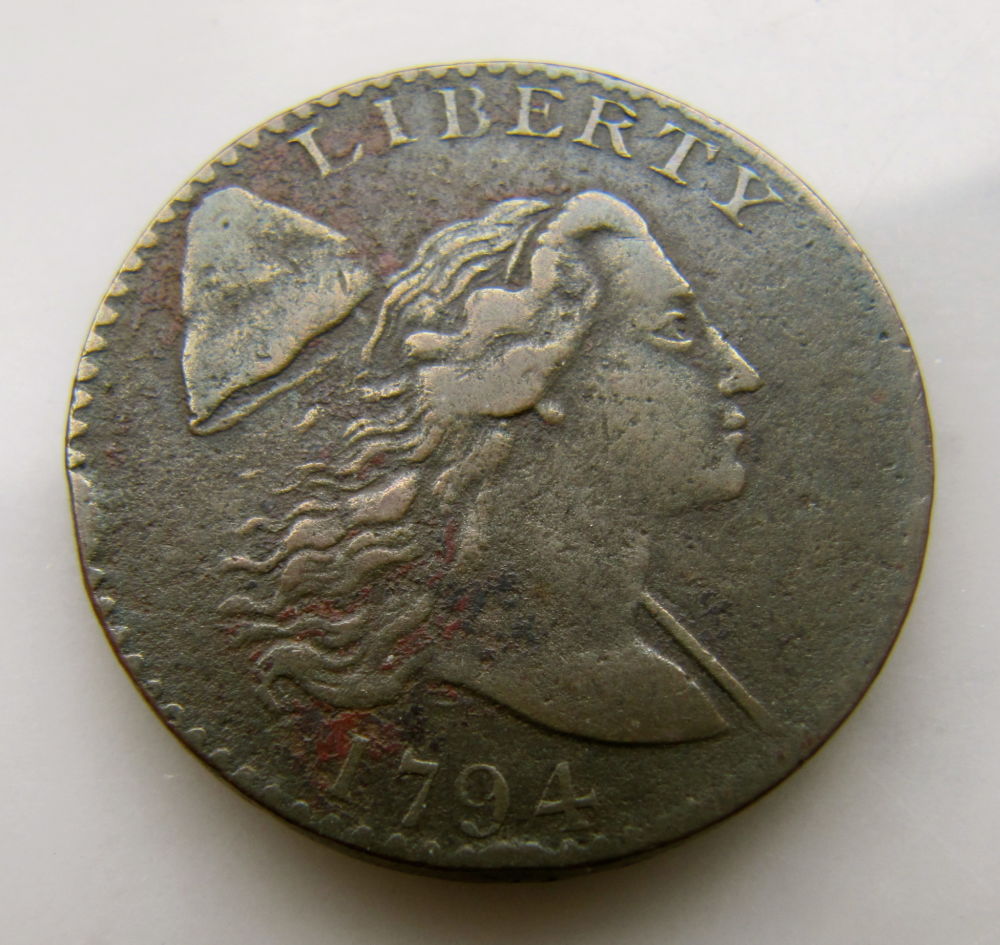 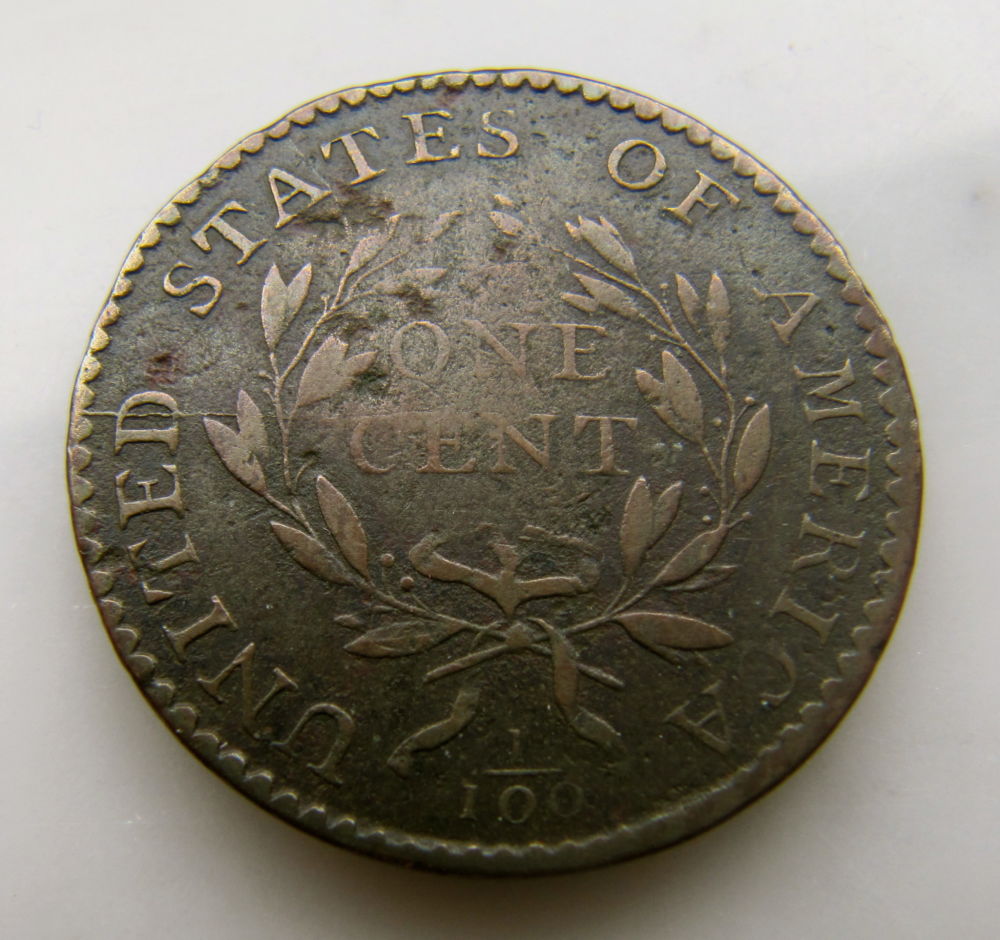 Edited by GERMANICVS
07/06/2015 08:45 am
|
|
Rest in Peace
United States
17900 Posts |
A wonderful and enlightening discussion. I've pushed my EAC buying back to 1802 and I'm only missing two dates after that. Those earlier are so top of the line blue chip that I just can't consider purchasing any of them with problems (usually corrosion). They far exceed my own maximum spending limit of $200 for non-TPG purchases. With only a few exceptions I keep that limitation and only buy +$200 coins in TPGs.
I do buy a few 'type coin' series that I believe I know well beyond that limitation in raw state, but I don't count EACs as one of those series.
When I'm putting (what I consider) a larger sum into a single coin I always keep in mind that at some point either I or my heirs will sell the coin. If the coin is lovely it will always garner interest and desire. The more collectors who would want the coin, the greater chance that it will maintain value.
Even though the early EAC in no problem TPGs are fought over and garner considerably higher prices and much greater interest I look at that as a primary reason to keep my patience and wait for those superior examples.
When I look at the coins in my collection I want each of them to be good reasons for keeping a box of drool rags close at hand.
|
|
Pillar of the Community
United States
9811 Posts |
Quote:
Even though the early EAC in no problem TPGs are fought over and garner considerably higher prices and much greater interest I look at that as a primary reason to keep my patience and wait for those superior examples. That's the way to collect that will pay off in the long term, big time!  "Buy the Book Before You Buy the Coin" - Aaron R. Feldman - "And read it" - Me 2013! ANA Life Member #3288 in good standing since 1981, ANS, Early American Coppers Member (EAC), Colonial Coin Collectors Club member (C4), Conder Token Collector Club member (CTCC), Civil War Token Society (CWTS) member, Liberty Seated Collectors Club (LSCC) & Numismatic Bibliomania Society member (NBS), USMex, Member in good standing, 2¢ variety collector. See my want page: http://goccf.com/t/140440 |
|
Pillar of the Community
United States
3369 Posts |
Buy what YOU like. I somewhat regret selling a VF details 1795 because you could see pinscratches under a loupe. It was a nice coin in-hand.
I say this because of liquidating an estate collection of modern proofs. None of the heirs wanted them. They had value for the gold eagles, not because they were collectable. The same is true of 1794 cents. What's an heir going to do with them? They could end up in a yard sale or a dumpster and you can't stop them. I lost track of the number of trips to the transfer station carrying Dad's treasure heap.
"Two minutes ago I would have sold my chances for a tired dime." Fred Astaire
|
| |
Replies: 18 / Views: 3,273 |







 Posted 07/01/2015 4:57 pm


