| Author |
 Replies: 11 / Views: 2,317 Replies: 11 / Views: 2,317 |
|
|
New Member
Italy
13 Posts |
Hi collectors, my name is Andrea, I'm from Italy and this is my first message in this forum. I'm basically a collector of world coins from XX century, but last week I was fallen into temptation and I acquired a coins that I was looking for many time: a columnario. In particular, an 8 reales minted in Mexico for the king Carlos III in 1761. This pice should be rather common, and I bought it in an auction, so I'm quite confident that it's genuine; but I saw that there are a lot of forgeries of this tipology of coins, and I would ask your opinion about it, because I know that there're some experts of these issues here. Its weight is 27,0gr (sorry, but my scale can't be more accurate). I hope that the pics can be clear enough, to take a picture of silver is not easy for me. Thanks in advance to anyone who will bring his opinion in my topic. 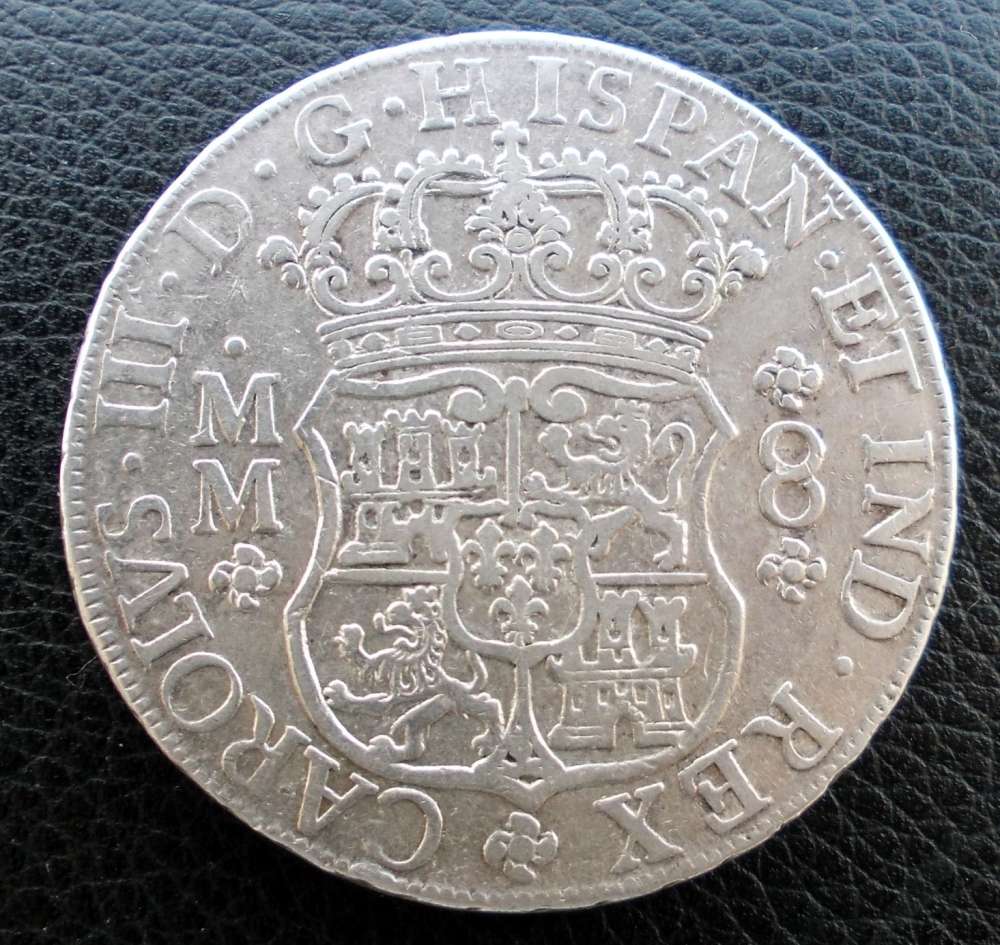 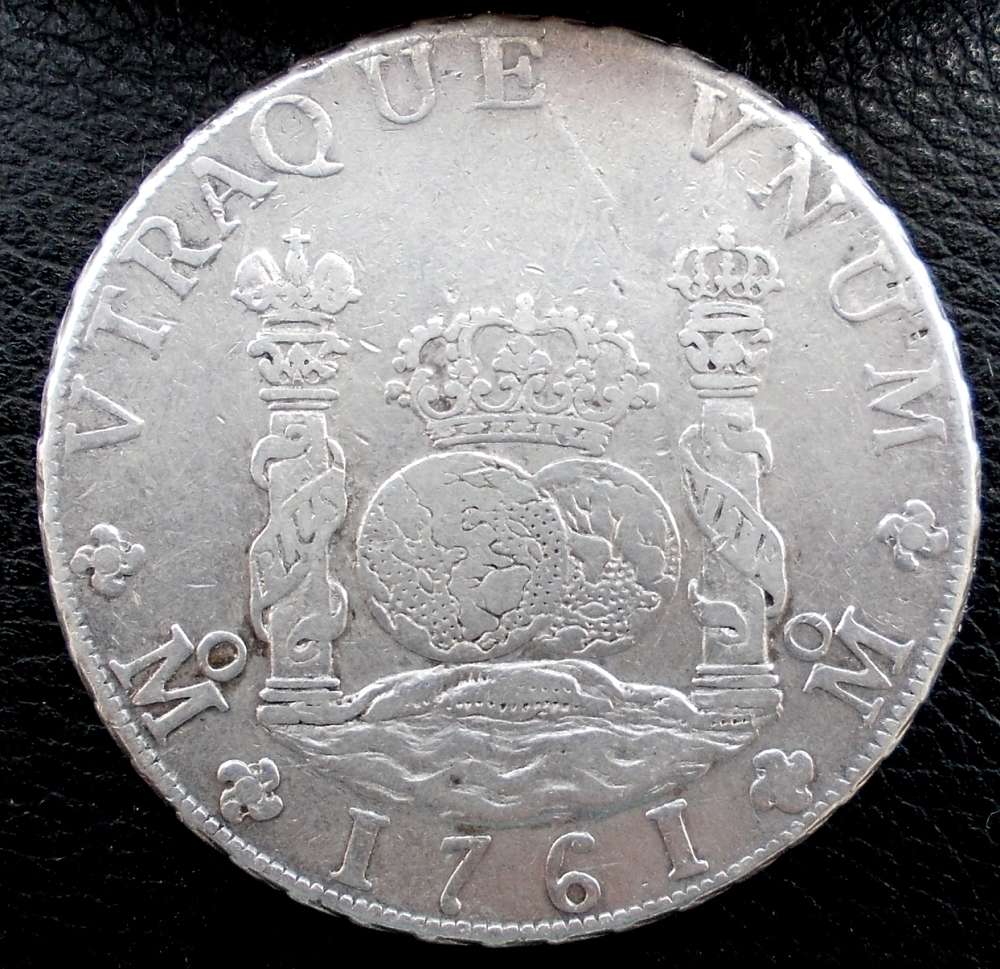    |
|
|
|
Pillar of the Community
Hong Kong
1270 Posts |
No problem to me so I agree it is real. Henry
|
|
Pillar of the Community
Austria
566 Posts |
|
|
Pillar of the Community
United States
5362 Posts |
I see nothing that makes me really suspicious.
I would however, always advise weighing and determining specific gravity. Your results should be about 26.4 to 26.8 grams and the density should be 10.31.
It should also contain roughly 2,000 ppm (0.02%) of gold at a bare minimum which is enough to register quite easily on a hand held XRF tester. See if a local coin dealer or jeweler has one.
|
|
Pillar of the Community
United States
4883 Posts |
First off (since nobody has said it yet), welcome.
Let me next remark that swamperbob is a guru on coins of this type. That said, the only thing that seems a bit odd to me is the very uneven spacing of the letters in "VTRAQUE" - which may mean nothing, but I'd sort of want to see a certified specimen that exhibits the same peculiarity.
Buying these raw, even at auction, is risky business - they've been counterfeited extensively for a very long time. As suggested above, if you can have its composition analyzed via x-ray fluorescence, that'd be definitive.
Colligo ergo sum
|
|
Pillar of the Community
Hong Kong
1270 Posts |
One day coins collection would become science. Very ironic!
|
|
Pillar of the Community
United States
5362 Posts |
Henry - Actually a scientific approach is long over due. Coin collectors of modern world coins (1770 is considered modern) are far behind collectors of ancient coins in this regard. Museums have been using the approach for artifacts for nearly 3 or 4 decades.
The reason we need science is for protection against forgers who have many new capabilities in this digital age.
|
|
Pillar of the Community
Hong Kong
1270 Posts |
Bob,
I am working as a medical technologist in a public hospital. We always face a problem of accuracy of results and reproducibility of a test. Same argument would also happen in XRF and S.G., how accurate your test is?
I don't always resist scientific methods to confirm metallic contents in a coin but sometime it is obvious that a coin is fake or is genuine. Then the use of another method to confirm is an excuse to face a question. On the other hand, we are not sure in two hundreds' years ago, a mint or a mint master had a good faith to mint coins with absolute good enough silver used? Some coins of Croatia Ragusa crowns had S.G. as low as 10.0 are still genuine coins.
Scientific data is a reference to determine a coin is genuine or not but I still rely on the craft or skill of a coin minted. The experience of determining a coin is fake or not needed to be succeeded generation by generation. I am deeply impressed by the sentence in your book : Wally always believed in helping children and teens to develop their interest in coins because he knew they were the collectors of the future. Without new collectors numismatics will die.
I am always appreciated to those share their experience on numismatics unselfishly and would be willing to publish a book even though via the countless difficulties, like you.
I have also published my coin book in HK last year (nearly the same time as yours). My aim is to arouse coin collectors and history fans to know more about the importance of coin (actual silver coins in my book) in histories. The feedback is of course not better than yours.
Please forgive my grumblings.
Henry
|
|
New Member
United States
17 Posts |
Looks like the real deal to me. Congrats on your purchase, I've always liked these.
|
|
Pillar of the Community
United States
5362 Posts |
Henry Test accuracy.
The XRF tests were done in three different labs. The most recent RTI used a new state of the art apparatus that can get accurate repeatable results to 10 ppm or 1 ppm depending on exposure time. Earlier tests were less precise based on the particular apparatus. But even the tests I did using a first generation lab XRF were accurate to the limits of the machine which in 1996 was about 1,000 ppm. I always used control coins like my 1805 Mo TH Class 2 which has now been tested 6 times. The earliest machines read no gold for that coin because they were not precise enough but this new machine found 12 ppm. That is the first time the coin has tested with a detectable level of gold. The 12 ppm is 0.0012% a very low level for Mexico City during the patio period.
For SG I use different scales. I have a cheap digital where I run tests in a few seconds. These will vary but not outside the limits I need. Almost every coin that I get I check with an Ohaus 4 beam 1/100th gram mechanical scale. Most counterfeit coins can be tested on that 1/100th gram scale because I am looking for SG expressed to three significant figures 10.3 or 10.2 or 10.1. When I am trying to get a more precise result I need to use a 1/1000th gram analytical scale. I use that scale on rather rare occasions because XRF is easier. The scale is getting old and I have been having some problems in set up. I think I need to buy a new one but they are not cheap.
Just like XRF testing with hand held guns - you can pick out the really bad coins - perhaps 98% need only a 1/100th scale or a hand held XRF - but on more difficult coins like Class 2 made before 1870 you need a 1 to 10 ppm XRF or a 1/1000th gram scale. So far I have not had many problems with repeat-ability of my tests.
Regarding debased coins made in the mint (frauds) I am open to the possibility they exist but I look for records to prove it. If no records exist documenting a coin as debased at the mint (unlike the 1828-1829 Ga or 1834-1836 Go or 1834 to 1835 Zs coins which were documented at the time) I become suspicious that the coin is counterfeit - a fraud that originated outside the mint. I have seen too many counterfeits passed off as debased when they were just plain counterfeit. They are also called test strikes or patterns but these labels are also given out too freely.
I think I have seen too many scams and have known too many forgers and counterfeiters to blame mint officials easily.
|
|
New Member
 Italy
13 Posts |
Thanks very much for your kind and precious replies. Surely, I'll check weight and density of this coin with more precision; XRF tester sounds more difficult to me, because I live in a town and I don't know if any jeweller has the instruments to do it in my province. Lucky Cuss pointed out the detail of the uneven space of the letters in the word VTRAQUE: thanks, it's a particular that I didn't notice before (it's clear my inexperience with this coinage). I tried to view more other piece of 8 reales, still from Mexico and still from 1761, and I saw that this trait marks also other coin. One in particular shows exactly the same configuration: http://www.acsearch.info/image.html?id=2001756Your opinion about it? I don't know if in future I'll acquire other pieces of this fascinating tipology: they're quite expensive for my standard and, as you said, they've been counterfeited extensively, so it's necessary to be very experienced to collect them seriously. Anyway, could you suggest any books or websites where I'll be able to reach some informations in depth about them? |
|
Pillar of the Community
United States
4883 Posts |
That at least one other example exists that's considered genuine and visually matches up well with the characteristics displayed by yours goes a long way toward validating your specimen.
Colligo ergo sum
|
| |
Replies: 11 / Views: 2,317 |
|







 Posted 07/10/2015 11:18 am





