Coin Community Family of Web Sites Join Thousands of Coin, Bullion, & Money Collectors
Specializing in Modern Numismatics Coin, Banknote and Medal Collectors's Online Mall 300,000 items to help build your collection! Join Thousands of Coin, Bullion, & Money Collectors Shop for APMEX Bullion on eBay!Royal Canadian Mint products, Canadian, Polish, American, and world coins and banknotes. Vancouvers #1 Coin and Paper Money Dealer


Username:
Password:
Save Password
Forgot your Password?


This page may contain links that result in small commissions to keep this free site up and running.

Welcome Guest! Registering and/or logging in will remove the anchor (bottom) ads. It's Free!

Gold As A Marker For Early Silver Coins

To participate in the forum you must log in or register.
Author Previous TopicReplies: 30 / Views: 4,481Next Topic
Page: of 2
Pillar of the Community
swamperbob's Avatar
United States
5362 Posts
 Posted 07/11/2015  03:16 am Show Profile   Bookmark this topic Add swamperbob to your friends list Get a Link to this Message Number of Subscribers
Since my book came out it seems there is nearly endless comment (conjecture) about my theory that a minimum of 200 ppm (0.02%) gold must be present in any coin made from silver produced by the Patio process followed by cupellation and roasting. I used that 200 ppm threshold to distinguish between genuine silver coins of Mexico made in the colonial era (before 1830) and the Contemporary Circulating Silver Counterfeit coins made in the UK and US for the China trade after 1830.

Most of this criticism comes in the form of "what if" scenarios that postulate the possible melting of older silver or the use of pure silver from other indeterminate sources. The only references to "published works" have been the general statements that XRF tests failed to be able to identify which mines silver came from. That final comment is stated as a true-ism and has appeared in print many times.

So I have been examining the subject, in particular, the studies that rejected the XRF trace contaminant methods and discovered that most of the scholarly objections dated from the 1980s and earlier when XRF was in its infancy. Most "scholars" have now abandoned that position as thoroughly discredited. But the old incorrect ideas die hard among the laity. In that context I think of "flat earth" or the sun revolving around the earth. Clinging to older comfortable theories and resisting scientific change is especially difficult when your own eyes and expertise tend to fool you.

The silver counterfeits have been around so long (last produced in 1930-1935) that they have been part of the numismatic scene and have been so for our entire lives. I presume there are no living collectors who were active in 1935 on this forum. The silver counterfeit 8Rs have been routinely accepted as genuine because there were no visual clues to the forgery. They are like the flat earth or the earth centered universe because our senses seem to confirm the obvious but INCORRECT things we see.

As part of my studies, I have uncovered new tests done by researchers working on silver objects dating from 1580 to 1900 that not only supports the position I took in my book, but indicates I was actually far too conservative in using 200 ppm as a cut off figure. Their testing indicates 2000 ppm or 0.2% is a better estimate of the required gold content in all silver refined and processed before the advent of the Parkes process in 1850 in the UK. The Parkes process was a method of removing lead from silver that was unnecessary in Mexico because the ores were different. So in the UK and elsewhere in Europe it was possible to refine silver to 99.8% fine - but NOT in Mexico.

The study also indicated that other standard contaminants which appear to be universal in identifying "old world" silver exist which can also be used to knock off modern forgeries and to differentiate new world silver from the old. I believe these added trace contaminants will finally be able to isolate the UK produced silver counterfeits from the Chinese or US versions.

The Parkes process was the first refining and parting method that was capable of producing silver that was 99.8% pure anywhere in the world. It superseded the patio, cupellation and roasting methods employed in Mexico which could not reach as high. I have run into estimates of about 99.3% fine as a limit.

The document itself is found in the Journal of Analytical Atomic Spectrometry 1999 entitled
Quote:
Determination of Impurities in antique silver objects for authentication by laser ablation inductivity coupled plasma mass spectrometry.


http://pubs.rsc.org/en/Content/Arti...!divAbstract

http://projects.itn.pt/HisCudo/13.pdf

The authors are W. Devos, Ch. Moor and P. Lienemann.

As I first read the complete text about a week ago I was struck by the correlation of their scholarly work and my "amateur" studies made before 1999 with the help of a good friend (Mark Amaral) who worked in the lab at the Plymouth, Mass nuclear power plant. Mark had access to a then state-of-the-art XRF machine accurate to 1000 ppm. He was not a coin collector but he liked my idea of potentially identifying genuine vs counterfeit coins by finding trace contamination and agreed to help me test my theory. After that summer of experimentation with coins, new and old, genuine and counterfeit, we together reached the same conclusions as the paper cited above.

I am no great scholar and the correlations may be somewhat coincidental but this new peer reviewed study should finally end debate on the issue.


Quote:
GOLD ON THE ORDER OF 0.2% MUST BE FOUND IN ANY SILVER COIN THAT ACTUALLY DATES BEFORE 1850.


The paper notes the advent of an electro-chemical process in 1884 which increased the purity levels to 99.9999% pure. This process is a combination of the Miller process of 1860 (99.95% pure) and the 1874 Wholwill process (99.999% pure).

I have to presume that the 1884 date was a reference to the introduction of the merged processes in the UK. The added 4th 9 after the decimal point was likely attributable to the 1884 date which is ten years after the 99.999% estimate. The two processes were used one after the other in relation to the Comstock lode in Nevada and for the first time silver purity reached truly modern levels.
Pillar of the Community
thq's Avatar
United States
3343 Posts
 Posted 07/11/2015  07:42 am  Show Profile   Bookmark this reply Add thq to your friends list Get a Link to this Reply
Thanks Bob. Reading this 0.2% rule for Au made me think about other metals, and I turned up this article.

http://www.academia.edu/3280432/The...17th_century

Table 4 metal analyses indicate 0.2% Au (2000 ppm) being a high level for early Mexican coins. Your original 200 ppm appears be a better cutoff for authenticating. The rule appears to apply only to Mexico, as Potosi and Lima Au levels are typically much lower. Because of this the rule would not apply to pre 1850 European coins, which could have legitimate Au contents as low as 10 ppm depending on bullion source.
"Two minutes ago I would have sold my chances for a tired dime." Fred Astaire
Edited by thq
07/11/2015 07:55 am
Pillar of the Community
pepactonius's Avatar
United States
9395 Posts
 Posted 07/11/2015  08:18 am  Show Profile   Bookmark this reply Add pepactonius to your friends list Get a Link to this Reply
Won't counterfeiters just start adding 0.2 percent gold to their early silver fake coins from now on?
Pillar of the Community
swamperbob's Avatar
United States
5362 Posts
 Posted 07/11/2015  5:31 pm  Show Profile   Bookmark this reply Add swamperbob to your friends list Get a Link to this Reply
thq - I have only read through the new report but I think there are factors not taken into account in your reading but I lack time to address that or the simple addition of gold right now. I will try to finish when I return home tonight.
Pillar of the Community
swamperbob's Avatar
United States
5362 Posts
 Posted 07/12/2015  01:33 am  Show Profile   Bookmark this reply Add swamperbob to your friends list Get a Link to this Reply
thq - Interesting article - VERY INTERESTING INDEED. It actually adds some new data that will aid in authentication of certain types of coins. Thank you for uncovering it.

I hope more similar articles can be discovered by you and other members. I need more eyes and much more time to process the data that is out there. This is not a one man project.

I will start by saying that after reading the paper a few times, I believe that gold MUST be found in the 8 reales made from 1770 to 1820 in Mexico City and that the level of gold was clearly underestimated in my earlier notes and writings. Whether 2000 ppm is correct or 1000 ppm or some other range I do not know yet. I also want to re-state as fact that the 12 ppm gold reading I got for my own 1805 Class 2 coin (secured from a forger who made the coin in 1920) is vindicated by these two reports and that the existence of Class 2 coins from Mexico City is also proven. That coin was NOT made in 1805 and does not have an 1805 Mexican signature for metallic content. The coin is simply NOT GENUINE regardless of any opinions to the contrary based on appearance, gut feelings or expertise. The following coin is a Class 2 Silver counterfeit made ca. 1920 in New Bedford, Mass.
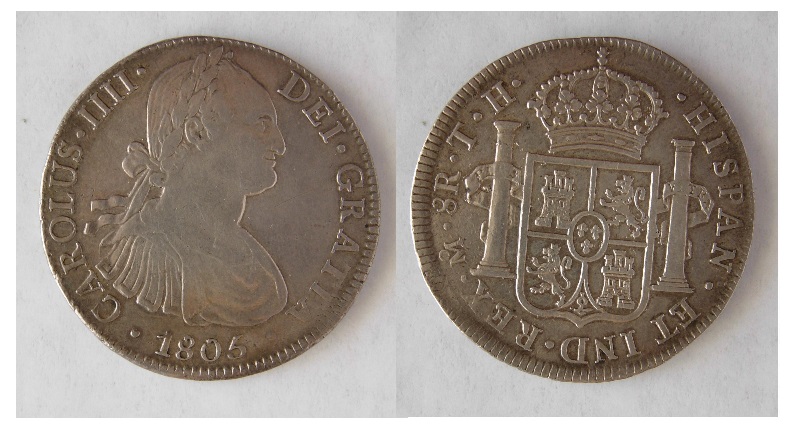
Gold-As-A-Marker-For-Early-Silver-Coins

Regarding this new report it appears to prove several of my contentions. First that silver was a contaminant in all gold mined in all locations of central and most of south America and also that gold was a contaminant found in silver at all the same points as well. Gold coins and ingots shown in Table 1 of the above report indicate that refining and especially parting of silver from gold (a different process than parting gold from silver) was not a very precise process anywhere in colonial Spain. The yield ranges are actually far lower than the theoretical capability of the methods known to be employed. I ascribe that to poor working conditions, haste to produce as much cash for the crown as fast as possible and probably to use of slave and semi-slave labor. The range of contamination is 0.8% silver to 25.4% silver in finished gold coin and ingots. The mean of the 56 readings is 12.74% silver contamination. However the single reading of 25.4% silver contained in the final Mexican entry dated 1818 can be labelled as aberrant (possibly a counterfeit but certainly a fraudulent coin.) Removal of this one item results in a mean of 8.0% contamination. Average contamination using the 55 tests (excluding the aberrant Mexican reading) yields an average of 6.32 percent.

Calculated by country of origin, the averages are:

Brazil 10 tests 6.77% silver
Peru 7 tests 7.03%
Mexico 7 tests 7.13%
Columbia 12 tests 10.03%
Chile 4 tests 9.30%
Bolivia 1 test 7.40%
Ingots 15 tests 6.05%

This indicates to me that the capability of parting silver from gold was NOT done using nitric acid or if acid was used it was not repeated multiple times as it should have been. It appears that cupellation and roasting was a very poor method of producing pure gold or silver at this point in time.

It is dismaying that Table 3 which lists 25 gold coins (typically later dates than Table 1) does not include the trace contamination of silver at all. The point of the table for the authors of the study was clearly to demonstrate the correlation of other trace contaminants with specific areas or mining regions. Omission of silver levels may have been intentional to maintain some level of secrecy.

I have found that it is difficult if not impossible to gain access to any of the trace contaminant data bases created by any of the testing labs. They maintain their data and hold it close to the vest.

Regarding Table 4 - This table refers to silver coins and shows gold as well as other metals as contaminants. The lowest contamination of gold in silver comes from the products of the Potosi mint and in general from mines in the earliest periods of production. This period is unique because the highest levels of native gold and silver were being removed from the mines (the choice ores) and silver taken from the indigenous peoples was included in the numbers. These early silver and gold deposits were refined very wastefully because the methods need to refine "stubborn" ores were not in place. More on Potosi will be discussed below.

The first grouping of coins in Table 4 are from Alphonso VI of Portugal and these show clearly that two sources of gold are represented (see report indicating Potosi and Mexico as the sources). Mexico has Au (gold) as a primary marker and Potosi has As (arsenic) as a contaminant. Where gold is low, arsenic is high and vice-versa. Portugal, it must be noted, did not employ pan amalgamation during this period. I am unsure of the parting methods employed, however, I am very sure that later post 1870 methods REMOVED Arsenic from the silver. It is therefore a simple substitution of Arsenic as the contaminant that must be present in Potosi coins NOT gold.

Likewise the Bahaia issues are Portuguese in nature and the ores came from the same sources with the addition of some native Brazilian ores. I would speculate based on the data from Table 4 that the ores were mixed closer to a 50-50 ratio than the earlier coins because both Au and As contaminants are present. The sum of the two contaminants approaches an average of 1000 ppm. It appears to me that a likely marker for authenticity is the presence of BOTH As and Au in coins from Bahaia.

The single coin from Guatemala in the study (1808) has a silver contamination of 0.087% (870 ppm). That is four times as high as my threshold number and appears to display a similarity of Guatemalan ores with Mexico, which is geologically sustainable. Remember that the North American and South American plates were not from the same area of the planet at the time of the gold/silver intrusions into the igneous rock that formed the mountains. Here we are entering the field of plate tectonics but the basic facts fit. The Andes and Sierra uplifts and intrusions occurred at different times and at substantially different locations.

After Guatemala, Potosi is addressed in Table 4. The first 6 coins of the 14 tested have the lowest concentration of gold as a contaminant of any of the coins on the table. It must be noted that these six coins were NOT made with silver extracted by mercury amalgamation. That process was developed in Mexico in 1557 and took a few years to spread to Potosi (1570 to 1572 are best estimates). So it would appear that pre-amalgamation coins have a different profile of contaminants that must be present. Mercury amalgamation unlike cupellation carries Arsenic unaffected into the metal pool extracted from the ore. Arsenic is a white metal that amalgamates with mercury just like silver and gold. If there is no reduction step in the process (which appears to be the case) then Potosi gold should be contaminated with Arsenic - and it is. Fortunately these coins are fewer in number comparatively and they would not be likely to skew the results of tests done on later date European coins that were tested. Remember that Mexican silver production predominated by 1770 which is the start of the interval studied in my book. It is a fact that Mexico was producing 5 times as much silver as Potosi in 1770 (see Figure 2.) and that this disparity increased with time. By the early to mid-nineteenth century estimates indicate that over half of all the silver in the world originated in Mexico. That is enough to contaminate virtually every silver coin produced after 1800 and before 1850 with traces found in Mexican silver. So unless the silver was parted before being re-coined the contaminants present in Mexican coins should also appear in coins made from them. The ability to part to a threshold below several hundred ppm was not available anywhere before 1850.

Lima coins show a 203 ppm average gold contamination and it appears that most if not all were pan amalgamation silver. I question the first coin because of the 15 ppm gold trace combined with 2075 ppm arsenic. This looks like potentially a coin from a different source or one refined with a different process. Regardless of the 15 ppm gold reading, the 2075 ppm arsenic level (OVER 2% arsenic) is an indicator of appropriate age but perhaps not authenticity.

Finally we get to Mexico and the 15 coins that were tested. Of the 15 coins, 13 are from the period before or immediately following the adoption of amalgamation. These 13 coins average 1,679 ppm gold. This is the highest of all the countries tested and clearly indicates that gold is the primary contaminant in the ore. There is one reading of 160 ppm that I would be concerned was an aberration because it occurs along with a low lead level. However, in this table lead was not always determined. The tests for our book would point to this lead content as being simply too low to be genuine.
If you eliminate issues of Mexico struck before the patio process was developed - you end up with just two coins. The coin from 1758 had a gold contamination of 560 ppm and the coin from 1821 had a gold contamination level of 2155 ppm or 2.12% silver. In producing our book we tested over 200 coins from the 1770 to 1821 period not just two. Our average result was much higher than 200 ppm. Unfortunately I lowered the number because of the Potosi results. It is time for me to look back at these data to see if Arsenic was present in a higher ratio and to eliminate gold as a criterion for Potosi ONLY and instead substitute Arsenic as the primary contaminant.

Based on both reports you also need to take into account that the newest test series expand the number of trace contaminants in silver and gold to include As, Zn, Cd, Sn, Sb, Au, Pb and Bi. These elements when trace levels are determined form a pattern that in combination clearly suggests whether a particular coin was made before 1850 or after 1850. The specific data in the 1999 report that I first cited used normative data not actual data. The authors of that study indicate."For security reasons, only relative values are shown." I do not necessarily agree with that position but I accept it.

I am not suggesting a FIXED number at this time - but it is very clear that Mexican coins using silver extracted by the patio process followed by cupellation and roasting could not remove all of the gold from the silver. The levels fluctuate but they are normally well above the 200 ppm level I used and at times even EXCEED 2000 ppm. Most hand held XRF guns have an accuracy level of 0.1% or 1000 ppm so a small technological advance might remedy this concern.

I am still looking for other peer reviewed reports and tests on this subject. The report discovered by thq may have disclosed too many specific numbers but both seem to confirm not deny my basic theory.

The second question was raised by pepactonius. He says:


Quote:
Won't counterfeiters just start adding 0.2 percent gold to their early silver fake coins from now on?


One factor that is good for authenticators is the "from now on" part of that statement. Only from this time forth (actually 1999) would forgers even know they had to add gold. So any coin that has a provenance dating back to 1990 would be unlikely to have a corrected alloy. This is one reason I published pictures of all the counterfeits I was aware of so that I could fix in time those coins. The simple fact is:

NO CORRECTION OF A FORGERY CAN BE MADE BEFORE THE ERROR IS KNOWN AND PUBLISHED.

Pepactonius, I used to wonder the same thing myself until I realized that gold is only one of an array of trace contaminants that belong in some coins and not in others. As long as too many results do not get leaked out the average forgers will not know which and how much of each element to add to get a correct signature. Gold is one of the easiest metals to purify to a state of 99.9999% fine; VERY FEW other metals can be economically refined to anything near that standard.

Where in the world would the average forger find 99.9999% pure Arsenic, Zinc, Cadmium, Tin, Antimony, Lead, Bismuth etc.? Even 99.99% copper is hard to find. Most copper is a real hodgepodge of trace contaminants. Many would raise red flags.

In addition, whenever an alloy is created in a furnace, the forger will face another issue. Cross contamination. It is not the large components of the alloy that will get you discovered it is the trace contaminants.

So starting at the beginning, where would you get your silver? Silver is not commercially available in a state purer than 99.99 fine. It is easy to say "I will melt old period coins" but it is increasingly expensive to buy them. I do expect that old culled coins will be recycled, but unless the forger separates his silver by mint he will screw up.

Let's say a forger was able to re-melt enough coins from only one mint and one time period. Would that insure silver that contained the correct signature? That depends on the furnace and fuel used. In our more than 200 tests, we uncovered a few modern fakes because they had odd signatures. One of the metals present which did not belong was an element added to furnace linings in the 1930's to make them last longer. At temperatures needed to melt gold there is a trace contamination from the lining to any open crucible inside. This element is common in very recent silver but it has no place in Mexican or South American silver. We also discovered that SOME rare earth elements are NEVER found in period coins but others are always there. These odd elements can make their way into silver refined after 1980 if the source used silver reclaimed from recycled computers. There are some rare earth elements like Yttrium and Scandium which belong in some of the silver. Where would you go to get them or Iridium? You can't pick them up at your local pharmacy.

So I leave you with a final comment, that even if a forger gets his hands on the correct formula: He cannot, at this time, duplicate it economically.



Pillar of the Community
thq's Avatar
United States
3343 Posts
 Posted 07/13/2015  07:41 am  Show Profile   Bookmark this reply Add thq to your friends list Get a Link to this Reply
The article I turned up was primarily directed towards Brazilian gold coin fingerprinting, but it's more interesting to me for what it revealed about Spanish colonial silver. And now to another related subject...US silver coinage pre-1860.

On another current thread I theorized that early San Francisco silver coinage (pre Comstock) was made with locally available scrap silver. California gold refining in that time was done with locally produced mercury (New Almaden eg) to recover/purify gold and any incidental silver. American silver in that period was originally Spanish silver, and in California this would have been primarily from Mexico. I would expect that metal analysis of pre 1860 San Francisco coins would verify Mexican origin based on Au content.
"Two minutes ago I would have sold my chances for a tired dime." Fred Astaire
Pillar of the Community
swamperbob's Avatar
United States
5362 Posts
 Posted 07/13/2015  11:00 am  Show Profile   Bookmark this reply Add swamperbob to your friends list Get a Link to this Reply
thq I agree 100% - the value of the arsenic trace for Bolivian silver was an entirely new and unsuspected clue - so thank you for finding that report. That clue now gives me an answer for XRF test results that had skewed our gold numbers when Bolivian tests were mixed with Mexican. It also serves as a warning that Peruvian may be slightly different as well (we tested very few Lima coins).

You bring up a very valid point which applies to not only California but New Orleans and Philadelphia as well. The US melted millions of Mexican coins to secure the silver for our own coinage. It is possible that both silver and gold coins produced may be verifiable by this trace method.

The first thing that needs to be determined are the assay and refining techniques used in the US to determine if nitric acid parting or some other parting method was used. The use of nitric acid was far more likely to occur in the US because by 1860 industrialization was well under way. I also recall something from a mint report in the early 1850s that suggested buying War time Mexican silver coins specifically to remove the gold content.

The same method I am suggesting can be used with any coinage as long as the sources of silver can be defined and the refining techniques used are known. It is a brand new field that holds great promise for authentication. Forcing the counterfeiters to get the assay correct should allow the products of all but the most sophisticated forgers to be detected.

Pillar of the Community
thq's Avatar
United States
3343 Posts
 Posted 08/26/2015  4:00 pm  Show Profile   Bookmark this reply Add thq to your friends list Get a Link to this Reply
swamperbob, I just read an interesting set of silver xrf comparisons for California-made 19th century tableware, in the book "Silver in the Golden State". The information is not at all germane to coins, but it documents commercial conditions that led to table silver in the 1870-90 period having unusually high lead to gold ratios.

Lead/silver bars from the Cerro Gordo mine (near Owens Valley) were shipped to San Francisco for refining. Lead was the principal product, used to make shot and pipe. Silver was a byproduct, and was sold relatively cheaply to the local silver trade (Shreve, Vanderslice, Koehler & Ritter, Schulz & Fischer) compared to Comstock silver. The lead/gold ratio in the 1870-1890 SF tableware is all over the map but typically 20:1, whereas earlier ratios (coin melt and Comstock silver sources) were typically 5:1 or less.

There's some confirmation here that the secondary metals content in silver is dictated by source, refining process and end-user needs.


"Two minutes ago I would have sold my chances for a tired dime." Fred Astaire
Pillar of the Community
swamperbob's Avatar
United States
5362 Posts
 Posted 08/26/2015  5:09 pm  Show Profile   Bookmark this reply Add swamperbob to your friends list Get a Link to this Reply
thq There are many such reports buried in technical journals of arts and antiquities. No one has ever attempted as far as I know to systematically collect and correlate all the data except the Winterthur Analytical Laboratories in NY. I attempted a contact there with no success, so I asked my laboratory contact at the RTI labs to check into it to see if they could get access to the database.

It is very sad to report that most numismatists gave up on this technology early on for reasons that are no longer valid. I discovered this based on the comments that were contained in the summary report from ANS when they rejected my book for publication. They cited the same old out of date information that I have heard in several forums where I have spoken. The "general consensus" among numismatists is that experienced dealers can tell genuine from forgeries in a nearly "mystical way" better than scientific tests.

Very early testing was rejected by the coin industry as too costly and the theory was attacked because there was a general lack of empirical supporting data. Most of the data employed to attack XRF technology dates to the 1990s or earlier.

That has now reversed - tests number in the thousands and trace markers are accepted for authenticating all types of silver EXCEPT coins.

Why ?

Dealers fear they will be discovered as "empty suits" selling as genuine coins that can be scientifically proven to be fakes. The same goes for the TPGs. Coins are big business and money is far more important to the establishment than historic truth.
Pillar of the Community
colonialjohn's Avatar
United States
1757 Posts
 Posted 08/26/2015  6:05 pm  Show Profile   Bookmark this reply Add colonialjohn to your friends list Get a Link to this Reply
Bob - remember OUR book is ahead of its time. This is not a book going to be accepted by everyone. Personally, I believe ORIGIN can not be dependent on XRF alone due to ore mixing (i.e., if it happens) and as a general rule. There will be exceptions and the data will not be homeogenous IMO. We went through this multiple times with copper for U.S. Colonial coins. It has been accepted (I think) that most copper mined in the U.S. Colonial (i.e., pre-1800) period was exported like in Simsbury, Connecticut with the Higleys due to insufficient technology to turn copper ore to copper ingots. Was the copper American or English in origin based on XRF analysis? However, remember origin and authenticity with trace contaminants is a whole different scenario. Since the book has come out NO THIRD PARTY has PUBLISHED this mint for these Spanish American coins is an exception.

This is different in your scenario with silver in terms of the minting technology - of course than with copper in the American Colonies in the 18th Century being from American Colonial mining sources. No one yet has proven by scientific analysis that any U.S> Colonial copper has come from an American copper mine DIRECTLY.

With time multiple methods WILL be required to prove origin. My new book due out in a year - Forgotten Coins of the American Colonies - 25th Anniversary Edition of William Anton's book will be PACKED with XRF data and new frontiers on this subject for contemporary counterfeits.

I already mentioned to the Mexican Coin Company that CAST silver pieces (i.e., War of Independence) and gold content may need a new approach and not follow this 0.2% Au rule. As this company does have a hand held XRF it may find other? discrepancies even with detection levels only to 0.1%.

Comparing coins to known standards ... running SEM/EDS microstruture data with chemical composition and particularly Lead Isotopic Analysis are showing some great promise.

As I said if I am buying a struck (not cast) Eight Reale being a pillar,Portrait or C&R and the gold is less than 0.2% - I will take a very close look at it - if its one order of magnitude below (<0.02%) let someone else own it ... IMO.

For Lead isotopic analysis and origin ... see this breakthrough article. PM me if you want the pdf.. At this point I have not seen any numismatic article countering any statements in our book. SHOW ME THE BEEF!

Pb Isotopic Article:

Prehistoric copper metallurgy in the
Italian Eastern Alps: recent results
Gilberto Artioli, Ivana Angelini, Paolo Nimis, Anna Addis and
Igor M Villa

John Lorenzo
Numismatist
United States
Edited by colonialjohn
08/26/2015 6:18 pm
Pillar of the Community
swamperbob's Avatar
United States
5362 Posts
 Posted 08/26/2015  10:23 pm  Show Profile   Bookmark this reply Add swamperbob to your friends list Get a Link to this Reply
John, I think you are following in large part the line of argument used before 1999 to discredit origins tests using XRF test. This was the same line that has been adopted by the opposition including Mexican Coin Company representatives at my presentation in Arizona last year and since. It was based on the belief that variations within the trace contamination in various parts of ore deposits make mine or vein source detection impossible. That presumed fact was incorrectly applied to cast doubt on the entire process I was presenting.

One has NOTHING to do with the other. Remember, my line of argument is not that I can prove the origin of the metal down to mine or vein at all at. The three major intrusive systems - Mexico - Bolivia and Peru can and HAVE been conclusively identified by museum tests of early artifacts. They have data establishing ranges of contamination of 8 marker elements. What that has proven is that the gold marker so predominant in Mexican silver is NOT as apparent in Peru (about half) and barely present in Bolivian silver at all (about 5%).

What can be proven is the date of refining, parting and manufacture of items based on silver purity and the composite of other retained trace contaminants.

The industrial methods used to refine silver are all known from studying history. The imports of mercury and nitric acid are also documented for each country. The availability of water and wood are also well covered by numerous written sources. The success of each method was confirmed by fire assays done at the time and more recently by XRF and SEM by several different laboratories. With that data base - it is not conjecture or speculation at all that the process is a KNOWN parameter. If we know how the silver was refined - the end state purity can be established - it is simply not ore dependent it is based on the chemistry employed to refine the metal.

The ecconomical parting of trace gold was NOT a priority in most Mexican producing silver mines. I have found a source from 1827 that indicates NONE of the branch mints in Mexico even attempted to part the trace of gold from the silver. This means that higher than minimum gold levels (0.2%) should be seen in cast coins actually made during the war years not a lesser amount.

Another issue which can be proven is that the nitric acid method of parting WAS NOT used in Mexico. Fire reduction was the only method in use. This is a simple economic fact. It is impossible to part a trace of gold found in a mass of silver. The reverse is possible - removing a trace of silver from a mass of gold is when the acid method was used.

There was no place in the world that could produce 99.999 fine silver in 1799. Natural silver in crystaline form was at one time known to exist in Mexico but even thatr was not 99.999 fine. This form of silver, according to numerous sources was gone by the first decades of the 18th century in any event. The big mining efforts Real del Monte were producing silver from low grade silver sulfide ores that were refined by the patio process. Any high grade silver ores were fire refined and the residues were treated with mercury.

The book may be ahead of its time for numismatics which is basically still operating with techniques that are 100 years old.

It is frustrating to deal with people who follow personal financial gains over truth.
Pillar of the Community
colonialjohn's Avatar
United States
1757 Posts
 Posted 08/27/2015  06:13 am  Show Profile   Bookmark this reply Add colonialjohn to your friends list Get a Link to this Reply
In the beginning the gold marker as you call it was an authenticity tool for DISTINGUISHING CC & regal issues. Lets see how far down the line it works for classifying the origin of these issues with just XRF. Some people believe all the issues CURRENTLY in the Red Book for Machins Mills pieces were ALL struck in America ... you THINK you are the only party in numismatics dealing with financial gains over TRUTH.

Keep me posted on any electrodepostion ideas or examples for the C&R's ... technology keeps moving forward ... I too was frustrated ... no more ... as MORE people year by year are believing ... that Material Analysis will keep opening doors to new ideas on proper attributions for certain coinages.

JPL
Pillar of the Community
MathieuMa's Avatar
France
1591 Posts
 Posted 08/27/2015  09:02 am  Show Profile   Bookmark this reply Add MathieuMa to your friends list Get a Link to this Reply
> It is frustrating to deal with people who follow personal financial gains over truth.
That sums it well, indeed .

Hum, just rechecked the Chihuahua 8 reales that you analyzed - Au is between 0,22 and 0,91 depending on the area (where it's at 0,22 is a brown area, rich of ~45% copper and only ~55% silver).
Edited by MathieuMa
08/27/2015 09:07 am
Pillar of the Community
swamperbob's Avatar
United States
5362 Posts
 Posted 08/27/2015  1:05 pm  Show Profile   Bookmark this reply Add swamperbob to your friends list Get a Link to this Reply
MathieuMa The readings you report make sense to me. The darker "brown" area being only 55% silver 45% copper should have less gold than a brighter silver area which theoretically would be 90% silver 10% copper. This is simply because there is gold in refined silver because the patio process concentrates both from the ore. The same thing does not happen when copper is refined so the copper will be free of gold (to the single ppm level anyway).

The variation in readings also indicate the mixture was far from homogeneous. Which further substantiates that very poor quality controls were in place. If the mints did not mix the alloy well enough to insure a uniform pour than then are very unlikely to attempt to part the gold trace at all.
Pillar of the Community
thq's Avatar
United States
3343 Posts
 Posted 08/27/2015  2:41 pm  Show Profile   Bookmark this reply Add thq to your friends list Get a Link to this Reply
Reading the book on California silver was also educational for learning a little about the development of silver refining techniques. At the Comstock the early refining was done by the traditional Mexican pan amalgamation, mixing mercury/water/salt/copper sulfate with the ground ore to make a pulp, then spreading the pulp on a patio in the sun to form an amalgam. This was modified into the Washoe Process to work ore faster, using stamp mills for grinding, followed by amalgamation in 300 lb batches in an iron vessel.

Apparantly the early 1700's Mexican vaso process of roasting the ore in an oven to directly smelt silver wasn't used on the Comstock, but was practiced extensively on the Cerro Gordo ores. Because the Cerro Gordo ore contained mostly lead, which forms a flux with the silver, a modified direct smelt process based on vaso was used to process most of the ore into 80 lb lead/silver ingots. The exhaustion of the lead/silver deposit needed for roasting effectively ended all Cerro Gordo mining in 1877.
"Two minutes ago I would have sold my chances for a tired dime." Fred Astaire
Edited by thq
08/27/2015 2:43 pm
Pillar of the Community
swamperbob's Avatar
United States
5362 Posts
 Posted 08/27/2015  11:46 pm  Show Profile   Bookmark this reply Add swamperbob to your friends list Get a Link to this Reply
I find the history of mining fascinating. The nineteenth century contains the greatest single number of developments in mining and refining technology in all the history of mankind.

Each metal and almost each different type of deposit requires a different treatment plan. Reading a book like "Daily Life in Colonial Mexico" by Friar Ilarione da Bergamo from 1768 proves how little people really knew at that time about refining. There was a virtual mystical process for refining that was handed down from expert to expert who guarded the "secrets" of the art. These experts were revered and granted very high status although what they dis often wasted silver. Even the first attempt to bring German mining experts into Mexico in 1783 failed terribly in large measure as a result of stubbornness on the part of both groups of experts because neither had a firm grasp on the chemical reactions involved.

The introduction of chemistry to mining, even silver mining came relatively late in time. The Parkes Process in 1850 was the first chemically based method and it solved the lead silver problem. It was the discovery of the Comstock Lode in the US that drove the science of refining into fast forward. The US unlike either Germany or Mexico was built on individual scientific research and this individual entrepreneurial approach to mining and refining was driven to maximize personal return.

With rgard to silver refining each of the new processes Washoe, Green River, Parkes Process (for lead/silver), Cyanidation processes, Cholrination, Moebius and Thum Balbach electrorefining all leave their "thumbprints" in the silver. These prints come in the form of purity that increases with each process. Each new process reduces the number and/or concentration of contaminants that remain behind.

These identifying prints are already being used by museums and art historians to authenticate period artifacts. It has reached the stage where silver items supposedly made in the 19th century are now some of the easiest to distinguish from modern forgeries.

I find the reluctance of numismatists to adopt these new already accepted tools to reflect poorly on their approach to authentication in general. It strikes me a bit like the Church hierarchy who had a difficult time with Copernicus.

  Previous TopicReplies: 30 / Views: 4,481Next Topic
Page: of 2

To participate in the forum you must log in or register.


Disclaimer: While a tremendous amount of effort goes into ensuring the accuracy of the information contained in this site, Coin Community assumes no liability for errors. Copyright 2005 - 2026 Coin Community Family- all rights reserved worldwide. Use of any images or content on this website without prior written permission of Coin Community or the original lender is strictly prohibited.
Contact Us  |  Advertise Here  |  Privacy Policy / Terms of Use

Coin Community Forum © 2005 - 2026 Coin Community Forums
It took 0.55 seconds to rattle this change. Forums

