Coin Community Family of Web Sites Join Thousands of Coin, Bullion, & Money Collectors
Coin, Banknote and Medal Collectors's Online Mall Vancouvers #1 Coin and Paper Money Dealer Royal Estate Auctions - $1 Coin AuctionsJoin Thousands of Coin, Bullion, & Money Collectors Royal Canadian Mint products, Canadian, Polish, American, and world coins and banknotes. Specializing in Modern Numismatics 300,000 items to help build your collection!


Username:
Password:
Save Password
Forgot your Password?


This page may contain links that result in small commissions to keep this free site up and running.

Welcome Guest! Registering and/or logging in will remove the anchor (bottom) ads. It's Free!

Please Post Your Coins Which Have A Hemispherical Depression

To participate in the forum you must log in or register.
Author Previous TopicReplies: 142 / Views: 22,468Next Topic
Page: of 10
Pillar of the Community
CoinHuntingDrew's Avatar
United States
4932 Posts
 Posted 08/12/2015  12:12 am  Show Profile   Bookmark this reply Add CoinHuntingDrew to your friends list Get a Link to this Reply
I think we need to coin a new term for this, maybe "crater"?
Pillar of the Community
Pete2226's Avatar
United States
3330 Posts
 Posted 08/12/2015  06:27 am  Show Profile   Bookmark this reply Add Pete2226 to your friends list Get a Link to this Reply
Thanks for the questions, cwb, I wish I had answers!
Pillar of the Community
Pete2226's Avatar
United States
3330 Posts
 Posted 08/12/2015  2:03 pm  Show Profile   Bookmark this reply Add Pete2226 to your friends list Get a Link to this Reply
I have learned something interesting about the US Mint and the Rockwell Hardness Test. The report I found this in is 400 pages, so I have not yet read it. The report is:
ALTERNATIVE METALS STUDY
Contract Number: TM-HQ-11-C-0049
FINAL REPORT
August 31, 2012
Submitted to: United States Mint
801 Ninth Street, NW
Washington, DC 20220


The contract for the study was awarded to: Concurrent Technologies Corporation
(CTC) headquartered in Johnstown, Pennsylvania


On page 43. there is a section entitled: Table 2-2. Rockwell 15T Hardness for One-Cent Coin Alternative Material Candidates
It lists the hardness for Copper Plated Zinc as 62-72 and this is post anneal.

The report also states on pg 40:

Quote:
The Rockwell 15T measurement
protocol was used since it is the United States Mint standard and is well correlated with
striking experience.


On page 42, it states:

Quote:
Rockwell 15T hardness tests results, before and after annealing for incoming materials are shown
in Tables 2-2 through 2-4. For materials received as planchets, only post-anneal values are given
since pre-anneal hardness values were not received (nor were they required) from the suppliers.
The reported values represent the mean of at least four readings taken on each of three separate
samples. Hardness between 62 and 72 Rockwell 15T are considered nominal for RTS planchets
at the United States Mint.


This document may be found here:
http://www.usmint.gov/about_the_min...12-08-31.pdf

I am going to have to give this all a bit of thought before I am ready to draw any conclusions. I would appreciate any help along the way. So far, I have only perused this document - no thorough reading yet!
Bedrock of the Community
coop's Avatar
United States
62064 Posts
 Posted 08/12/2015  2:31 pm  Show Profile   Bookmark this reply Add coop to your friends list Get a Link to this Reply
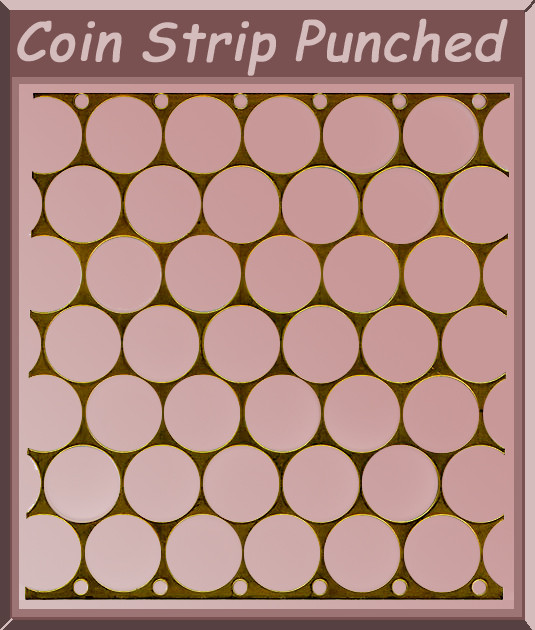
Here is an image of a blanking strip. (I've had it for years and don't know what date it was taken)
Please-Post-Your-Coins-Which-Have-A-Hemispherical-Depression
Pillar of the Community
Alexer's Avatar
Canada
2632 Posts
 Posted 08/12/2015  3:20 pm  Show Profile   Bookmark this reply Add Alexer to your friends list Get a Link to this Reply
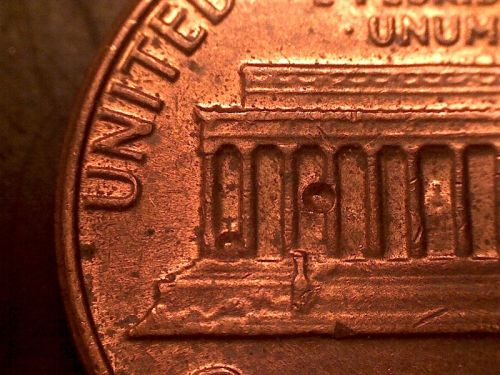
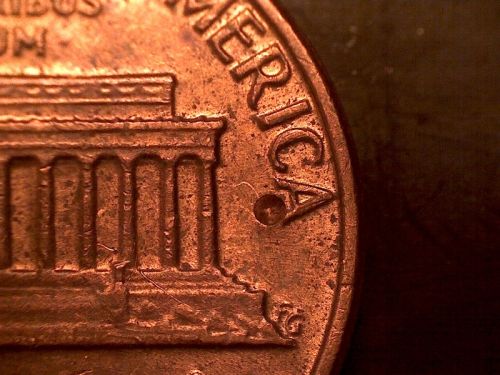
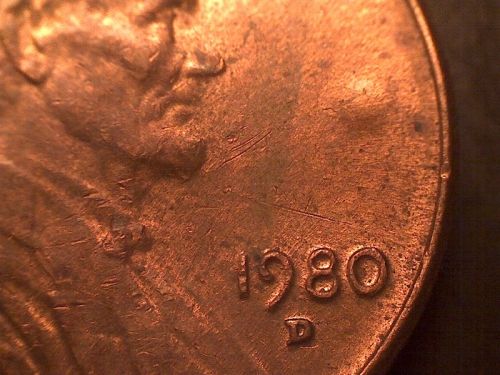
I would be curious to see the flip side of your 2 coins to see if there is any indication of a bump present. Here is a cent similar.

Please-Post-Your-Coins-Which-Have-A-Hemispherical-Depression

Please-Post-Your-Coins-Which-Have-A-Hemispherical-Depression
Pillar of the Community
Pete2226's Avatar
United States
3330 Posts
 Posted 08/12/2015  3:41 pm  Show Profile   Bookmark this reply Add Pete2226 to your friends list Get a Link to this Reply

Quote:
I would be curious to see the flip side of your 2 coins to see if there is any indication of a bump present. Here is a cent similar.


The depressions on your coin are virtually identical to mine! Amazing! What year is your coin? Are both photos the same coin? Is there any bump present on the obverse?
Thanks for posting!

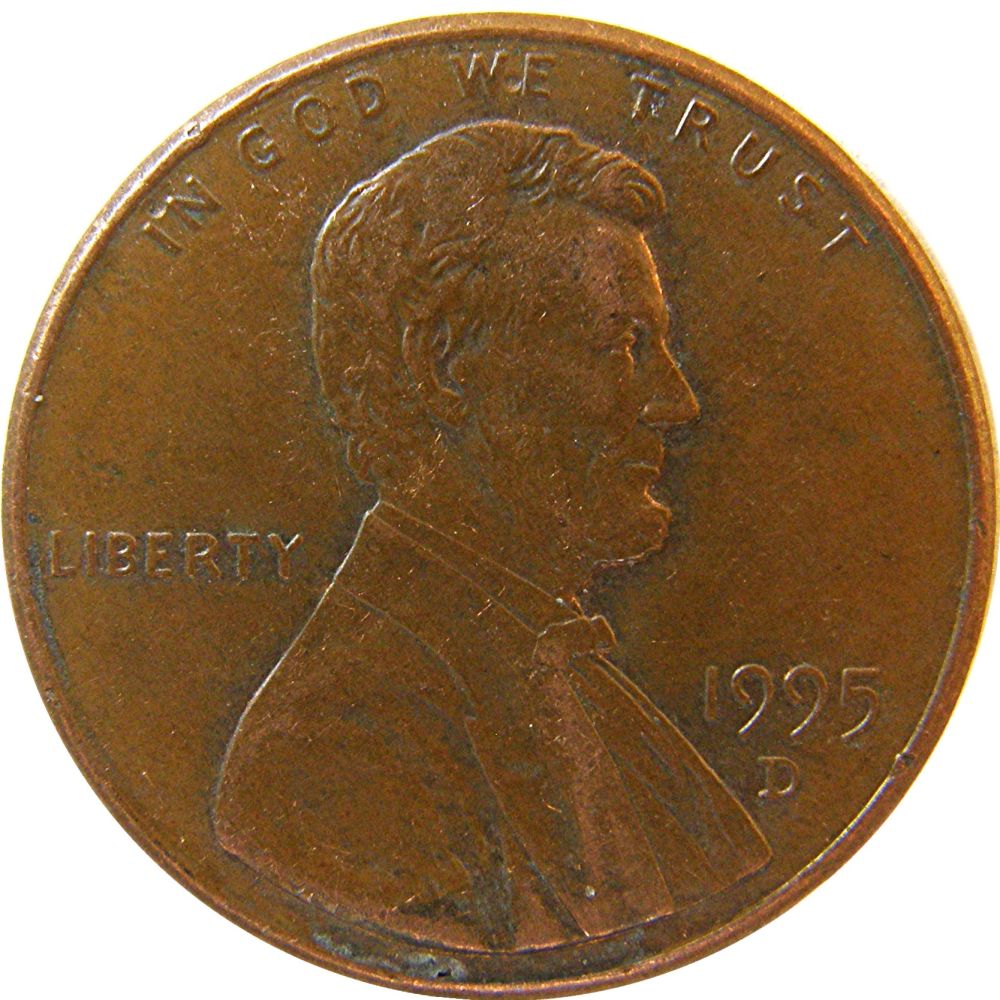
I see no bump on the obverse of my coins. Here they are:


Please-Post-Your-Coins-Which-Have-A-Hemispherical-Depression

Please-Post-Your-Coins-Which-Have-A-Hemispherical-Depression
Pillar of the Community
Pete2226's Avatar
United States
3330 Posts
 Posted 08/12/2015  3:54 pm  Show Profile   Bookmark this reply Add Pete2226 to your friends list Get a Link to this Reply
I have done some more research on this and I have learned that Mike Diamond's statement that the zinc based planchets need no annealing appears to be correct, although I am confused as to why in the 2012 test report, the numbers are listed as post annealing.

I have also learned that the one cent planchets are the only coin planchet that the mint acquires from commercial sources.

I have also learned that the US Mint does own a Rockwell Tester and used it in a follow up study on alternative metals. That information is in their 2014 Report to Congress, along with a photo of the tester. (Paragraph 3.2.6) The report is here: file:///C:/Users/Pete/Desktop/Coins...ppendix-4%20(1).pdf

I have not found any reference to whether the Rockwell Tester is used somewhere in the production of coins.
Pillar of the Community
Alexer's Avatar
Canada
2632 Posts
 Posted 08/12/2015  4:49 pm  Show Profile   Bookmark this reply Add Alexer to your friends list Get a Link to this Reply
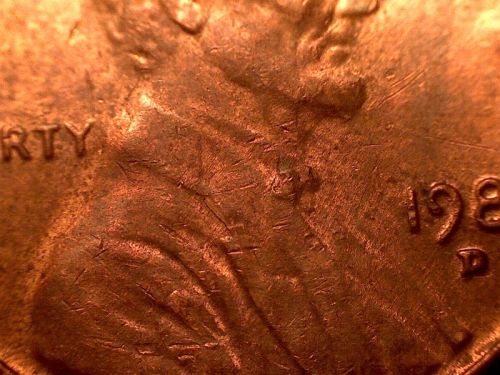
The cent is 1980-D although I believe they are PMD as a bump does show on the opposite side for each depression.
Seeings yours has no bump, I wonder if its possible debris from the roller itself, as the 2 rollers meet they provide even pressure on opposite sides, not leaving a bump... Just a guess.

Please-Post-Your-Coins-Which-Have-A-Hemispherical-Depression

bump in Lincolns collar
Please-Post-Your-Coins-Which-Have-A-Hemispherical-Depression
Pillar of the Community
Pete2226's Avatar
United States
3330 Posts
 Posted 08/12/2015  5:10 pm  Show Profile   Bookmark this reply Add Pete2226 to your friends list Get a Link to this Reply

Quote:
Seeings yours has no bump, I wonder if its possible debris from the roller itself, as the 2 rollers meet they provide even pressure on opposite sides, not leaving a bump... Just a guess


I am not sure what to think about that...

I am gravitating back to thinking that it is a Rockwell Test Mark.
I have learned:
that the cent is the only coin where the mint does not punch out a blank. They have the planchets shipped to them from a Commercial Supplier.
The mint has a Rockwell Test Machine
It makes sense to me that, as a matter of quality control, they would randomly test a shipment of planchets to determine that they do, in fact, meet specs.
Bedrock of the Community
biokemist6's Avatar
United States
12437 Posts
 Posted 08/12/2015  6:46 pm  Show Profile   Bookmark this reply Add biokemist6 to your friends list Get a Link to this Reply

Quote:
I have also learned that the US Mint does own a Rockwell Tester

Then the question is, where is the Rockwell Tester located or do they have more than one? If there is only one and it is located in Philly, that would disqualify your coins as they are from Denver and Jarden Zinc would ship planchets directly to each mint. However, given the softness of a zinc planchet, I am skeptical that a test mark would survive post-strike.
Pillar of the Community
Pete2226's Avatar
United States
3330 Posts
 Posted 08/12/2015  7:25 pm  Show Profile   Bookmark this reply Add Pete2226 to your friends list Get a Link to this Reply

Quote:
Jarden Zinc would ship planchets directly to each mint


Is Jarden Zinc the supplier? Are they the only one who supplies planchets? Where did you find this information?

Thanks for your insights!
Bedrock of the Community
biokemist6's Avatar
United States
12437 Posts
 Posted 08/12/2015  11:30 pm  Show Profile   Bookmark this reply Add biokemist6 to your friends list Get a Link to this Reply
Yes, Jarden Zinc is the sole supplier to the US Mint. Jarden also supplied the RCM with copper-plated zinc planchets before the switch to plated steel.
Pillar of the Community
Pete2226's Avatar
United States
3330 Posts
 Posted 08/13/2015  2:48 pm  Show Profile   Bookmark this reply Add Pete2226 to your friends list Get a Link to this Reply
Today I talked with an individual with the company who did the Alternative Metals Study for the U S Mint. He says that a Rockwell test Mark on a Zinc Planchet will still be visible after a coin is struck on that planchet. He says that it will probably be altered somewhat, but it is impossible to say exactly how because too many other factors are involved.

I have not yet been able to determine whether or not the U S Mints used Rockwell Tests as quality control on their supplies of Copper-Plated Zinc planchets. It would make sense to me that they would do so, but I cannot prove or disprove this yet! I just cannot imagine them sending a very large number of RTS planchets through the minting process without first doing a random testing to make sure their hardness meets specifications.

I do know that Rockwell 15T measurement protocol is the United States Mint standard and is well correlated with striking experience. I also know their hardness requirement for RTS copper-plated zinc planchets (62-72). I also find it interesting that this hardness range is slightly higher than that for Cupronickel (the Incumbent Material for 5-cent coins) and even higher than that for Cupronickel-Clad C110 (the Incumbent Material for Quarter Dollar Coins).

I have also learned that a Standard Rockwell Hardness Tester may have either a conical-shaped diamond-tipped indenter or a ball indenter. Since the shape of the Rockwell Test mark on Mike Diamond's site seems to imply a ball indenter, I would assume that is what was used.

Having reported all this, let me say that I am not sure that I understand everything I have just reported!
But I am working on that!

I am most appreciative for everyone raising questions and making comments which are helping to guide me in my search for answers.
[RTS = Ready-to-strike]
Pillar of the Community
Pete2226's Avatar
United States
3330 Posts
 Posted 08/15/2015  08:24 am  Show Profile   Bookmark this reply Add Pete2226 to your friends list Get a Link to this Reply
Rockwell Hardness Test with Zinc Planchets


I am listing here a summary of my findings on this subject.

Here is one explanation of hardness testing and Rockwell hardness values: "Unlike other measurements that directly relate to a material's physical properties (e.g., weight is directly related to mass), hardness is a comparative measurement. It's typically defined as the resistance of a test specimen to permanent indentation. Using standard testing methods, operators compare the results of a test specimen to a known specimen -- i.e., a hardness test block -- whose hardness they'd like to match.

How hard can this be? Actually, not hard at all if done properly. Unfortunately, hardness tests and testers often are misused, leading to erroneous results. The problem may lie in the user's assumption that the tester is measuring an absolute physical characteristic such as weight or length. While it's always true that a piece of brass that is 1.0023" long is the same length as a piece of steel 1.0023" long, it's not always true that a piece of brass which gives a particular Rockwell hardness value has the same mechanical properties as a piece of steel with the same Rockwell hardness.
An even bigger mistake is assuming that converting from one hardness scale to another is the same as converting from inches to millimeters. Incorrectly specified parts, bad procedures, conversion charts and unfamiliarity with the nature of hardness testing leads to incorrect measurements and, ultimately, to product failure." (1)

With a Standard Rockwell Hardness Tester, ball indenters may be used instead of diamond tipped indenters. It appears that for products of the U S Mint, ball indenters are used - as can be seen in an image which is an example of a Rockwell Test mark. A Rockwell test Mark leaves a depression. The depression should have no pressure ridge around it and have a smooth floor. The circular design might be distorted into a slight oval. The basic shape of the depression approximates a hemisphere. (2)

The U S Mint uses the Rockwell 15T measurement protocol. (3)

A hardness between 62 and 72 Rockwell 15T are considered nominal for RTS Zinc planchets at the United States Mint. (RTS= Ready to Strike). (4) The U S Mint obtains one cent planchets RTS. (3) (5) This hardness range is slightly higher than that for Cupronickel (the Incumbent Material for 5-cent coins) and even higher than that for Cupronickel-Clad C110 (the Incumbent Material for Quarter Dollar Coins). (6)

There are 4 major Zinc Alloys. They are identified by numbers: Alloy 190, Alloy 304, Alloy 720, and Alloy 750. Only Alloy 750 has a Rockwell 15T within the standards of the U S Mint. (7)

Zinc planchets need no annealing. (8)

The US Mint does own a Rockwell Tester and used it in a follow up study on alternative metals. (9)

A Rockwell Test Mark on a Zinc Planchet will still be visible after a coin is struck on that planchet. It will probably be altered somewhat, and it is impossible to say exactly how because too many other factors are involved. (10)

The company which supplies zinc planchets to the U S Mint does Rockwell Hardness Tests on their Rolled Zinc Strip (11) and on blank planchets before shipping where customer specifications require that it be done. (12)

I have attempted, unsuccessfully so far (no surprise there), to communicate with the U S Mint about this question. However, I simply cannot imagine that the Mint would not test these planchets against all their specifications (including hardness) or require certification from the commercial producer that they meet specifications - or both. It would be quite a costly mistake to go into mintage with planchets which are substandard.

I see no way to prove, conclusively, that the marks on these coins are Rockwell Test Marks. However, with what I have learned, I think that the odds that they are Rockwell test Marks have increased substantially.

Please feel free to ask more questions or give additional thoughts about this. They have certainly been a help to me so far in pursuing this research.

Thank you all.

Footnotes
(1) http://www.qualitydigest.com/april9...ardness.html
(2) http://www.error-ref.com/?s=rockwell
(3) Page 40, Alternative Metals Study, Final Report, August 31, 2012 by Concurrent Technologies Corporation, http://www.usmint.gov/about_the_min...12-08-31.pdf
(4) Page 42. Ibid.
(5) http://www.treasury.gov/about/educa...cturing.aspx
(6) Page 44 Alternative Metals Study, op.cit.
(7) "Technical Brief: Physical and Mechanical Properties of Solid Zinc Strip - Comparison to Other Metals" by Jarden Zinc Products (Suppliers of Zinc Planchets to the U S Mint) http://jardenzinc.com/Coinage.aspx
(8) http://jardenzinc.com/Coinage.aspx
(9) The U S Mint 2014 Report to Congress, along with a photo of the tester. (Paragraph 3.2.6)
(10) Personal Communication with an individual involved with the Alternative Materials Study for the U S Mint performed by Concurrent Technologies Corporation.
(11) http://www.jardenzinc.com/techdata/...olidZinc.pdf
(12) Personal Communication with a Sales Representative from Jarden Zinc.

Pillar of the Community
Pete2226's Avatar
United States
3330 Posts
 Posted 08/15/2015  11:41 am  Show Profile   Bookmark this reply Add Pete2226 to your friends list Get a Link to this Reply
I think that this is all I will be posting on this subject unless other examples show up or I happen to hear from the mint or other questions are raised...

Edited by Pete2226
08/16/2015 08:35 am
  Previous TopicReplies: 142 / Views: 22,468Next Topic
Page: of 10

To participate in the forum you must log in or register.


Disclaimer: While a tremendous amount of effort goes into ensuring the accuracy of the information contained in this site, Coin Community assumes no liability for errors. Copyright 2005 - 2026 Coin Community Family- all rights reserved worldwide. Use of any images or content on this website without prior written permission of Coin Community or the original lender is strictly prohibited.
Contact Us  |  Advertise Here  |  Privacy Policy / Terms of Use

Coin Community Forum © 2005 - 2026 Coin Community Forums
It took 0.37 seconds to rattle this change. Forums