


Coin Community Family of Web Sites Join Thousands of Coin, Bullion, & Money Collectors
Royal Canadian Mint products, Canadian, Polish, American, and world coins and banknotes. Shop for APMEX Bullion on eBay!Specializing in Modern Numismatics Join Thousands of Coin, Bullion, & Money Collectors Vancouvers #1 Coin and Paper Money Dealer Coin, Banknote and Medal Collectors's Online Mall 300,000 items to help build your collection!


Username:
Password:
Save Password
Forgot your Password?


This page may contain links that result in small commissions to keep this free site up and running.

Welcome Guest! Registering and/or logging in will remove the anchor (bottom) ads. It's Free!

Thingee, How-Did-That-Happen

To participate in the forum you must log in or register.
Author Previous TopicReplies: 5 / Views: 1,139Next Topic  
Pillar of the Community
MorgansRmine's Avatar
United States
1219 Posts
 Posted 01/14/2008  12:37 pm Show Profile   Bookmark this topic Add MorgansRmine to your friends list Get a Link to this Message Number of Subscribers


Thingee,-How-Did-That-Happen

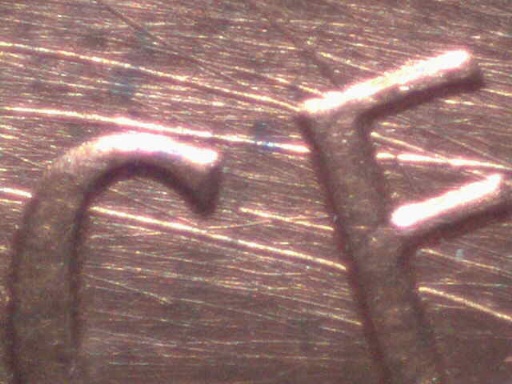
The scratches you refer to are die polishing lines. The face of a die starts as a flat piece of metal. The devices, lincolns profile, date, motto, etc are then engraved down into the surface at varying depths. The same way you would engrave a name on a trophy or an endearment on a piece of jewellery. This leaves the surounding area, fields, as the highest point on the die. When both dies strike each other with no coin inbetween, markings or clashes from the obverse are left on the reverse die and vice versa. These clashes are then polished away leaving polish lines engraved in the fields. Since the devices are sunken down into the die, the polishing procedure skips over the device and starts again on the next field. When the next coin is struck, the pressure genarates enough heat to melt the outer surface of the coin. This molton meltal flows into the devices and cools instantly as the dies separate leaving the raised devices and polishing lines. Hope this helps.
Valued Member
Jorgy's Avatar
United States
145 Posts
 Posted 01/14/2008  3:38 pm  Show Profile   Bookmark this reply Add Jorgy to your friends list Get a Link to this Reply
The only "Die" that is actually engraved is the mater hub. All other hubs and dies are made by squeezing the blank and hub together under a lot of pressure.

Edited for spelling error.
Edited by Jorgy
01/14/2008 3:43 pm
Pillar of the Community
MorgansRmine's Avatar
United States
1219 Posts
 Posted 01/14/2008  5:39 pm  Show Profile   Bookmark this reply Add MorgansRmine to your friends list Get a Link to this Reply
Your right. Should have specified that somewhere in my explanation.
Pillar of the Community
foundinrolls's Avatar
United States
3507 Posts
 Posted 01/15/2008  12:45 am  Show Profile   Bookmark this reply Add foundinrolls to your friends list Get a Link to this Reply
There are several faults in that explanation and parts of the other, I am sorry to say.

First, the diagnosis of the lines is actually correct. This is the effect of die polishing also called die dressing. It is often done to a die after two dies clash so that a die showing clash marks can continue in service.

Just about everything else is out in the ether somewhere.

A model of the coin around 15 inches in diameter is used by placing it on a Reducing Machine (Janvier Transfer reducing Machine). Its a lathe like thing that takes the design and puts it on the end of a piece of steel with the finished piece having the design on it the same size as a coin. This is the first Master Hub.

Without going into all the metallurgy of the process, The Master Hub is used to make a Master Die. It is a hydraulic process whereby the Hub is pressed into a piece of steel to make the die.

They then reverse this. They use a Master die to create a Working Hub. They make many Working Hubs. Again, pressure is used to press the master die into the rods used as hubs.

The working hubs are then used to create working dies. Also, the shape of the tips of the rods used to create working dies are slightly conical and not flat.

OK, now you have working dies in a press that just clashed. If it is caught, a technician removes the die, dresses it, creating those minute scratches , and at a later time loads it back into the press.

Some of the coins will show the scratches. It is simply the immense pressure of the strikes that cause the lines to show up on coins as they are marks on the die. Eventually the pressure of subsequent strikes will obliterate the lines after awhile. Heat and molten metal plays no part in this.

Thanks,
Bill

Edited by foundinrolls
01/15/2008 12:48 am
Pillar of the Community
Metalman's Avatar
United States
7123 Posts
 Posted 01/15/2008  02:31 am  Show Profile   Bookmark this reply Add Metalman to your friends list Get a Link to this Reply
The minting process does not have to be a mystery .

http://www.usmint.gov/mint_tours/in...tion=vtShell
Pillar of the Community
thingee's Avatar
United States
2177 Posts
 Posted 01/15/2008  9:17 pm  Show Profile   Bookmark this reply Add thingee to your friends list Get a Link to this Reply
Thanks for the thread MorgansRmine. I think I've got it now thanks to the posters!
  Previous TopicReplies: 5 / Views: 1,139Next Topic  

To participate in the forum you must log in or register.


Disclaimer: While a tremendous amount of effort goes into ensuring the accuracy of the information contained in this site, Coin Community assumes no liability for errors. Copyright 2005 - 2026 Coin Community Family- all rights reserved worldwide. Use of any images or content on this website without prior written permission of Coin Community or the original lender is strictly prohibited.
Contact Us  |  Advertise Here  |  Privacy Policy / Terms of Use

Coin Community Forum © 2005 - 2026 Coin Community Forums
It took 0.27 seconds to rattle this change. Forums
