| Author |
 Replies: 14 / Views: 3,502 Replies: 14 / Views: 3,502 |
|
|
New Member
United States
20 Posts |
Here's the obverse and reverse of an eight reales purchased recently on ebay. The reverse matches Riddle 237. The coin's weight is 27.1 grams. I am sorry about the rough quality of the images. I used MS Paint to remove extraneous background around the coin, resulting in rough edges. As side from the obvious rim flaw, the coin's edge is fairly regular. There is some apparent die rust, which suggests that the dies (at least the reverse die) were reused. 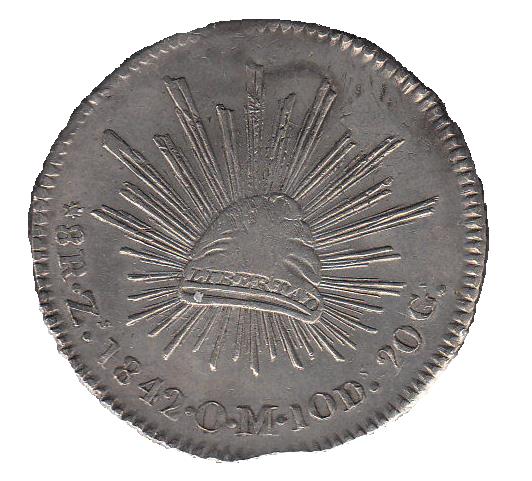 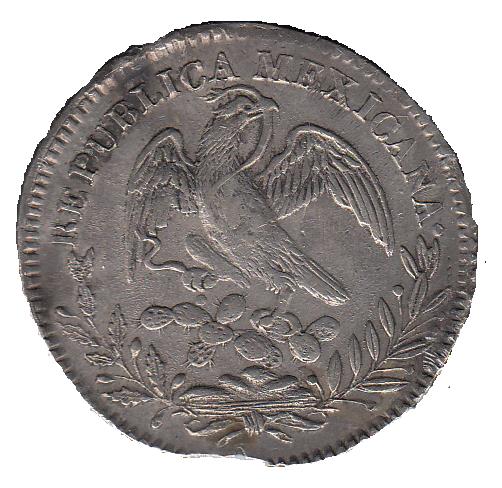 |
|
|
|
Pillar of the Community
United States
4883 Posts |
Of course, Riddell No.237 is ostensibly an 1834 Zs. Your specimen doesn't seem to precidely match any of the 1842 dated counterfeits Riddell documented (Nos.272-277). The weight is as you probably know about right. It'd be worthwhile determining its specific gravity so as to get a read on its silver content. I'm not sure which die you're taking to be the reverse. If you mean the eagle side, technically that's the obverse. In any case, your comment about the die being reused is interesting because roughly during this period, the Zacatecas mint supposedly disposed of well worn dies without canceling them, a boon for those who would forge this coinage. I'm posting pictures of my recently acquired 1842 Zs that also turned out to be counterfeit. It's overweight at 27.8 grams and oversized at almost 40mm in diameter, but its specific gravity is only 8.75, which suggests really minimal (if any) silver content. 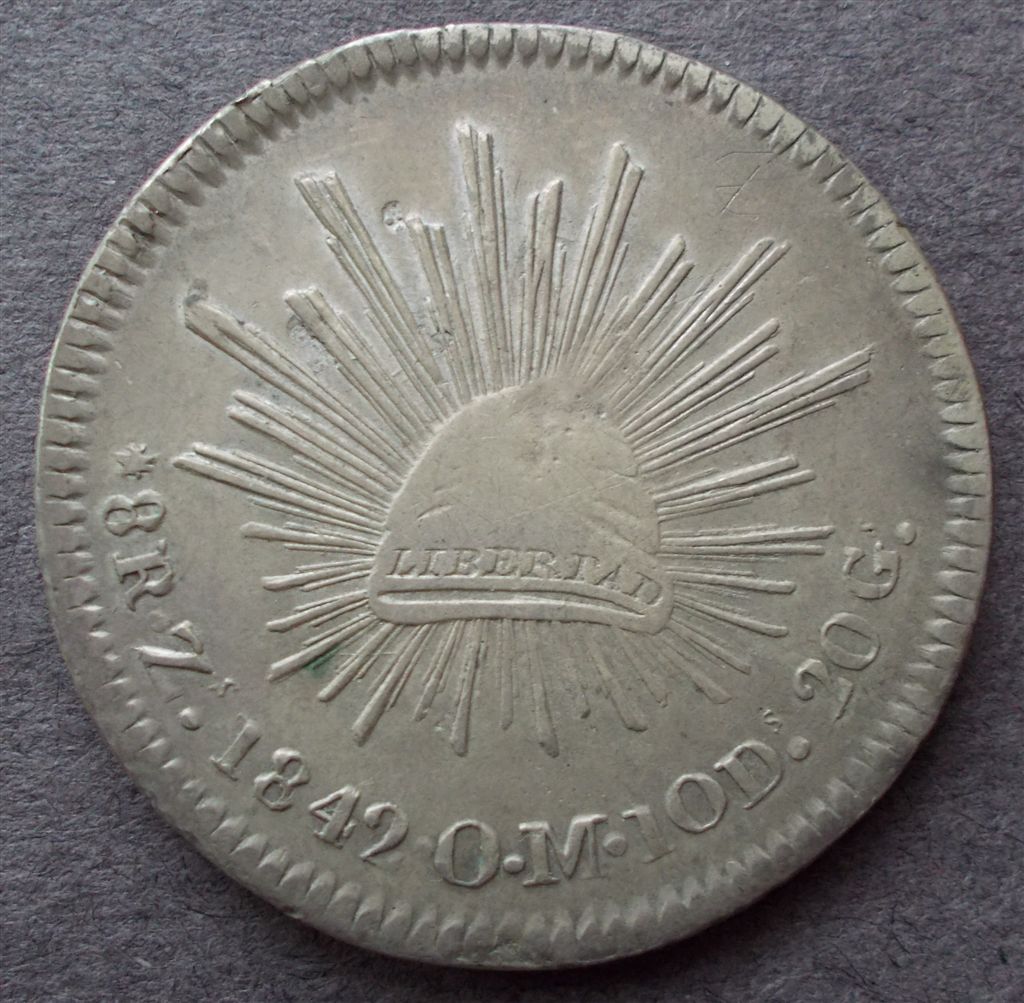 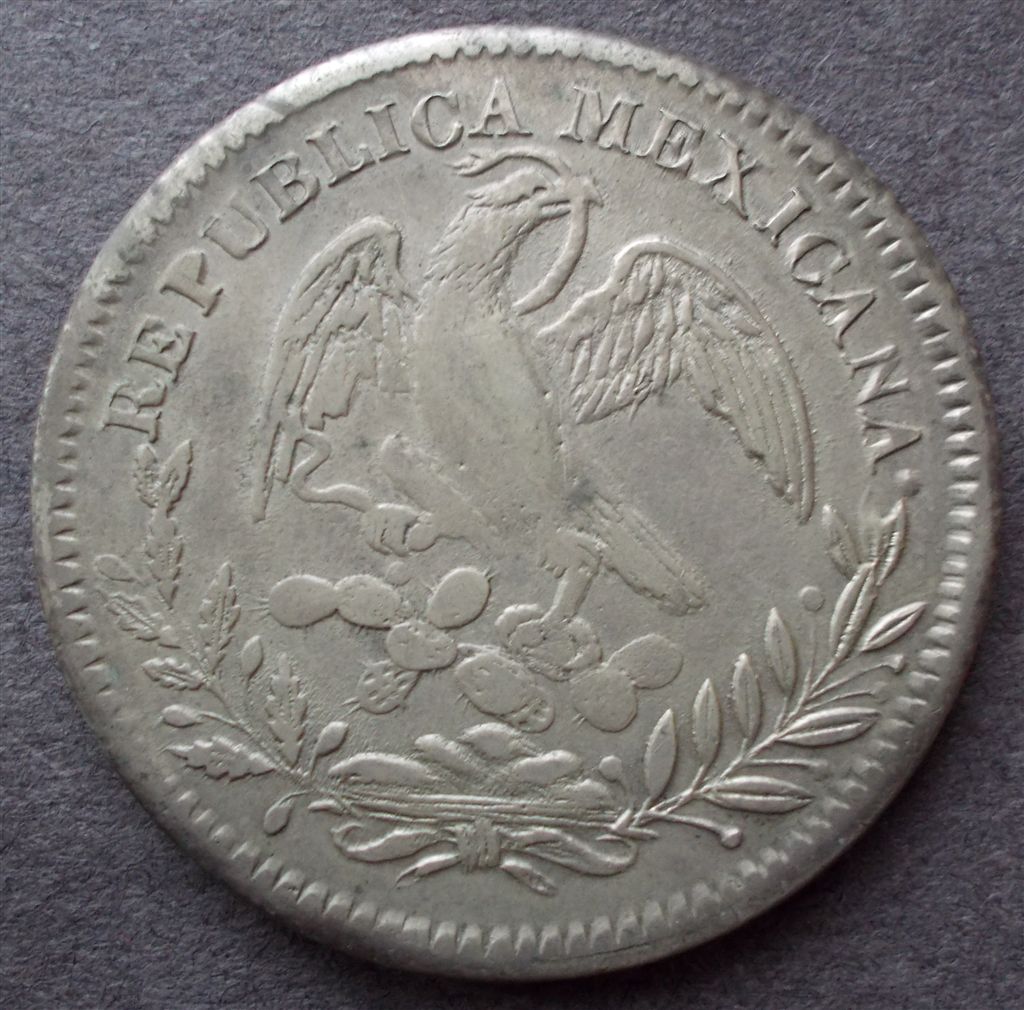 This one also doesn't seem to exactly correspond to any that Riddell catalogued. But I note that yours seems to have the same peculiar, irregular seven pointed star that mine does, and the "0" in "10Ds." is set high, and on the eagle side, the "C" in "REPUBLICA" is set low, two additional similarities that probably aren't merely coincidental. I believe yours and mine may very well have been struck with the same pair of dies. Colligo ergo sum
|
|
Pillar of the Community
1153 Posts |
Lucky,
How do you determine the specific gravity and is there a table or website that states what number should correlate with which coin? I would like to learn more about detecting counterfeit coins and this seems like a necessary skill to learn.
|
|
New Member
 United States
20 Posts |
Lucky Cuss -
Thank you for the information and images.
I've always treated the date side of the cap and rays series as the obverse.
I wouldn't be surprised if your coin and my example circulated contemporaneously with good, legitimate 8 reales. I think the fact that your coin is debased as well as mine (see below) point to intent to commit fraud by passing these fakes off as legitimate coins in everyday transactions, a common activity that dates back to the beginning of coinage. Could it be that Riddle 237 was used for other years?
The eagle side of both coins seem to be the same design, while the cap and ray sides differ, especially with the design of the rays.
Both dies for my coin are definitely not discards from the mint. There are far too many differences. The lettering on the date side is thin, especially for the date, and the style is simply wrong. The eagle side is way off in terms of style, what Riddle, I believe, refers to as an eagle that is too thin. The mound is totally wrong. Also, there are small raised spots near the eagle that indicate, in my opinion, rust.
I don't have a picture of the edge design (I need to purchase a decent digital camera) but I can say that it is a pretty good replication of the design used by the Republic mints. The edge flaw at 6 o'clock is missing the design. It's a clean break in the pattern which suggests that some sort of edging machine was used to produce the edge pattern.
I am sure that a specific gravity test would yield a coin that is very low in silver. The crude test of tapping the coin with a pen yields a very high tone that is not encouraging if one is looking for good silver content.
I will see if I can perform this test. Does anyone have the specific gravity for legit Mexican Republic 8 reales?
Thanks
|
|
New Member
United States
20 Posts |
The coin's diameter seems to be in the neighborhood of 38-39 mm. The specific gravity, done with my very cheap scale is 10.42.
Also, I forgot to mention that there's a very small test cut at the base of the rim flaw in the middle.
|
|
Pillar of the Community
United States
4883 Posts |
Quote:
How do you determine the specific gravity and is there a table or website that states what number should correlate with which coin? See: http://www.attilacoins.com/Calculat...ity_coin.aspQuote:
Does anyone have the specific gravity for legit Mexican Republic 8 reales? A genuine specimen with a bit above 90% silver content should have a specific gravity of just over 10.3 Quote:
The specific gravity, done with my very cheap scale is 10.42. That wouldn't seem to be a valid measurement. I'd remark that an expensive scale is not a prerequisite for obtaining reasonably accurate results. You can purchase an adequate digital scale on ebay for under $10 that weighs to the hundreth of a gram, which is what's required. I've found that these are surprisingly capanble instruments, especially if you calibrate them beforehand. Quote:
The eagle side of both coins seem to be the same design, while the cap and ray sides differ, especially with the design of the rays. I disagree with respect to the last point. I think if you superposed the images, it would reveal they're also the same. Quote:
Both dies for my coin are definitely not discards from the mint. There are far too many differences. I'd simply remark that in this era, each mint produced its own dies, employing local engravers of varying ability. Differences abound under such circumstances. But the odds do favor a contemporary counterfeit being struck with spurious dies. Colligo ergo sum
Edited by Lucky Cuss
11/01/2015 08:56 am
|
|
New Member
United States
20 Posts |
The rays seem a little thicker with your example, but that might be due to lighting and image resolution, so, yes, the two coins are basically the same.
I think the dies were produced outside of the mint. I don't think the dies used were "retired" mint dies.
Yes, the specific gravity figure is probably off, considerably, but I do need to get a scale with a higher gram weight capacity. My small scale can only go up to around 75 grams, so it cannot accommodate a larger cup with water to perform a the test. I'm going to a friends house today. They have a more robust scale.
Thanks
|
|
New Member
United States
20 Posts |
Hi Here is the coin in the original 2 x 2 holder. Thanks 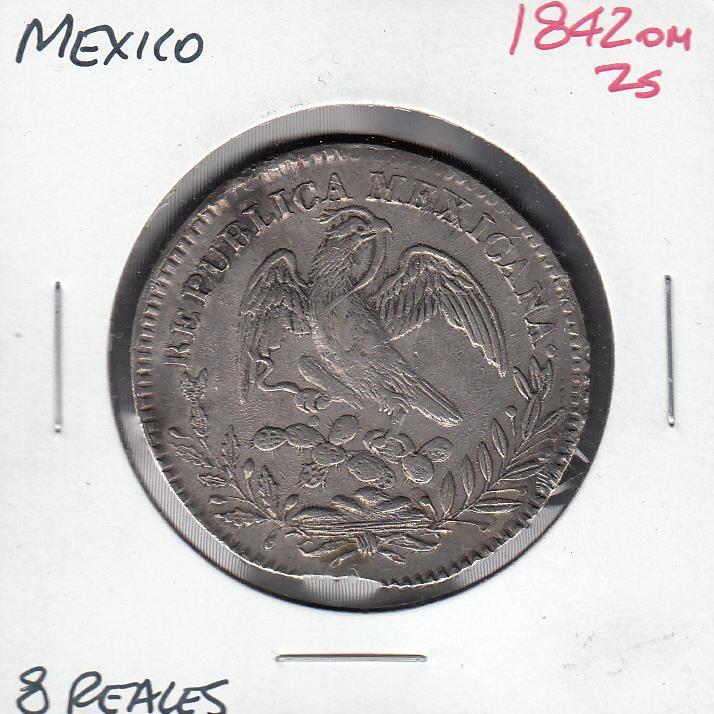 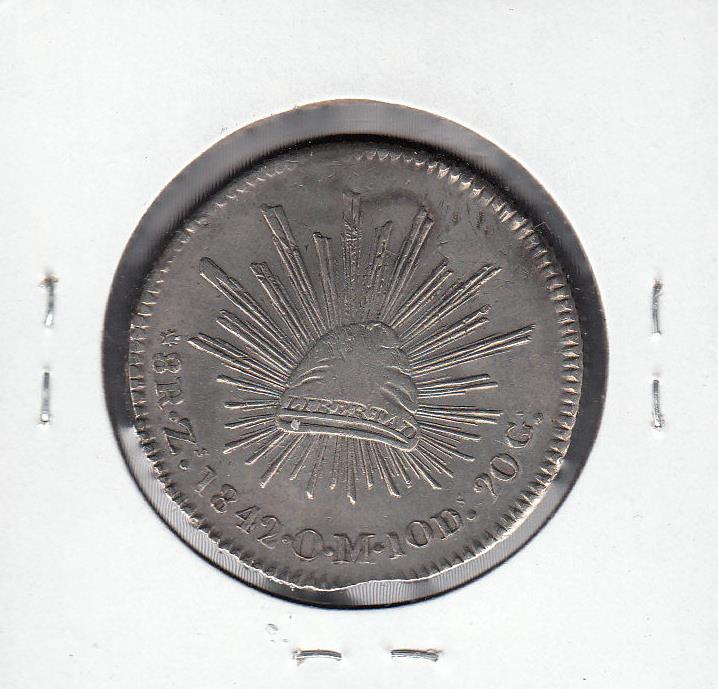 |
|
New Member
United States
20 Posts |
The specific gravity using another scale, is 10.037, so this coin is, to no surprise, debased.
|
|
Pillar of the Community
United States
5362 Posts |
The 1842 Zs OM is a mule of an 1842 Zs OM fantasy cap die and the Eagle die of the Riddell # 237 so robinjoe you are correct. The counterfeit is one of my all time favorites. I have owned examples of this Riddell type since 1960.
I understand that Mexican convention is to call the eagle side the obverse because it contains the seal and name of the country. I also understand that US convention normally refers to the side with the date as the obverse. So I have adopted the convention (right or wrong) of saying Cap or Eagle side. That way no one is confused.
There are a minimum of three types (if you do not count the metal used) of counterfeits that use the same eagle die. The Riddell # 237 as noted is an 1834 Zs OM and it is one of the most common contemporary counterfeits let alone just Riddell examples. There is the 1842 Zs OM which you started with. This one also is common. There are of course varieties based on die wear. There are examples with clear s superscripts for example. There are also copies with a FULL SNAKE including over the breast of the bird.
The scarcest type is one that is dated 1842 Zs OM but which uses a substantially re-cut eagle die. The easiest tells are the eagle's right wing tip (recut with extra feathers) and the snake's head (recut to resemble a correct head). I can not locate my pictures right now - they are somewhere?
These are NOT mint made dies that were worn out and discarded. These are well made counterfeits that successfully circulated alongside genuine coins. These copies were most likely produced in the north eastern US or possibly the UK because they are extremely common in the NE part of the US and Canada but were not common according to Riddell nor are they actually common in Mexico. I have heard stories from some collectors and dealers linking these particular coins to an Attleboro, Mass jeweler who went out of business in the 1930s.
But regardless of where they were made they entered circulation in large numbers. I have seen literally hundreds of these in the 55 years since I bought my first one.
|
|
Pillar of the Community
United States
4883 Posts |
Quote:
The specific gravity using another scale, is 10.037, so this coin is, to no surprise, debased. But not so much, as that still works out to about 75% purity, Makes yours and mine really very different regardless of the dies used to strike each. Quote:
I have heard stories from some collectors and dealers linking these particular coins to an Attleboro, Mass jeweler who went out of business in the 1930s. Does that imply that these may have been produced as late as the 20th century? That'd sort of take the "contemporary" out of contemporary counterfeit. Colligo ergo sum
|
|
Pillar of the Community
United States
5362 Posts |
Lucky Cuss I mentioned that there is a wide range of metals used. Copper with a silver wash, pure copper no plate, 80% silver and lower debased silvers, German Silver, Lead tin alloys. The 1842 types all use later metals - German Silver predominating. Some also seem to have used the dies or impressions for casts as well as struck coins. This may be why the dies lasted so long.
As far as the tie to a Jeweler in Attleboro - it was based on a story I heard from more than one source that a die pair associated with an 1842 counterfeit 8R version was sold at auction along with about 20 examples in the 1950s or 60s. One person who claimed to have seen both the dies and the 1842 coins picked out the Riddell # 237 eagle when I showed him the Riddell book. The die and coins he recalled were in the auction of a defunct jewelry firm that had closed in the 1930s but which had been in business over 100 years. The dies do not appear to be extant - at least no one acknowledges owing them. On several grounds the story may be incorrect and I do not see it as adequate to classify the coin as "modern" in any respect.
I have not done tests of the alloy looking for modern contaminants at this time.
There are as I said many different alloys involved. I guess you, like Riddell himself, see metal content as "different" since Riddell numbered coins struck from the same dies as different numbers provided they have different assays. I do not - I prefer die typing since counterfeiters use whatever metal is at hand normally. Quality control is not their big thing.
An SG of 10.037 would be 74-75% silver if the components are copper and silver. That would be very atypical for 1842 Zs types - high silver contents are known for the 1834 version not the 1842. Could it be a lead tin alloy? Does it ring?
|
|
New Member
United States
20 Posts |
Hello Swamperbob
Yes, the coin has a high thin ring when tapped by a pen. I compared it with the ring produced by a 1979 onza. The 8 reales decidedly higher, sort like a very high soprano way off key! The onza has a lower richer sound you'd expect from a coin comprised of one troy ounce of silver.
The seller of this coin is based in Nova Scotia, so that could provide more weight to the theory that this type originated in the Northeastern part of the United States.
I find that as I get older (I'm 63 now) my numismatic interests have evolved to include imitative and counterfeit coinage, official and private in origin. Where this leads me I cannot say, but the journey is fascinating, I think!
Thanks
|
|
Pillar of the Community
United States
5362 Posts |
robinjoe Nice to find a collector with interests similar to mine. I began collecting Cap and Ray coins in 1957 when I was 10. Not much money back then. I became interested in Mexican 8R counterfeits in 1960. My collection covers all countries but I focus heavily on the 8R coin types from 1772 to 1897.
I am beginning work on Volume II "Counterfeit Cap and Ray Eight-Reales" a follow-up to the first book on Portrait 8R counterfeits. This example of yours would be an interesting addition. Non-Lab level XRF testing (accurate to the range of 0.1 to 1% could be used to confirm the alloy and it would be a new type).
I am developing a list of collectors who have Cap and Ray Counterfeit 8Rs and would be willing to share data.
Are you interested?
|
|
New Member
United States
20 Posts |
Hello Swamperbob
I would be happy to send this coin to you for analysis. You might be able to get a more accurate measure of specific gravity. I think this coin is very low in sliver content, but what else is present I cannot determine.
Let me know if you would like to have me send this coin to you. My email address is joeldiasy@juno.com
Thanks!
|
| |
Replies: 14 / Views: 3,502 |
|







 Posted 10/31/2015 11:18 pm


