| Author |
 Replies: 9 / Views: 1,531 Replies: 9 / Views: 1,531 |
|
|
Pillar of the Community
 United States
3098 Posts |
I picked up this Decentius centenionalis for $4.00 at a flea market over the summer. It looks to be a high grade coin, but has all the heavy green on it. I tried a soaking in "Verdi-Care" but that didn't do much of anything. What suggestions do folks have for cleaning/improving this coin? Thanks for your ideas. 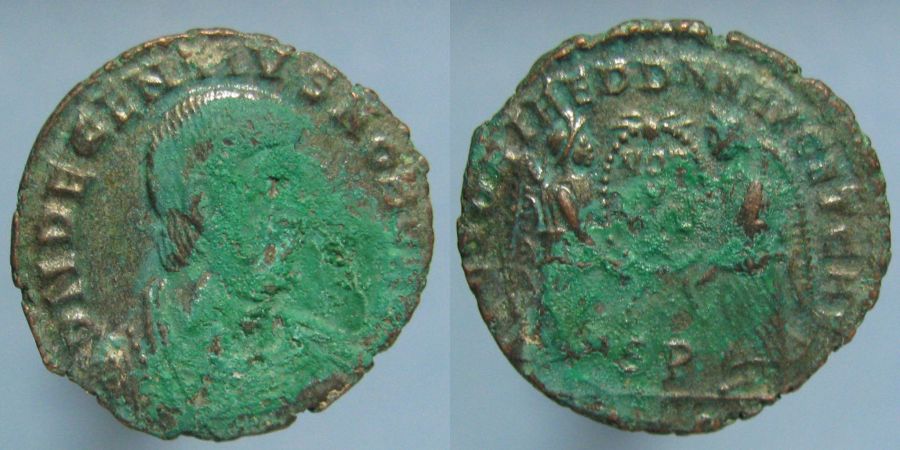 Paul Bulgerin
|
|
|
|
Moderator
 United States
23731 Posts |
You might want to try soaking it in olive oil, I think trying anything else will remove whatever patina is left on the coin.
|
|
Valued Member
United States
100 Posts |
Some sort of acid (vinegar, hot sauce, or ketchup) might do the trick. Might.
|
|
Pillar of the Community
United Kingdom
2624 Posts |
I will be watching this with interest... I have a coin with a very hard mineral deposit on it and if there is a solution to your coin maybe I will try it on mine. 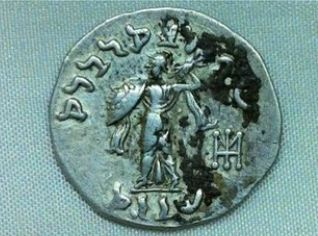 Looks like the only thing that would shift it is a power tool...and I am not that brave. How hard is the green? Does a toothpick touch it? |
|
Pillar of the Community
 United States
3098 Posts |
DavidUK,
If your coin is silver soak it in lemon juice. That's how I clean ancient silver coins.
The green on my Decentius is pretty hard. I am going to attempt some manual cleaning with my dental tools on some of the thicker parts to see if that does any good.
Paul Bulgerin
|
|
Moderator
United States
23731 Posts |
David try soaking it in some diluted warm white vinegar.
|
|
Pillar of the Community
United Kingdom
2624 Posts |
OK I will give that a try... thanks guys :)
Be careful Paul...I look forwards to seeing the finished product.
|
|
Pillar of the Community
United States
949 Posts |
Paul,
I have a similar coin with a similar verdigris deposit. Needle and microscope is my approach. It is slow going, but with care it effectively removes the layer without too much impact on the patina. But you may expect that the verdigris is bonded to the patina, and so your movements of the needle must be to split the layers. I can only work on mine for short intervals, and only occasionally take it out. But once removed it does not return.
I'll try to post a pic of my progress if I can find one.
David,
You might want to check that "deposit" before you remove it. I have a a few silver coins like that, and the dark stuff turned out to be what is sometimes called "horn silver" That is a chemical alteration of the silver of the coin, and if that is what you've got, it will leave a scar (pit) if removed.
Edited by lrbguy
11/11/2015 01:50 am
|
|
Pillar of the Community
United Kingdom
2624 Posts |
The deposit is very hard indeed, I will get the coin out when I have a bit of spare time and try and work out what is going on.
I thought it had to be mineral deposit when I looked at it last but I could be wrong, and often I am.
|
|
Pillar of the Community
United States
949 Posts |
Paul, I could not find my example for Decentius or Magnentius or whoever it was, but here is a piece I have done some work on from Maximinus II with the same problem. I'm sorry I don't have a "before" shot, but before I started the reverse was uniformly covered with the green you see still on it. 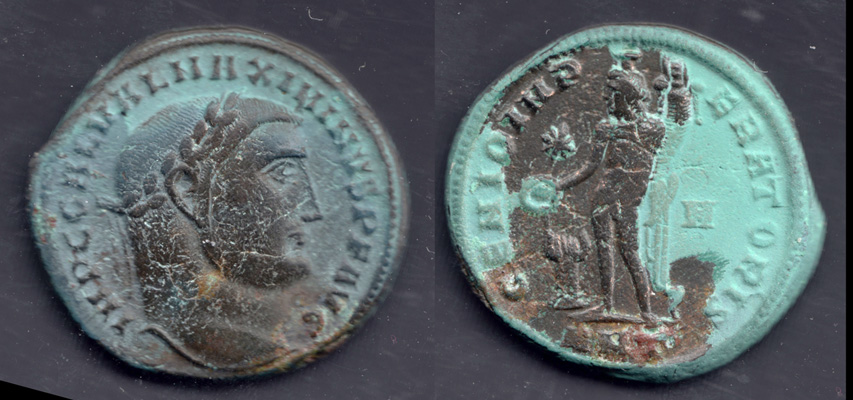 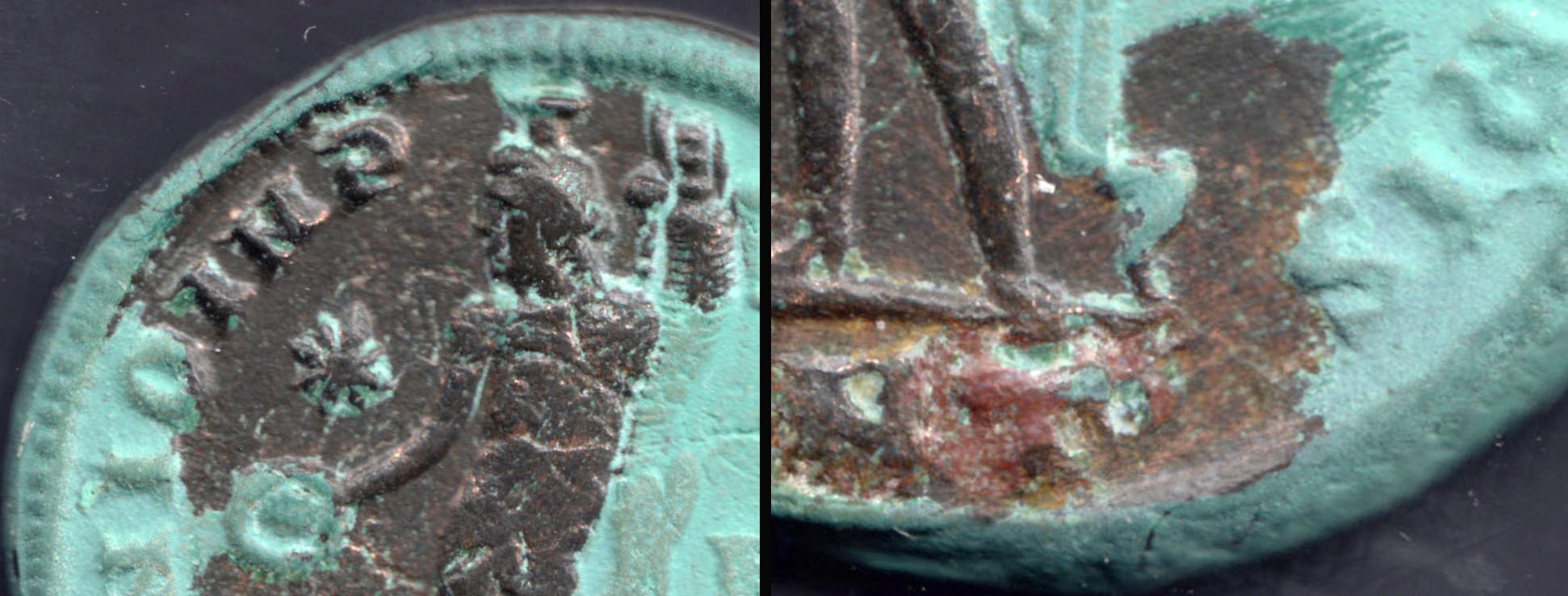 In the close-ups you can see that despite some occasional "brassing" the patina is largely intact. If treated chemically this would all have been stripped. One point I did not mention before is illustrated by the right close-up, namely that sometimes the verdigris is a layer on top of some other accretion. These can complicate the removal process, so you have to be alert for the possibility they are there. [EDIT: I forgot to mention that I have not touched this coin for ten years now, so I am reasonably sure that the surfaces are fairly stable as you see them. Once deposited the verdigris does not hurt the underlying metal of the coin, and the only reason to remove it is for reasons of appearance. Here conservation and presentation are in conflict.] David, I thought you might like to see the ravages of horn silver (a mineral form of silver chloride) on a coin that I am sure is of interest to you. (Sorry for the quick and dirty scan; I wanted to get this up quickly.) 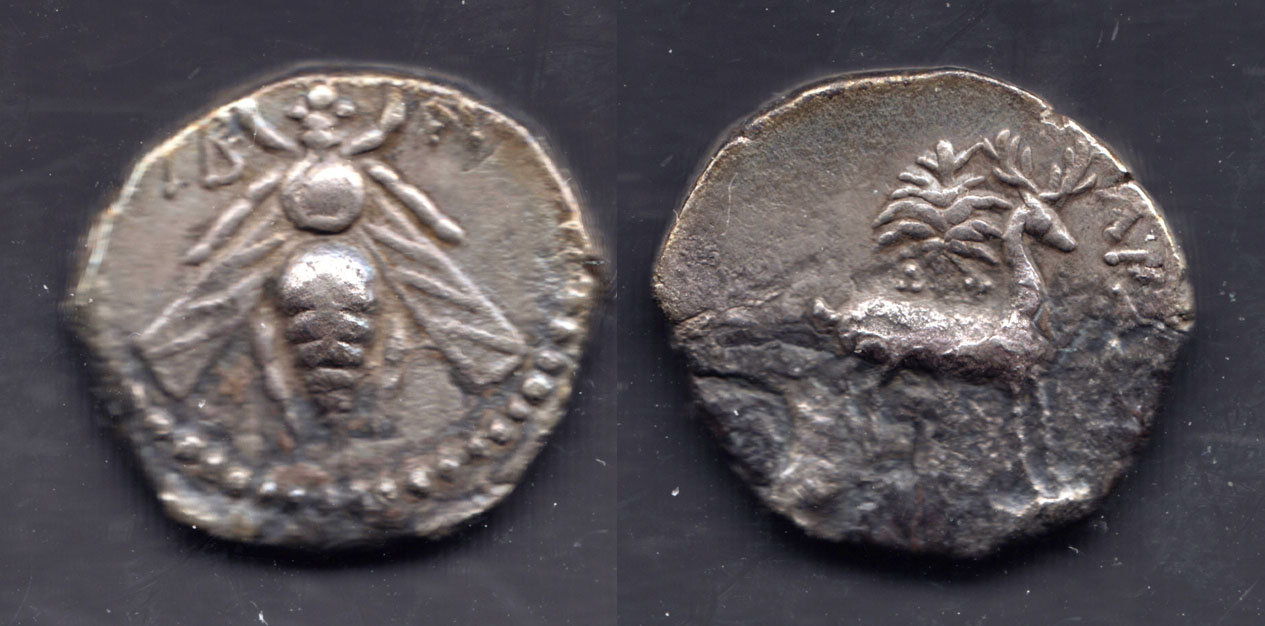 This coin was afflicted and treated before it came to me over 30 years ago. I don't know what was done to treat it, but I doubt if I could have done any better. The loss is irretrievable, but in some sense necessary so that the mineral conversion can be stopped. It is stable now, but hardly a showpiece. Thank goodness it still has a presentable side. Edited by lrbguy
11/11/2015 11:05 am
|
| |
Replies: 9 / Views: 1,531 |
|







 Posted 11/10/2015 5:48 pm





