| Author |
 Replies: 11 / Views: 2,822 Replies: 11 / Views: 2,822 |
|
|
New Member
Italy
5 Posts |
Hello, need help recognizing two coins I found at home, there's no readable text or numbers or either, just kanji I don't understand. Wondering if they are coins, tokens, medals or what? Hope someone can help, thanks! 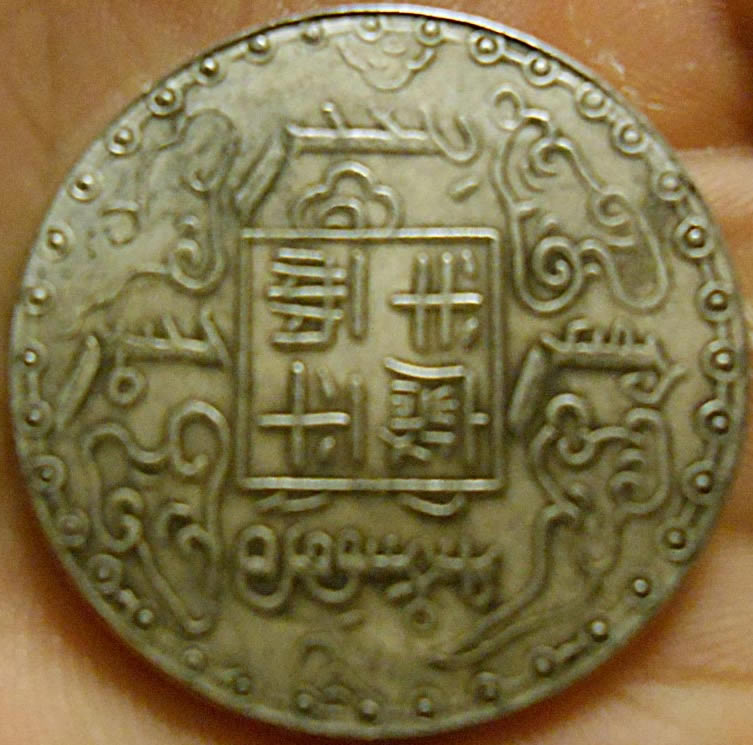 This one is identical on both sides: 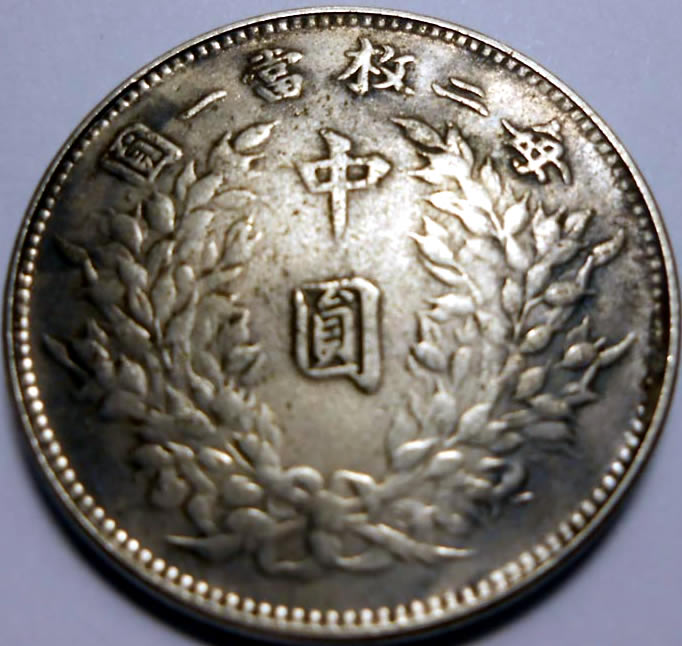 |
|
|
|
Pillar of the Community
United States
932 Posts |
 They appear to be chinese. I don't know the exact coinage type, but maybe a foreign coin expert could help. |
|
Pillar of the Community
United States
6130 Posts |
Imitations of old Chinese silver dollars. Phonies FAR outnumber genuine pieces, because China does not protect obsolete currency from counterfeiting.
If a magnet sticks to either, it's a cheap fake
|
|
New Member
 Italy
5 Posts |
Yes, they do stick to the magnet... So are they surely fake, os is it possible they are not-silver coins?
|
|
Pillar of the Community
United States
6130 Posts |
Sadly, both coins are supposed to be silver, which is not magnetic. I am afraid both are fake. I am interested in knowing what these are fakes of, however. The top one I have never seen come up before, and the bottom looks like the reverse of the "fat man dollar" but the characters aren't right.
|
|
Valued Member
United States
347 Posts |
The first coin is a replica (fake) of a rare "half tael" silver coin minted in 1884 by the Jilin Machinery Bureau in Jilin. An authentic piece has a silver fineness of 98%. An authentic specimen in the Shanghai Museum may be seen here. The second coin ("identical on both sides"?) is a fake of a "zhong yuan" silver coin minted in 1914 with a portrait of Yuan Shikai on the obverse. An authentic piece has a silver fineness of 78%. A specimen can be seen here. Gary |
|
New Member
Italy
5 Posts |
Wow, great find, thanks to all for your help! Sad to hear they're both worthless junk, but it was nice to see the original ones. The first one looks exactly like the one in the link posted, but it's obviously a fake and not silver. The second one was probably not even meant to be a fake, as both sides look the same, in fact I thought it was just a token. I also had these other chinese coins in my collection and now I doubt they are original, are those also supposed to be silver? 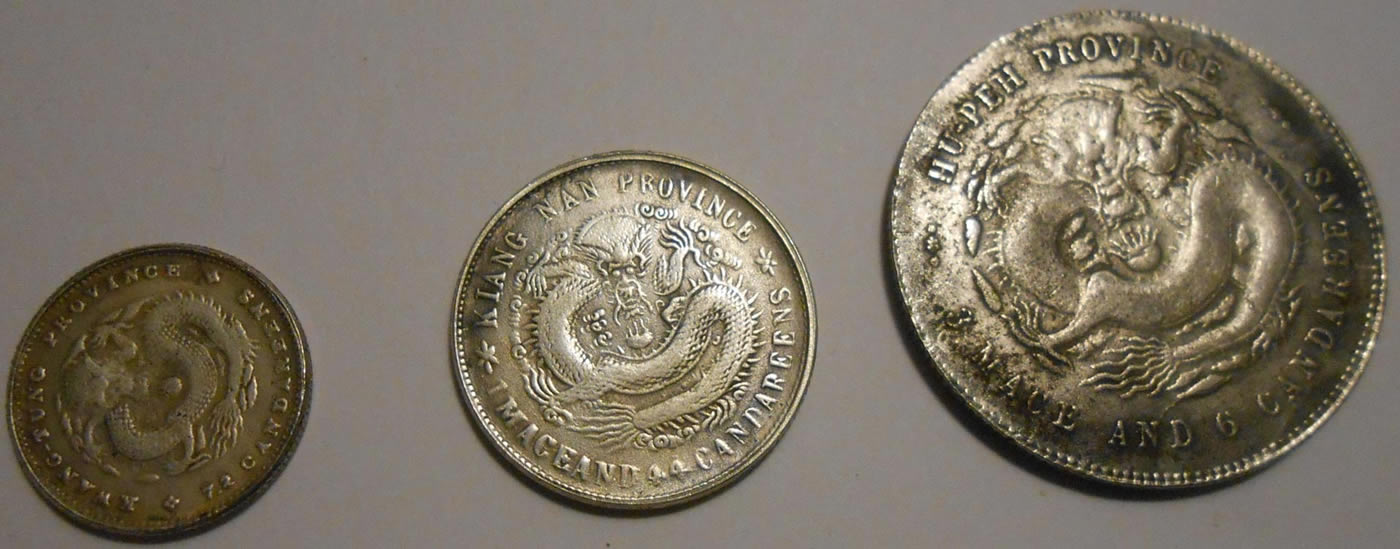 |
|
Pillar of the Community
United States
1316 Posts |
On the first two, I wouldn't say they are worthless junk. There are a lot of people who find the study of these Chinese fakes fascinating as they better learn about their own coins. And in China, the existence of these fakes has become a fun, but frustrating piece if the collecting history.
I was just in China and bought a piece that had an 1882 Morgan obverse and a a random modern silver bullion reverse. As I collect coins of '82, I paid the guy about $1.35 just to have the curiosity and amusement in my collection.
If you collect coins, consider holding it just because it's a fun story. But sorry, if will never hold any real value if that is all you were really hoping for.
|
|
Pillar of the Community
United States
6130 Posts |
Chinese counterfeits are a major problem to the industry, but the bungled novelty items can be fun as worthless novelty items. My favorites were a supposed 8 reale originating from one "UNITED MAXXICO AMERICA", and a "PRIZE MODERN ELOWER" struck in real gold and modeled after a US $20 piece.
|
|
New Member
Italy
5 Posts |
I wasn't really hoping for real value, I just collect coins as a hobby and knowing they are fake they cannot belong to the collection, so I really have no use for them. I have to say it was interesting trying to find out where they were from, but it's some coins I guess I will never get my hands to the originals (from the link I see the original of the first fake is supposed to be worth more than 20000 bucks!).
I still hope the other 3 are legit (the biggest one is quite worn out, like it has been circulating for a while), no matter if common or of little value!
|
|
Pillar of the Community
United States
6130 Posts |
All three are supposed to be silver, so the magnet test would apply here as well. If it passes the magnet test, the next level would be to test for silver versus copper--you can use the tissue test (click the link) to test for silver versus cupronickel. That only works for the surface however. If you have an accurate scale, you can check the actual weight versus the supposed weight that you can find online. That said, none look promising. These types are also very heavily faked, usually either cast from genuine pieces or with designs cut by hand using a real piece as reference. The face of the Dragon is usually telling for the latter case, as it is seldom a good match to the original. The one at the far left might be genuine; the other two I am pretty sure are fake. The one in the middle is missing the denticles (little dots around the rim) over the word "Province"--usually indicative of casting. The one on the far right just looks squishy with very weak rims--also indicative of casting. |
|
New Member
Italy
5 Posts |
Unfortunately all three of them (and a fourth smaller one I forgot in the picture) are magnetic, so I guess they'll be banned from my collection... :/
By the way, what is the story behind this fakes, do they counterfeit them just to fool collectors or were they actually used as a currency, and you could find them circulating like the originals?
|
| |
Replies: 11 / Views: 2,822 |
|








 Posted 11/21/2015 09:05 am


