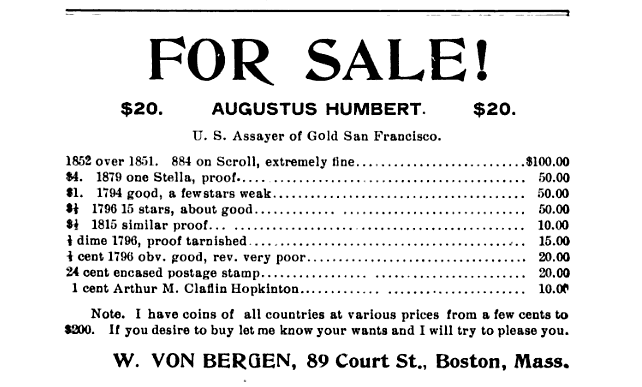
For the heck of it I took Von Bergen's ad and updated the pricing to current approximations.
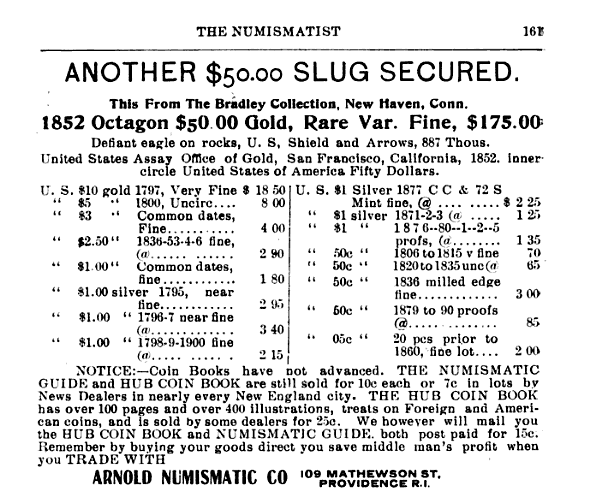
1852/51 Humbert $20 Assay (.884), octagonal, was $100, now only $28,500.
1879 Stella (Proof), I'll assume Flowing Hair, was $50, now only $230,000 (in PR65)
1794 $1, weakly struck Good, was $50, now only $67,500.
1796 50c in AG, 15 stars, was $50, now only $27,500.
1815/2 50c, not a proof (first was '18), must mean prooflike, therefore probably MS63 or better. Was $10, now $55k to $120k (MS63-MS65) without add for PL
1796/5 H10C, "tarnished" (i.e. toned), prooflike (no proofs exist), was $15, now figure $42,000 in MS63 (+PL add)
1796
Half Cent, split graded AG/Basal, was $20, now only $10k (w/pole) to $20k (w/o pole), assuming you can ever find one for sale.
24 cent encased stamp, I'm going to assume this is a Gault specimen since the reverse is not described, was $20, now $3,000.
1 cent encased stamp, Arthur M. Claflin, Hopkinton, was $10, an example sold at auction in 2005 for $15,500.
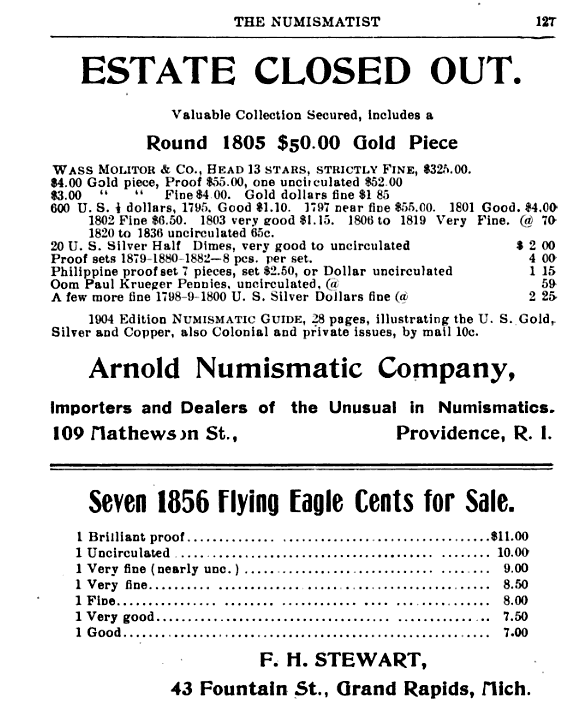
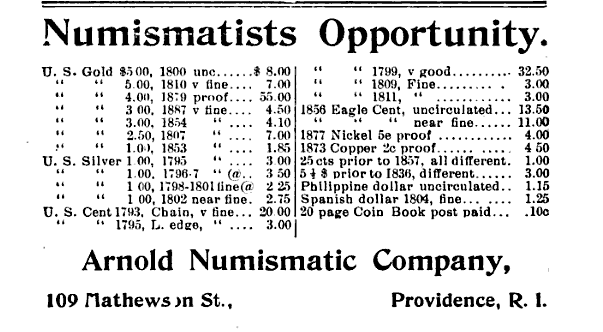
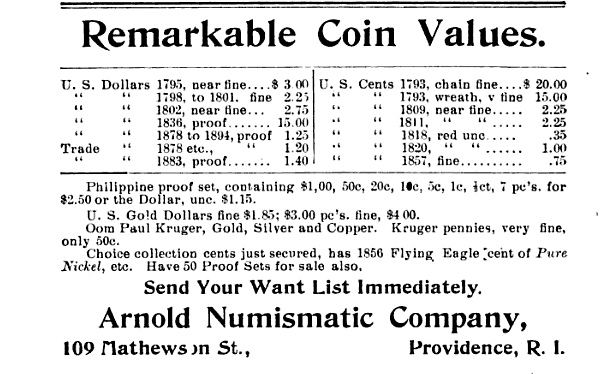
From Arnold Numismatic Company, that 1793 Chain cent in an unspecified Very Fine, with unspecified reverse: assuming AMERICA rev: was $20.00, now $30,000 to $50,000.
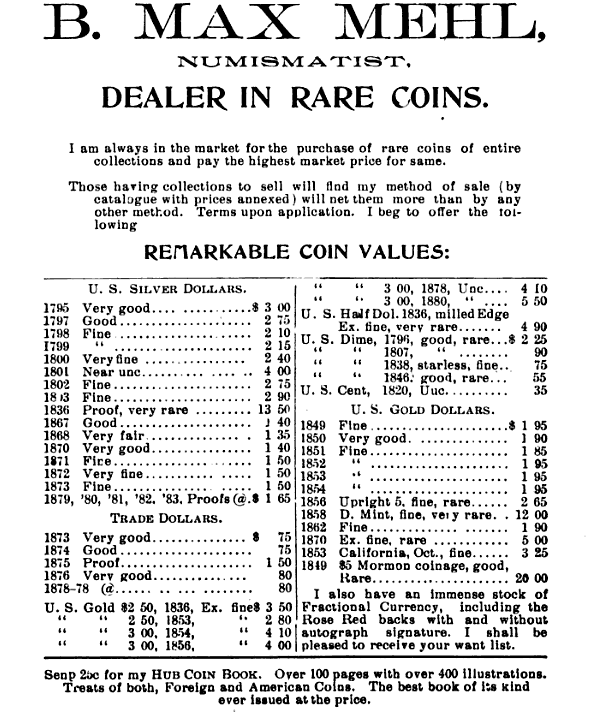
The 1799 Large Cent in Very Good: was $32.50, now $9k-$12k
The "1836 proof dollar", with unspecified die alignment, was "only" $13.50, now you can pick up a "low grade" PR64 example for only $90,000.
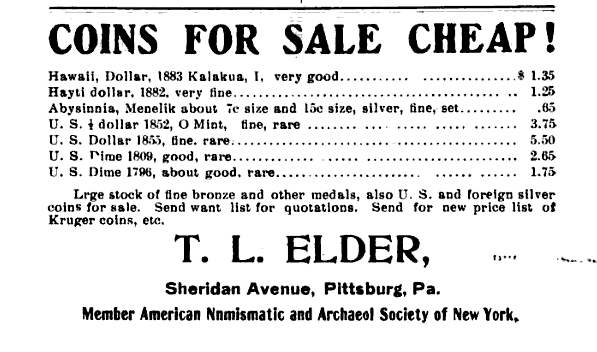
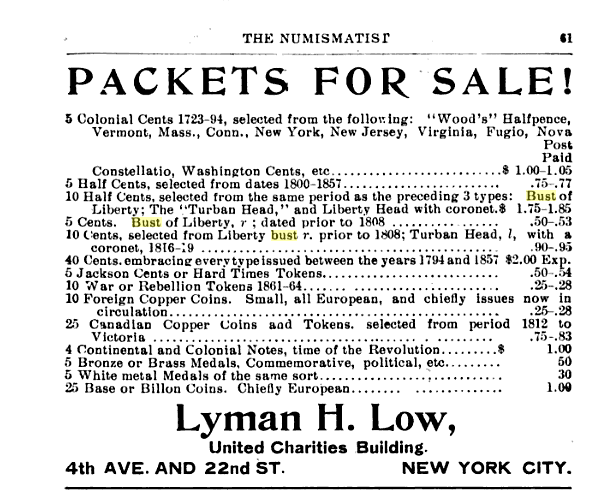
To keep this in perspective, in 1904, an average worker earned $0.20 to $0.25 per hour, or $200-$400 a year; a well educated professional might make $2.5k to $4k a year. Coin collecting was a hobby of the very wealthy.











 Posted 12/16/2015 3:06 pm