



Coin Community Family of Web Sites Join Thousands of Coin, Bullion, & Money Collectors
Coin, Banknote and Medal Collectors's Online Mall 300,000 items to help build your collection! Royal Canadian Mint products, Canadian, Polish, American, and world coins and banknotes. Specializing in Modern Numismatics Join Thousands of Coin, Bullion, & Money Collectors Shop for APMEX Bullion on eBay!Vancouvers #1 Coin and Paper Money Dealer


Username:
Password:
Save Password
Forgot your Password?


This page may contain links that result in small commissions to keep this free site up and running.

Welcome Guest! Registering and/or logging in will remove the anchor (bottom) ads. It's Free!

New Record For The Sale Of A Gnl Listed Counterfeit.

To participate in the forum you must log in or register.
Author Previous TopicReplies: 38 / Views: 5,673Next Topic
Page: of 3
Pillar of the Community
swamperbob's Avatar
United States
5362 Posts
 Posted 01/03/2016  11:55 pm Show Profile   Bookmark this topic Add swamperbob to your friends list Get a Link to this Message Number of Subscribers
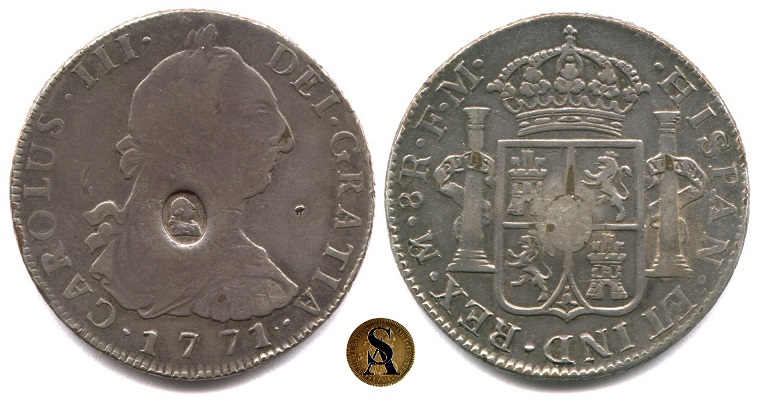
Today on ebay an auction concluded for a coin that was listed in our book on Counterfeit Portrait Eight-Reales. An example of the GNL 1771-O:Aa/R:MoFM-001 sold for 280 Pounds ($412.69 US).

Here is the listing:

http://www.ebay.com/itm/1771-George...231793345387

There were 18 bids from 5 bidders all in excess of $100 US. When I first became a member of ebay in 1999 I routinely saw these sell for UNDER $30 US.

Is the market mature? - FAR FROM that. Based on the exceptional rarity of these coins they are selling for much less than what they should bring. These are historic rarities manufactured over 200 years ago. The number of survivors recorded has not reached 100 examples of any single type and many are rarer than this example. Many are believed to be unique.

How many coins of the rarity level and age of the 1804 US Dollar can be had for less than $1,000?

I have asked the seller for copies of the pictures he used and permission to use them. The coin is the best known in existence of a new total of six examples of the type.

Here is the coin that appears in the book:

New-Record-For-The-Sale-Of-A-Gnl-Listed-Counterfeit.

My snipe bid was 200 pounds which I figured was a minimum value and it was never even posted. I was NOT surprised to lose the coin at all.

I remember that Dave O'Harrow advised me in 2000 not to discuss the subject of contemporary counterfeits in a public forum until such time as I was prepared to STOP COLLECTING these coins. He was well aware of the fact that if the actual rarity of these coins became public knowledge that I would price myself out of the market.

I actually began discussing this topic openly in 1998 when the doctor gave me only 3 to 5 years to live. I am very thankful he was wrong (I have been in remission for over 15 years now). It took me 12 years to prepare and write Volume I covering Portrait Eight Reales and I am starting Volume II now. So Dave's cautionary warning was true but it took about 2 years AFTER publication.
Pillar of the Community
austrokiwi's Avatar
2087 Posts
 Posted 01/04/2016  12:58 am  Show Profile   Bookmark this reply Add austrokiwi to your friends list Get a Link to this Reply
I am not trying to rain on you parade but I think you are overexcited in this case.


Quote:
Is the market mature? - FAR FROM that. Based on the exceptional rarity of these coins they are selling for much less than what they should bring.


That's tending to be hyperbole. The market value is what the market is prepared to pay. Which at this point is GBP280.00. Yes there may be potential for further appreciation in value but that potential does not necessarily lead to being able to accurately say " they are selling for much less than what they should bring"


Quote:
I routinely saw these sell for UNDER $30 US


If your saw them routinely then how can they be as rare as you claim?


Quote:
The number of survivors recorded has not reached 100 examples of any single type and many are rarer than this example.


Recorded by you I assume. How many examples have you missed seeing( its a question I always ask my self when it comes to my "feel" for rarity for my collecting interest)?

As you have indicated some dealers, collectors refuse to go near these "things" so I would guesstimate that on your declared sampling(100 examples) there are probably at least 10 more in the market for every one you have recorded. There is no point in arguing this All I am saying is that there is an un-measured population of which the 100 you have observed is a smaller sample


Quote:
How many coins of the rarity level and age of the 1804 US Dollar can be had for less than $1,000?


A lot!! I can't give you a number but as far as MTTs go I know of substantive rarities ( less than 20 known coins) with market values less than US$500.00. I have a coin in my collection( not an MTT) that is one of 5 ever produced.. current market value is probably not more than US$50.00. Until other people decide its worth more it will remain at that current value. My point being is that it is market demand that will set the price not the rarity.

Quote:


Many are believed to be unique.


I assume by you. Counterfeits generally come from reasonably sized mintage's so if there is one there will be more.

Now the other point that people have to note. These UK counter-marks are highly collectible because of the substantive story behind the counter-marks. So in the UK market there is an interest in the contemporary counterfeits of this issue but that interest, at this juncture, is unlikely to extend to all counterfeit 8 reales"

To illustate my point further: you missed this sale:

https://www.sixbid.com/browse.html?...&lot=1990412

I was the successful bidder I purchased the coin because of its relationship to the British counter-marking. I was prepared to pay that price because of the story behind that Birmingham counterfeit. I would refuse to pay more than US$50.00 for any other type of 8 reale counterfeit.
Edited by austrokiwi
01/04/2016 01:02 am
Pillar of the Community
swamperbob's Avatar
United States
5362 Posts
 Posted 01/04/2016  03:04 am  Show Profile   Bookmark this reply Add swamperbob to your friends list Get a Link to this Reply
Excited yes - incorrect NO.

I am drawing conclusions based on the way I see and understand the market just as you do. You are an expert in the MTT just as I am with regard to counterfeit 8Rs. I have been collecting counterfeit 8Rs since 1960 and over that period of time I have assembled a collection of about 600 Portrait (500 varieties about 10 new varieties per year average) and 3000 Cap and Ray counterfeits. I have no counts on types yet.

Regarding rarity versus market I completely agree that rarity is no guarantee of market value.

My belief is that the market for any item is driven by publication of knowledge (advertising). Unless and until collectors know about a type of coin it has no market at all which is what I would presume about any coin with a mintage of 5 or even a few hundred.

But I have numerous examples of historic counterfeits that became interesting after a champion arose.

How did the market for the 1804 Dollar (15 coins) develop? How did the market for the 1913 V nickel (5 coins) develop? Advertising.

People are interested if they know about a commodity. If rarity is kept a secret and no one knows - no one collects. I am trying to correct that omission.

So I believe that my statement is correct when I say that counterfeit 8Rs are selling for much less than what they should bring (in a perfect world). My belief is that when folks know there will be natural interest and prices will increase. This has already happened with several types - Machin's Mills, British Evasion and counterfeit half pence, Bectler Gold, Davignon Bust Halves and Kleeberg 2Rs. I believe that 8Rs should be seen as part of the same group and all else being equal they should go the same way.

You say

Quote:
If your saw them routinely then how can they be as rare as you claim?


That depends on your definition of routinely. Over my 5 decades of experience I have found that at a really good show I might find one new counterfeit variety. Most shows I find a couple duplicates. That is my routine. Prices were low because there were few of us looking. Prices are now up. I have 8 dealers now actively hunting for examples for me. They sent in 23 Portrait examples in the past year but only three were actual new varieties. That is routine. When I started collecting in 1960 I once paid $3 for a counterfeit. Many or most were free. I never saw $50 before about 1990 except in the bigger richer auctions and there it was in relation to other more well known counterfeits.

I said I have not recorded over 100 of any individual portrait counterfeit. In reply you say:


Quote:
Recorded by you I assume. How many examples have you missed seeing( its a question I always ask my self when it comes to my "feel" for rarity for my collecting interest)?


Of course it is my record, however, I based my opinion on data I have shared with other counterfeit collectors as well. The statement regarding a 100 count estimate was first made in a conversation I had with Dave O'Harrow in 2000. It was his number not mine originally. He started collecting counterfeits decades before me. My actual number of recorded varieties was inflated from 22 to 100 to allow just such a safety factor as you propose.

I think you are incorrect about the number of survivors however. This is because of the simple fact that most successful counterfeits contained an amount of silver that was worth recovering. Average figures in Riddell indicate about 40% of the correct amount of silver was present. So it is my belief (supported by other counterfeit collectors) that a 30 cent recovery on the dollar was attractive when compared to the alternative of no recovery. Most of these coins were melted to recover the silver they contained.

The only varieties that exist in anything like large numbers are the Birmingham issues particularly the ones with the BOE stamps and the base metal copies with a wash of silver.

Regarding my statement that "many unique" you again say

Quote:
I assume by you


Not by me alone but by every collector of counterfeit 8Rs I know. The general experience is that few examples except the Birmingham issues appear in numbers above a handful and many are one time finds. This is true in relation to many Cap and Ray coins shown in Riddell as well.

Regarding the Sixbid example you presume I missed - I can only say that not only did I not miss that coin but that it is the second most common variety I am aware of and one I believe will hit 100 recorded examples within the next few years. It is a silver wash type - one of the kind most likely to miss the melting pot.

Your statement that some dealers and collectors refuse to go near these "things" is unfortunately true but it used to apply equally well to the types of counterfeits I listed above. The dismissive use of these "things" is objectionable to myself and I presume to all other serious collectors of colonial era counterfeits. These counterfeits are every bit as important as any of the others listed. They are of the same age, rarity and spring from the same historical background.

The popularity of Bank of England Emergency issues (even their counterfeits) is based on a long period of positive advertising by many people in the business. That case illustrates my point that discussion leads to knowledge and knowledge leads to collector interest and interest leads to increased prices.

Finally if advertising didn't pay who would be paying a premium for an MS 66 coin over an MS 63? The misuse of the Sheldon Scale is a hoax of extraordinary proportions perpetrated on an essentially gullible audience based on grades that only "experts" see and never agree on. There are other examples as well - the proliferation of low mintage proof collector coins is another hoax. Hyped when first sold these artificial rarities sell at melt in a few years.

The number of counterfeit coins ever made is a fixed number that will not increase.


Pillar of the Community
jgenn's Avatar
United States
1156 Posts
 Posted 01/04/2016  11:07 am  Show Profile   Bookmark this reply Add jgenn to your friends list Get a Link to this Reply
The important milestone that I read was this:

Quote:
I actually began discussing this topic openly in 1998 when the doctor gave me only 3 to 5 years to live. I am very thankful he was wrong (I have been in remission for over 15 years now).

Wishing you many more years of numismatic research, swamperbob!
Pillar of the Community
colonialjohn's Avatar
United States
1757 Posts
 Posted 01/04/2016  1:00 pm  Show Profile   Bookmark this reply Add colonialjohn to your friends list Get a Link to this Reply
Austrokiwi & Everybody -

Speaking of that unusual auction of pieces ...

In that sale you may seen a farthing obverse brockage on a halfpenny host. I purchased that but its UNUSUAL. It has alot of room to be considered a fake or not made during the period. Interestingly - and not mentioned in the cataloging on the reverse non-brockage side are the letters GEO of the style of Georgian 1/2d! So the next question is what of the depression of the farthing obverse onto the coin. Under a stereo microscope there is some but not a lot of flow lines. But this could be a contemporary counterfeit farthing impression not made with a Royal Mint press but of a counterfeiting operation on say a bench type press but the impressed areas look really old. A most unusual piece ... I saw your piece ... but funds were limited ... this auction house did a good job ... particularly with those 1/2d errors and U.K. Evasions were all really KOOL. A noted California collector bought most of these ... could be some type of set-up piece to test the dies? ... also what needs to be entered into this equation ... why would anybody impress a farthing coin into a 1/2d planchet at this time? Why use a farthing die or coin? The depressed area does not look at all MECHANICAL it just looks like not as much pressure as one would see from a Royal Mint error from this time based on lack of flow lines? ... but again ... not sure ... next time I am in the bank I will check some 18thC errors in terms of flow lines ... something I have not done since buying a stereo microscope only two years ago ... in terms of it being flattened it does not appear so - the planchet is irregular and as with CC1/2d's its of this uniform thickness (i.e., thinner) - but irregular and oval as the vertical and horizontal diameters are more than a 1.0 mm differential ...

http://www.timelineauctions.com/lot...penny/58051/

JPL


Edited by colonialjohn
01/04/2016 2:09 pm
Pillar of the Community
austrokiwi's Avatar
2087 Posts
 Posted 01/06/2016  02:31 am  Show Profile   Bookmark this reply Add austrokiwi to your friends list Get a Link to this Reply
I am going to really put the cat among the pigeons with this post. I do so with absolutely no apologies.

There are numismatists and there are coin collectors. They are not necessarily one and the same although there can be some overlap.

A coin collector is a market follower


Coin collector simply fills the gaps; they are catalog followers. A coin collector will never accept counterfeits as being worthy of collecting under the current zietgiest.

A numismatist is much more than a coin collector a numismatist is interested in the story of the coin. For a numismatist a contemporary counterfeit, when it is a part of the story and landscape of coinage, is as valuable as the rarest of collectible coins. A numismatist "writes the story of coins"
Edited by austrokiwi
01/06/2016 02:34 am
Pillar of the Community
colonialjohn's Avatar
United States
1757 Posts
 Posted 01/06/2016  08:29 am  Show Profile   Bookmark this reply Add colonialjohn to your friends list Get a Link to this Reply
Mr.A -

No need ... an old mentor of mine William Anton said most people you meet in this hobby are pretty much into it just for the social ramifications. He use to call them simple-minded accumulators. 99% of the people I meet in this hobby are SMA's. Some examples - someone who has collected their entire lives and never wrote a coin article, people who chase MS66 type coins CONTINUOUSLY, people who when attending a gathering never go beyond type/grade in a show and tell among their peers, people who write an article never advancing any information - just compiling real time data. I could put names to all of these Mr. A ... not you ... I like your aggressive behavior ... I am the same way ... but you can't bad mouth SMA's which has been my problem from time to time. Dave Bowers once said the average collector spends about 20 minutes/week with his coins. Just because someone is a SMA and is a type collector with big pockets does not make him an IDIOT. Although his name is often on the cover of an auction catalog ... the bottom line ... he is still more often than not JUST a SMA.

JPL (hopefully not in your eyes a SMA)

LOL
Edited by colonialjohn
01/06/2016 08:55 am
Pillar of the Community
jgenn's Avatar
United States
1156 Posts
 Posted 01/06/2016  10:08 am  Show Profile   Bookmark this reply Add jgenn to your friends list Get a Link to this Reply
The last two comments sound "elitist". Please consider that the rest of us provide the liquidity that make more coins available on the market. I suppose you could travel the world to do your research at individual museums but if you need to acquire a coin for study you will need to get it from the same place we do.
Pillar of the Community
austrokiwi's Avatar
2087 Posts
 Posted 01/06/2016  12:27 pm  Show Profile   Bookmark this reply Add austrokiwi to your friends list Get a Link to this Reply
I am not sure that I like the term SMA. Collectors are important but I do think there is a distinct difference between those who just follow catalogs and those who contribute new information(an analysis of a coins monetary value isn't new information IMO) to the hobby. My comments were not meant to be elitist but to highlight a difference between those who conduct proper research and those who just collect.

I have some financially valuable coins in my collection but Some of my greatest discoveries and IMO the most valuable numismatic pieces cost less than US$50.00. A collector would see them as valueless. A numismatist is less worried about financial value and more worried about information.
Pillar of the Community
colonialjohn's Avatar
United States
1757 Posts
 Posted 01/06/2016  1:56 pm  Show Profile   Bookmark this reply Add colonialjohn to your friends list Get a Link to this Reply
Just a guess on my part but when someone has been waiting there entire life to get an assemblage of information out to the public in a book format and then seeing some people appreciate the most desirable off-metal types within this particular CCC series is a numismatist in my opinion. I think in this case it may be easy to confuse an obsessive collector with also a numismatist. This was the same monetary windfall I received from U.S. Colonials. I went in on the ground floor in 1982 and all my research with others the series EXPLODED giving me astronomical profits which most people in a certain organization sometimes still remind me with some envy and jealousy. Sometimes it just a side-effect of research. I will admit this one fault ... it does bother me if I spend $500 on a coin in 2016 and say in 2021 it will only be worth $250-$350 (being generous). Research keeps me going ... but knowledge is POWER. For my new book due out in late 2016 I did purchase a lot of coins just to study, photograph & XRF analyze without worrying to much of the profit potential. So here I did make exceptions. The late John Ford once said to me and some fellow trying to sell him some material ... I don't collect JUNK ... I only buy quality material. It's very difficult I think to use your $50 scenario in a pure black and white scenario ... simply put I can't recall many numismatists/collectors/SMA's that like flushing money down the toilet just to advance numismatic research information on a CONTINUOUS basis. Occasionally - of course. As a final thought I purposely purchased Chinese fakes so I could study their alloys then sold them back on E-Bay with XRF spectrum's to get my money back - some collectors really enjoyed buying this stuff just for their own knowledge. OK - I been a bad boy ... LOL.

JPL
Edited by colonialjohn
01/06/2016 1:58 pm
Rest in Peace
moxking's Avatar
United States
17900 Posts
 Posted 01/06/2016  4:45 pm  Show Profile   Bookmark this reply Add moxking to your friends list Get a Link to this Reply
Assigning a classification to people in the field of study or the collecting of any given genre is in itself a form of study. I have read innumerable social investigations of the collecting phenomena simply because I do appreciate their attempt at a fixed taxonomy.

Three findings that reoccur with some frequency from those surveys and reviews is that: (a) 'collectors' attempt to control some part of their lives by their choices for their collections; (b) express creativity in doing so, and (c) receive a sense of accomplishment and self worth from those choices.

The field of numismatics, which, by definition, is the study of coins, extrapolates that single topic into countless subdivisions. It offers the opportunity to take advantage of the infinite possibilities of choice. It allows for the shaping and creation of specific goals and the prospect of success, however defined.

I have been 'kicked' a few times on this forum for my own definition of a collector, or a numismatist, or an accumulator, or a hoarder. But by offering such terminology I do not mean to belittle any class nor elevate one above another. I do believe that by submitting my own designations of these definitions I can share some knowledge and be further educated by any responses to my presentation.

A hoarder is not what the TV show would have us believe. A hoarder suffers from a mental state that offers no relief from their gatherings. It is the gathering itself that stimulates the least relief and the piles that surround them, assembled for the 'some day' of potential use, is no more than an after affect of their need.

The TV show often presents people who are too lazy to put an empty can in the garbage, let alone put a garbage can out to the curb on a given day. That is not hoarding. Those are just plain pig-people.

The difference between an accumulator and a collector is exceedingly easy to define. An accumulator has an idea of what they own, but makes no inventory, and purchases as the opportunity arises with little thought to assembling any precise grouping. A collector knows what they have and has made at least some effort to inventory what they own, as well as list what they are searching for in a 'shopping list' manner.

Often a collector wants only one of each, while an accumulator is perfectly happy having X of any given item.

This is not to say that one or the other is preferable. The accumulator may enjoy 'forgetting' what they have so that they can rediscover choice pieces when they take the time to explore their stash. But the collector will receive a sense of accomplishment as 'the holes are filled' that will likely allude the accumulator.

This definition receives the greatest noise as an accumulator often feels they are being inadequately described. If an accumulator has no interest in making an inventory and has no need to acquire anything specific, then they are happy. I do not wish to negate their enjoyment nor am I subjugating their position as lower, only different.

The numismatist need not be published. The gathering of knowledge about a subject may in itself satisfy a numismatists own craving and gratify their search accomplishments. Too, it is possible they feel inadequate for the task of presenting their findings. It is frequently true that someone with the mind set to realize an expertise will make their findings available to others. Those who publish such knowledge often receive the same gratification as a collector who finally finds that last piece of the puzzle needed.

Last, as the subject has been broached by others, I would note that the laws of supply and demand DO NOT apply to finite collectibles in the same sense as a commodity.

The potential available assets of those interested parties for an item is more influential than the number of interested parties. While the rarity or commonality of an item will affect the number of interested parties, the amount those folks can spend is more important.

In other words, you might only have two people interested in a given item, but if their available monetary expenditure is large the item may sell for a large price.

On the other hand, you may have a large number of interested parties who, by the selection of their interest, have already defined themselves into a lower price bracket. Even though there are dozens of folks who might want to buy a truly unique state sales tax pattern with a remarkable provenience it is likely that few of them have enormous sums to bid on such a truly unique piece.

Sales tax token collecting is often chosen simply because it can be done for very little money. As an example, only.

Again - the number of people interested is not as important as the total possible cash outlay by the people interested.


Pillar of the Community
swamperbob's Avatar
United States
5362 Posts
 Posted 01/06/2016  10:41 pm  Show Profile   Bookmark this reply Add swamperbob to your friends list Get a Link to this Reply
Interesting discussion about types of collectors.

I find myself identifying with most of the groups at certain points. I accumulate by purchasing collections of all sorts to get access to a few items I really want. I rarely sell anything until an unforeseen expense arises and then "I waste time" selling things or simply to clear out space for things I really want.

I am a collector because I have lists and databases of all types of information but only regarding my primary interests - counterfeit 8 reales.

I am a numismatist because I believe that unless information I have accumulated about counterfeits is made available it may be entirely forgotten. I also believe that counterfeits and forgeries must be assembled into collections for purposes of future identification.

I would not consider myself elitist. I am well informed in only one area of numismatics - counterfeit and forgery identification primarily within the period from about 1770 to 1870. My focus on Spanish Colonial issues and their derivative Republican issues further qualifies my area of specialty.

I started collecting counterfeits for my own enjoyment and for 20-30 years never mentioned my interests at all - even to dealers. I assembled my collection in secret because I did not want my interest to raise prices. I experienced the effect of publication relative to counterfeit values THREE times (half pence, two reales and Riddell US Half Dollars.) So until I went public with my interests in 1998 I bought counterfeit 8Rs quietly.

I learned a great lesson about delaying or not publishing from George Perkins the Connecticut colonial cent expert. He had a great collection and knew enough to fill several books about his specialty but he retained most of that information until he was too old and feeble minded to write his book. I had the opportunity to read his files and his late in life rambling attempts at writing his book. It was sad to see how much he had lost.

This is also why I began this thread - hoping to get some thoughts on how to spread the word best.

I do really like the idea of a series of short articles on forgeries - adding one or so per week. I think that this could be a two part series Counterfeit and Forgery written at one per week. That would be something I could accomplish - I also like the idea of trading duplicates of counterfeits or forgeries with other collectors with a similar viewpoint.
Pillar of the Community
austrokiwi's Avatar
2087 Posts
 Posted 01/07/2016  03:07 am  Show Profile   Bookmark this reply Add austrokiwi to your friends list Get a Link to this Reply
I regard my self as a collector and student of numismatics......All my on going research seem to achieve is teach me how much I don't know. I do feel very uncomfortable with pure collectors describing themselves as numismatists. Some of this view point comes from living in a country where there is a long established Numismatic department at the local university. When I have talked with faculty members I have always been struck with how much more I need to learn.
Pillar of the Community
colonialjohn's Avatar
United States
1757 Posts
 Posted 01/07/2016  09:44 am  Show Profile   Bookmark this reply Add colonialjohn to your friends list Get a Link to this Reply
I really had three mentors in my life. The three mentors were William Anton - who taught me CCCs; Phil Mossman who taught me the correct way to research coins during my early years prior to and during the three ANS COAC events I spoke at ... (U.S. Colonials, CCCs and West Indies ANS/COAC Conferences)and Michael Hodder with his style of research in U.S. Colonial cataloging which has been totally lost today. Phil once told me the day we DIE is the day we stop learning. I just consider myself an obsessive collector and part-time researcher. I collect for PROFIT/To FULFILL this NEED of buying/studying coins/To promote the series I collect with research papers. I consider Gurney an obsessive collector and numismatist/researcher. The reason I say this as I personally went in and came up with information I thought was relevant - he would say in a matter of speaking - that's nice John - I have already been there 25 years ago as with this current escapade of Ag electrodeposition for the Cap and Ray CCCs.
To be continued in Volume 2 ...

JPL
Edited by colonialjohn
01/07/2016 09:46 am
Pillar of the Community
jerseyben's Avatar
United States
1211 Posts
 Posted 01/07/2016  1:49 pm  Show Profile   Bookmark this reply Add jerseyben to your friends list Get a Link to this Reply
John,

I enjoyed your write-up on SMA vs numismatist. I would like to expand on it a bit. I would say there are 4 main categories of coin collectors: The Ignorant, SMAs, Numismatists, and Scholars.

The Ignorant: These folks don't really know why they collect coins. They typically just follow trends and follow advice they heard from manipulative or bad sources. These people are followers. You can see them at your local coin club (only to never return) or ebay bidding blindly on anything and everything with no rhyme or reason.

SMAs: Similar to what John described, these folks are your everyday coin collectors. They seek to learn a bit about their preferred area of collecting but overall they tend to be type collectors. These folks tend to only collect slabbed coins. These folks are the ones driving the market. They are the reason Coin World and the Red Book exist. This IS the coin market.

Numismatists: These folks are coin collectors who choose to put education and research first and foremost. They believe in "buy the book before the coin". These folks may collect slabbed coins but understand what makes a coin collectible, beyond its subjective numerical grade. These folks contribute to the hobby in some manner, big or small. Maybe they write an article, help a younger collector, or organize a social coin group.

Scholars: These are the folks who write the books and articles in obscure specialty areas of numismatics. They submit, for both praise and criticism, new information that may or may not change the opinions of something related to numismatics.

Not attempting to disparage anyone. Just calling it like I see it in response to this thread.
Pillar of the Community
colonialjohn's Avatar
United States
1757 Posts
 Posted 01/07/2016  2:15 pm  Show Profile   Bookmark this reply Add colonialjohn to your friends list Get a Link to this Reply
The term simple-minded does make someone sound like an elitist ... agreed ... but you can't make everybody happy and someone always has another opinion (i.e., ever notice why coin dealers or many of them avoid these channels - understood as there is always the other side of the coin and why tick off a potential customer) ... be that as it may ... perhaps in Austria? unlike in the U.S. there are probably 200-400 coin clubs (i.e., 2-4 in each State). In my club now Northern Valley Coin Club of the 50 members I would say around 33% maybe buy 1-6 items a year probably due to low retirement income. So many of the members as in most clubs (ie., take a look at those coin clubs in Florida) HA! HA! HA! almost everyone is retired and really no one is under 45. OK. So what? Well most of these guys in my club its just a a night out away from the wife or just another item on the calendar to KEEP BUSY. Most of these guys never leave the 19-20thC or own more than 2-3 books ( Red Book and maybe two specialty books like Morgan and Peace dollars). In general - these are SMA's. Perhaps a better term say for classifying these people say in an ANA Numismatist article is retired semi-professional numismatists.

Can I borrow your Red Book for a minute ... PLEASE.

LOL.

JPL
  Previous TopicReplies: 38 / Views: 5,673Next Topic
Page: of 3

To participate in the forum you must log in or register.


Disclaimer: While a tremendous amount of effort goes into ensuring the accuracy of the information contained in this site, Coin Community assumes no liability for errors. Copyright 2005 - 2026 Coin Community Family- all rights reserved worldwide. Use of any images or content on this website without prior written permission of Coin Community or the original lender is strictly prohibited.
Contact Us  |  Advertise Here  |  Privacy Policy / Terms of Use

Coin Community Forum © 2005 - 2026 Coin Community Forums
It took 0.59 seconds to rattle this change. Forums