| Author |
 Replies: 78 / Views: 17,753 Replies: 78 / Views: 17,753 |
|
|
|
Pillar of the Community
United States
1763 Posts |
It was just a suggestion ... <BG> ... to proceed with caution. As mentioned by me before I seen and measured shipwreck coins where all the copper has almost leached out giving readings of Ag ~ at 99%! Realeswatcher's knowledge is always deep and accurate ... we wait for your edge shots ... for sure spending $100 on a XRF scan for gold determination (i.e., Au >0.1%) EVEN on one piece which is all that is necessary here ... may indeed ... be pennies for DOLLARS if this ORAN reference holds up ... even not so much profitable for you but a great historical confirmation/find?
To be continued ... for sure.
JPL
|
|
Pillar of the Community
Australia
3841 Posts |
Who knows, it might be something as absurd as someone wanted to make a fanciful guitar pick and also wanted to featured the King's portrait. This kind of cut does not make any sense as it could have been cut in quarters to make temporary fraction coinage.
My partial coin collection http://www.omnicoin.com/collection/gxseriesMy numismatics articles and collection: http://www.gxseries.com/numis/numis_index.htmRegularly updated at least once a month. |
|
Pillar of the Community
United States
1763 Posts |
GXSERIES - Exactly my point - the shape of these pieces follows a path that Pridmore would call "spurious" so if real (i.e., by Material Analysis) these piece then follows some less traveled path ... I have never seen shapes like this after 10 years of seriously collecting West Indies - even without countermarks their shapes are not in Pridmore ... but the only thing I know of Chinese money is Modern Forgeries and Cash Coins <BG>.
Who knows ... I agree.
JPL
|
|
Pillar of the Community
United States
5362 Posts |
realeswatcher You say as was pointed out in the listing they were apparently from Oran. You also indicate that it was most often Potosi cobs that were cut down to "this weight standard".
I did not see any of that information because the listing has never been given. Can we all take a look at the original listing? What was the weight standard and how uniform are the coins?
Something really bothers me about such items coming from Oran. Oran is a city located on the Mediterranean in Algeria. During the 1700s and 1800s, it was under Muslim control. French intrusion into the area is of later date. These clips were made in all but one case, to preserve the image of Charles III. Yet images of people are not normally accepted by Islamic countries especially during those earlier years.
It all seems very speculative at this point that circulation in any Islamic nation would have been welcome. Better to melt the coins and restrike then into more standard coins.
Also because Potosi was mentioned, I wonder why the 8Rs are nearly all from Mexico City not Bolivia. Even some of the coins with no visible mint marks or assayer initials have portrait types that are clearly Mexican.
I am not yet sold on what these are.
|
|
Pillar of the Community
United States
1962 Posts |
The only identifying info given was "PIECE DECOUPEE D'UNE MONNAIE DE 8 REALES... TROUVE A ORAN" (cut pieces of 8R, found in Oran, right Mathieu?)... From that bare bones description, and the price they sold for... if the seller or his source was trying to pass some kind of fantasy fakes, they did a really bad job. http://www.ebay.com/sch/m.html?_odk...pee&_sacat=0Well... it seems Oran was one of the coastal cities with a Spanish presence - they were there from the mid-1500s, per Wiki... then back and forth with the Ottomans through the 1700s-early 1800s... then to the French. So, there would definitely have been opportunity for the mingling of the Spanish coinage and native monetary standards. As I said, it is primarily Potosi cobs I've seen cut to around this weight (maybe a Lima cob or two)... no Mexico cobs (though I have seen earlier ca. 1690-1720 Mex. cobs cut to about a 22 gram standard, also out of North Africa - Morocco, I believe?). Also, no milled Pillars... Again, though, I have seen portraits cut this way at least once before... also, I believe from France. Yes, most of these here are Mexico portraits, but I see (2) Potosi and at least (1) Lima. If we assume the Oran thing is true, considering the Spanish influence... there's no reason varying types/mints of 8R couldn't have co-circulated. All I know is... I've seen plenty of Potosi cobs cut to right around this weight (off any Spanish standard), with similar-looking straight chop edge cuts, and on occasion I've seen these linked to Africa/North Africa. I would assume that they're connected. Some examples of the cobs... I have seen plenty more on ebay (and one or a few other portraits) which seem to conform to this same standard, but have never made an effort to catalog, record, etc. I have a thing against clipped cobs (holes, corrosion, even less-than-perfect strike don't really bother me - notable excessive clipping does... so I've generally avoided them, but I've definitely seen enough of them to where it's kind of "oh, those again". This grouping of portraits, more suggestive of a connection to the clipped cobs than just seeing one or two pieces here and there, has piqued my interest. http://www.acsearch.info/search.html?id=1787268http://www.acsearch.info/search.html?id=2510926http://www.acsearch.info/search.html?id=2510963http://www.acsearch.info/search.html?id=2510964http://www.icollector.com/Potosi-Bo...rd_i19335285http://www.icollector.com/8-Reales-...MBC_i9623346A couple others, stated by Sedwick to also be cut to an African standard, but in this case, a substantially heavier one: http://www.icollector.com/Potosi-Bo...ms_i14157307http://www.icollector.com/Potosi-Bo...rd_i17426038Also, see this earlier thread discussed on here which seems to be connected to this 2nd, heavier standard: https://goccf.com/t/116928 |
|
Valued Member
 China
106 Posts |
To realeswatcher: That's sounds reasonable.Therefore I thought all these coins are genuine. You have sparked me of recalling that Morocco has imitated the spainish 8r cob shape and produced local coinage.It is just the period of the portrait pillar coin. AH1188-1189 which is AD1774-1775.See image below. Though it was found in Oran Algeria,I think I was used in Morocco in the period of Spain influence. Forgive me for can't read french. 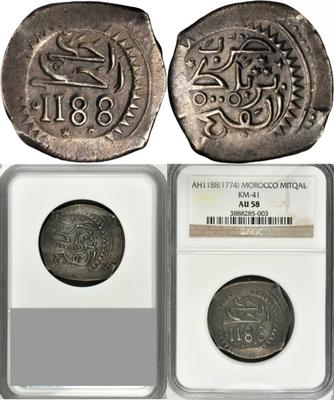 |
|
Valued Member
China
106 Posts |
To realeswatcher: You are really teriffic! The ebay listing you've posted is exactly where I bought them.I personally think it is a good buy,despite it can't be found in the SWCC neither the< monnaies et jetons des colonies francaises>. These may some sort of emergence coinage. Thanks for your information! |
|
Pillar of the Community
Australia
3841 Posts |
I have to disagree that these were made to imitate the cobs as there was no real need to do so. Again, my knowledge of Spanish colonial coinage is very limited so I can be very wrong. From my understanding, the cobs were struck and cut to Weight Tolerance so that they could be exported as 'bullion'. As this was deemed to be too cumbersome, machine milled coinage took over and this became a standard. Agreed, there were times when smaller denominations were needed and they were cut in quarters or something that mathematically makes sense for trade purposes. The real question is if these are indeed genuine and were used for commerce - isn't it absurd that it has taken more than 200 years for these to appear? Agreed, stranger things have occurred but this to me at best are attempts of making them into jewellery of some sort. That's also a huge assumption that they are genuine to start off with. My partial coin collection http://www.omnicoin.com/collection/gxseriesMy numismatics articles and collection: http://www.gxseries.com/numis/numis_index.htmRegularly updated at least once a month. |
|
Pillar of the Community
United States
5362 Posts |
Interesting data - the use of cobs cut to 4R or another heavier or lighter standard makes complete sense to me. Those were the common trade coins during the Spanish occupation. Most were cut clipped along one or two lines not 4. But to presume the same thing applies to portrait 8Rs that have been cut to preserve the portrait is a large leap of faith. I tried to estimate weight by area remaining and 18 grams is what I got - between the two quoted standards. So was there a third African standard between the two listed?
I am completely open to being convinced that there is such a coin, one only presumed to exist. After all, I discovered an entire class of Counterfeits that were only presumed to exist before I discovered scientific tests to disclose them. However, until I see more data - like individual weights - specific gravity and edge photographs - I am not prepared to jump on the bandwagon that presumes these are genuine coins cut to an unknown standard for a presumptive use in North Africa. I would also suggest that much more in the way of historic research is needed to determine something of the factual history behind the issue.
|
|
Pillar of the Community
United States
1962 Posts |
Quote:
Agreed, there were times when smaller denominations were needed and they were cut in quarters or something that mathematically makes sense for trade purposes. There was a previous comment along those lines... but that kind of assumes the 8R is being used AS the standard... In a case like this (if legit), the 8R are being co-opted for an entirely different standard. Quote:
I tried to estimate weight by area remaining and 18 grams is what I got - between the two quoted standards. The total weights of the groupings of (3) are given in the listings... generally averaging around that 15._ gram mark it seems. Two of the groups have pieces which are clearly a bit smaller ( 391351528832, 281895896806)... assuming they're genuine, perhaps whoever cut them was cheating a bit? Quote:
Most (cobs) were cut clipped along one or two lines not 4. That's sort of why I'm tying these together... the cobs I refer to typically have 4, 5 cuts semi-evenly around... to where the remainder ends up centered (opposed to one big hack from one side, leaving something crooked-looking). The way these portraits are cut is somewhat reminiscent of that. Quote:
portrait 8Rs that have been cut to preserve the portrait There clearly is an intended pattern with that... stupid thought, this is (again, if legit) simply crude ingot cutting here that we're dealing with, no counterstamping or similar, so not the most advanced operation. Maybe they just used the portait as a guideline for the cutting? Then of course, just to be difficult, there was the oddball in 391351519850. Quote:
...isn't it absurd that it has taken more than 200 years for these to appear? Who says it has? I can say that I've noticed enough of the cobs - almost always out of the Old World, never coming out of South or Central America) in this oddball weight range (largely too heavy to have possibly been done as 4R - nobody cheats up!! - and certainly way too light to just be thieving a bit from an 8) with similar clipping style that there is must be a pattern to it... Yet, all you ever see is occasional vague references about use in Africa (that's even all Sedwick states of them...). When you see them from the Spaniards, they just say "recortada" and leave it at that. Curious that it doesn't occur to them that 15-16g is not anything that would make sense in the Spanish realm... Perhaps it's no one has noticed because they just appear to be garden variety clipped down coins... and frankly, it may be such an obscure local standard that it doesn't matter. Surely if these were out of the Caribbean, collectors would get in a tizzy about them... but these are North African, so has anyone cared enough to research them? Spanish coinage certainly circulated in North Africa and the Levant/Ottoman lands, but you don't hear much about that... From that older thread I had linked, here's what the Algerian metal detector guy came up with. All cobs... certainly some obvious clippings present: 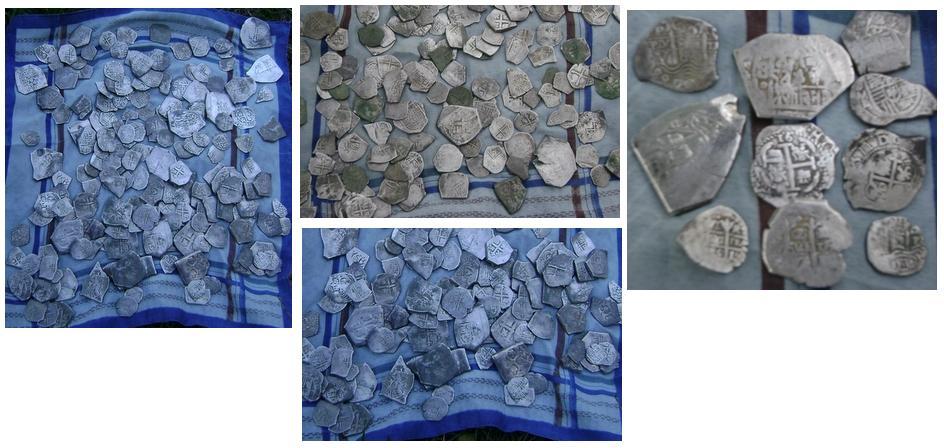 I think maybe some consult with a France-based North African expert would be in order... |
|
Pillar of the Community
United States
1763 Posts |
Who can argue - those hoard pictures - SAY ALOT. Will keep these in mind and realeswatcher if you see one on ebay or anyone else let me know - will purchase it if reasonable - analyze it and put it back on E-Bay as a ? N.African circulation piece ... etc. with its diagnostics IMO. |
|
Pillar of the Community
United States
5362 Posts |
To sum up the facts as presented.
1. There are 20 examples of cut down Portrait 8Rs from one seller in France.
2. The weights are given by lot of 2 or 3 coins. The weights for three vary from a high of 48.78 grams to a low of 39.79 grams. Shapes are not identical so the weights will not be identical in groups.
3. The patina implies a single origin.
4. The designs appear to match genuine coins.
5. The cob examples referred to are more numerous and weights vary from 12.15 grams to 23.5 grams. Several match rather closely the weight of a 4 reales.
The presumptions or suppositions:
1. The coin came from Oran from a hoard.
2. They are genuine coins cut down at a time long ago.
3. They are cut to a North African standard.
Since the pieces lack any type of an authentication stamp - they can be readily created from culled genuine coins or silver counterfeits at any time. All that is needed is a method of aging to create an apparent patina.
These coins may be real or they may be a fantasy issue. Tests and data needed are:
Individual weights
Individual specific gravities
Edge photographs
XRF tests
Because these pieces are not marked in any way (other than being cut) they will be very difficult to authenticate. The tests needed may well be more expensive than any value attached to the coins themselves.
|
|
Pillar of the Community
United States
1962 Posts |
Bob, yes, that's what we have... Though, again, I know I've seen at least another example of this kind (I don't THINK it was from this seller, though I'm not positive b/c again, I didn't save pics or the page or anything)... Also, with the cobs, I do want to reiterate that while cobs have certainly been cut to all different standards for varying purposes all over the world (and surely there will be some similar mint/date pieces that were cut in coincidentally similar ways in completely unrelated places)... I have seen enough around that 16 gram weight, cut in similar fashions - again, generally TOO HEAVY to be intended for use as a 4R under the Spanish system - sometimes linked to North Africa... that I believe there's a pattern there. When I then see portraits that have sort of a similar of a similar clipping style... and are close to that weight I've seen on those late Potosi cob 8R... seems like than coincidence to me. PS - Those other pieces that are African-sourced - the ones in that 22-23g vicinity - are a different clipping style - 1 or 2 edges lopped off - and are of course much heavier than the pieces I'm referring to. Africa (even just North Africa) is a big place... that was clearly a different standard (I'm sure there were quite a few). Another apparent example of this heavier type in addition to the ones I previously linked. Similar date, but MUCH higher weight, DIFFERENT style of a long straight cut off of one side...: http://www.icollector.com/Potosi-Bo...rd_i17426038http://www.sixbid.com/browse.html?a...&lot=2074741Edited by realeswatcher
01/17/2016 06:40 am
|
|
Pillar of the Community
United States
1962 Posts |
OK, found an example from 3 years back - pic below. Looks to be Potosi, 1790s. Certainly the same style of clipping... Very close to 4R weight in this case, which leads Hervera to call it as such, but again, since some pieces from the ebay grouping clearly range to a higher weight, you assume those higher weights most closely approximate the empirical standard (and that the lighter ones represent intentional undercutting). Those larger planchet Potosi 8R would be ideal to do this with, as the remainder cut could LOOK the same area-wise, yet have less silver. Also, logically... for the milled coinage, if you were simply cutting fractional small denoms. based on the 8R as the standard, wouldn't you simply cut it in half as we did here? "8 Reales. 13,46 grs. Recortada para circular como 4 Reales." http://www.acsearch.info/search.html?id=1322531============ Then this one... only 12g., but perhaps? Very similar style... however it's a Mexico PILLAR 8R: http://www.acsearch.info/search.html?id=576801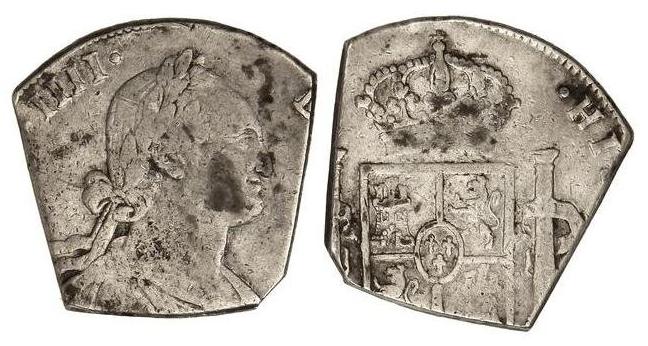 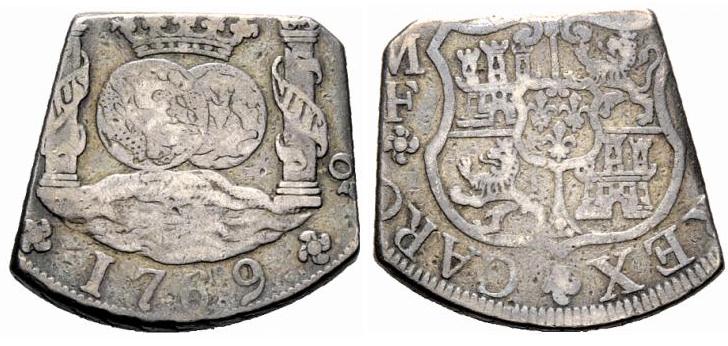 |
|
Pillar of the Community
United States
3363 Posts |
Another possibility is that these pieces were used as a source for silver smelting rather than coins. I collect spoons from this period, and worn Spanish colonial coins were a major source of the silver. Silverware was made on commission with the patrons supplying a mix of coins and old silverware. The spoons represented tangible wealth at the time, worth an acre of land typically, and it is plausible that coins used for melting were cut as needed for a job. A large English spoon I have from 1702 weighs 44 grams, and an American coffee spoon ca 1750 weighs 7.5 grams. Neither of these matches an exact coin weight multiple.
"Two minutes ago I would have sold my chances for a tired dime." Fred Astaire
Edited by thq
01/17/2016 08:51 am
|
| |
Replies: 78 / Views: 17,753 |








 First Page


 Posted 01/13/2016 09:04 am


