This may read like a mystery book with the final page torn out, but here goes.
I was recently thinking about a short article I read in "The Celator" years ago. It dealt with tetradrachms struck by Nikokles, king of Paphos, in the name of Alexander the Great, between c. 325 and 317 BC.
It seems that for more than two thousand years, apparently, no one noticed teeny-tiny Greek letters, spelling out Nikokles' name (below), hidden in the tufts of hair along the front of the lion's skin on Alexander tets struck under this king. According to a listing at Forvm, "The letters are so subtle that numismatists did not take note of them until 1919 (Newell, 'Myriandros')." Coins #3118-3123 in M.J. Price's 1991 study of Alexander's coinage include the minute letters. Price wrote, "The clandestine manner in which the inscription has been engraved suggests that it was not intended that it should be read by all...There was little chance that it would have been spotted in ancient times."

A neat thought, that this king's name would be in supposed plain site for two thousand years, with no one noticing. However, unfortunately, this is a bit like the Emperor's New Clothes. I have read about the letters, but have yet to see even one clear example. At best I can sort of see shapes that suggest letters. I believe the one pictured in "The Celator" article may have been this specimen below, which is a Price 3122. These pics are from an Ira and Larry Goldberg auction in 2014. The coin realized almost $11,000 on an estimated value of $5,000 - $7,000, so clearly the mystique of the hidden name has a dollar value.
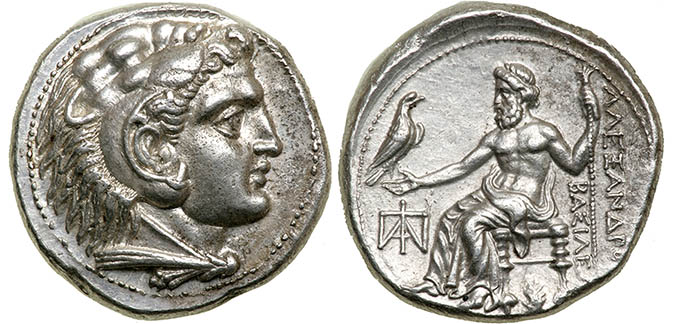
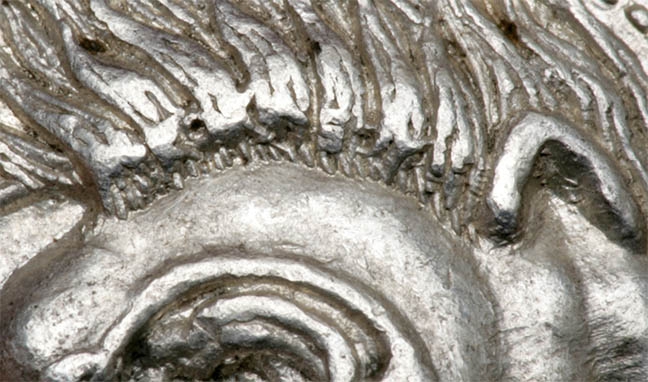
In their catalog description, the Goldbergs wrote this:
"This tetradrachm is part of a discrete issue that clandestinely bears the name (Greek letters removed here) on the obverse. As the name is found on seven different dies of varying style, it cannot be the name of the artist. Thus, the inescapable conclusion is that it is the name of the king of Paphos, Nikokles. Nikokles is known to have subsequently struck tetradrachms in his own name, so exactly why he was so careful to hide his name on these coins is not known. According to Price, the issue was probably struck at the time he was allied with Ptolemy I in his war against the Cypriot cities of Kition and Marion. Later, ca. 310/9 BC after Ptolemy had gained control of the entire island, Nikokles intrigued with Antigonos Monopthalmos, but Ptolemy sent a force against him under Argaios and Kallikrates. The generals surrounded the palace and ordered Nikokles to commit suicide, which he did along with the rest of his family including his wife, daughters and two brothers."
Below is a Price 3119 from a 2013 CNG sale. The catalog description for this one seems to suggest that the letters were a defiant, but secretive, gesture: "This piece formed part of a discrete issue of Alexander-type tetradrachms that bore the name of Nikokles in tiny letters along the border of the lion skin on the obverse (Price p. 388 and coins 3118-3123). Those pieces had to have been minted in the late 320s (they appear in a hoard buried c. 317) and they are a clear sign that Nikokles must have already wished to take on a leading role in Cypriote affairs in opposition to the overlordship of Alexander and his successors. As is well known, he was finally destroyed by Ptolemy I in 309."
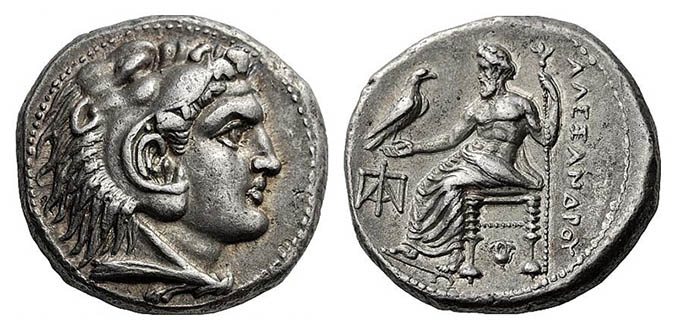
If anyone reading this ever comes across a pic of a clearer example, with less wear upon the letters, I'd love to see it!




 Posted 02/06/2016 09:51 am





