@DrDarryl: Very nice, thanks for sharing!
Here is one from my collection that I have exhibited at various coin shows. It is a process set (I've always heard them referred to as "process sets") of the revese of a bronze commemorative medal for the 1971 Missouri Sesquicentennial.
I've added some text to help explain each step of the process.
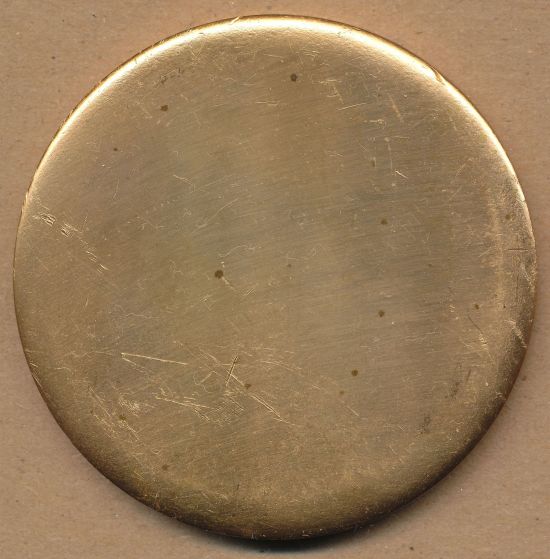
Step 1The bronze planchet is punched from a metal strip - much the same way coin planchets are produced (except no rims are added).
 Step 2
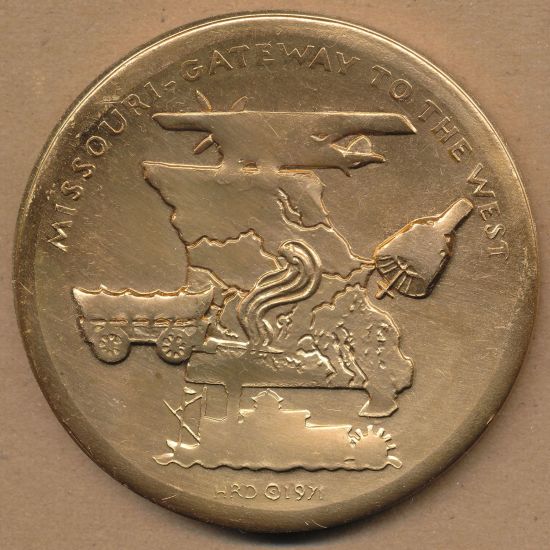
Each planchet is then washed to remove any foreign matter from its surfaces and then annealed (softened) by a controlled heating/cooling process.
Once annealing is completed, the planchet is struck for the first time. Metal in the planchet begins to flow into the design carved into the dies. The first strike of a high-relief medal does not produce a complete design impression - the highest points of the medal's design generally show little or no detail.
The metal flow caused by the tremendous pressure used to strike a medal generates heat and causes the planchet to re-harden. It can generally only be struck once or twice before it must repeat the annealing process.
 Step 3
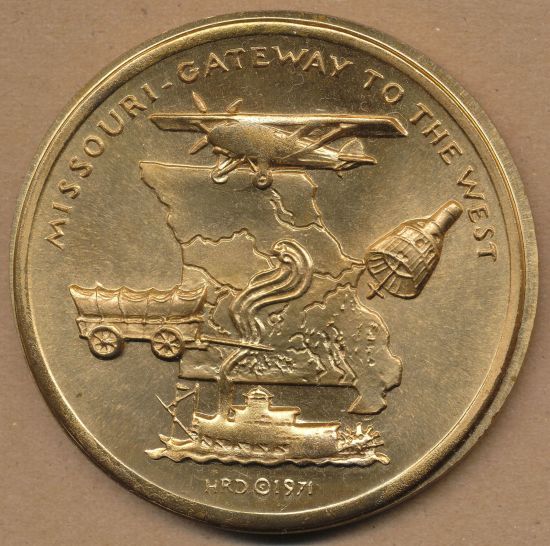
The planchet repeats the "strike then anneal" process multiple times until the full design is brought up.
 Step 4
As the "strike and anneal" process continues, more and more of the design details become evident on the medal. Note the additional detail on the river boat and airplane, for example.
 Step 5
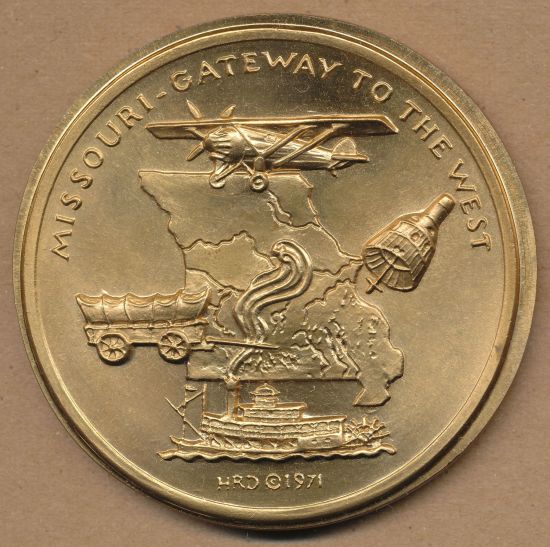
Now fully struck, the medal has a shiny appearance. It also has excess metal at its rim that needs to be trimmed off via a lathe before the medal is finished. High-relief medals are not generally struck in a collar, so excess metal is pushed between the dies during the striking process.
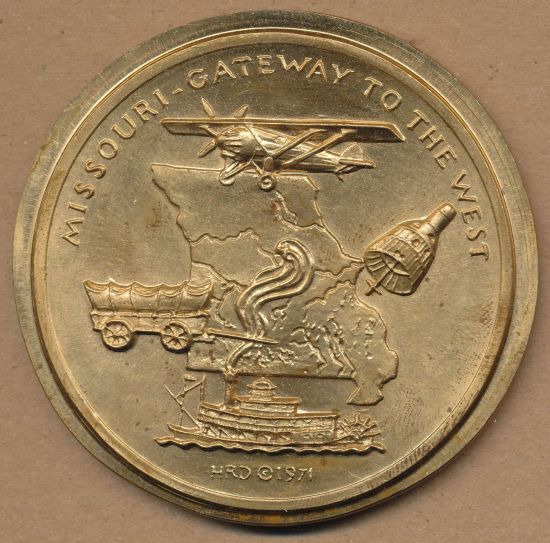 Step 6
The medal is then sand-blasted to remove its "shiny" finish and to give it a satiny appearance.
A medal could be considered "finished" at this point. It could be given a thin coat of clear lacquer and sold to the public. This one, however, went through one more step and was "antiqued."
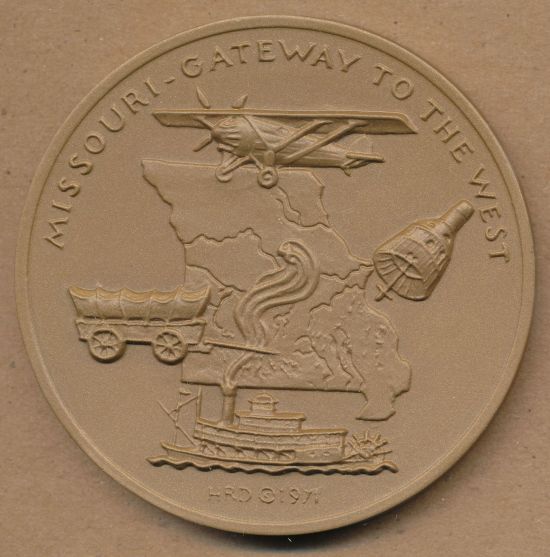 Step 7
The medal is briefly coated with a solution that darkens its entire surface; medals are often immersed in the darkening solution. The darkening process is the first step in creating the "antique finish" seen on many medals.
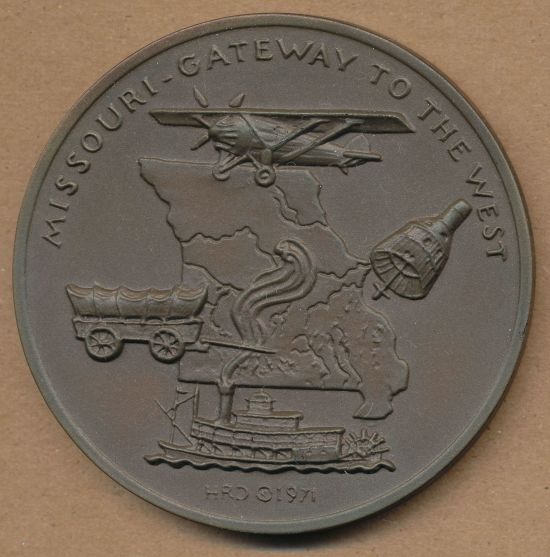 Step 8
The high points of the medal are then buffed to remove the darkening agent. The resulting bright vs. dark areas of the medal (i.e., its "antique finish") highlight its relief and make its design details "pop."

Here is the obverse of the finished medal.





 Posted 03/16/2016 01:05 am





