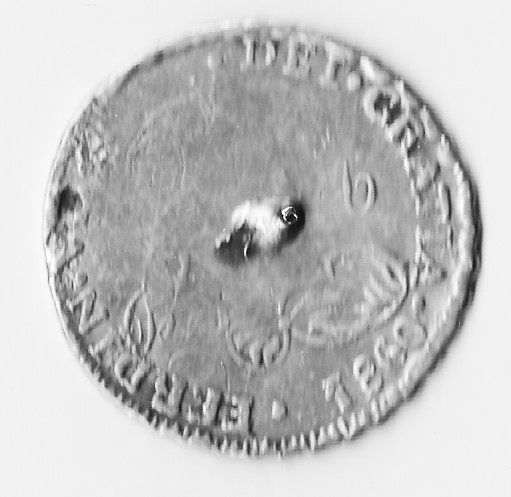
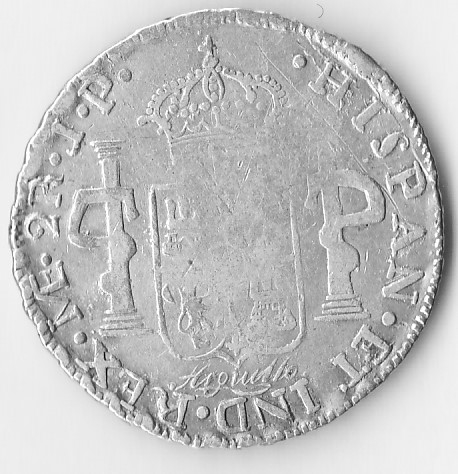
Finally procured the infamous 1860 Kleeberg CCC 2R button. It was originally discovered by R. August then a second specimen was encountered by D. Wnuck. A third has recently been found by a South American collector who passed it to me.
A picture of this button is in the Colonial Newletter update in April 2011 through the Eric P. Newman portal or MNA Library/Colonial link.
Will supply some pictures soon. The script on the back can finally be read as ARGUELLO like the famous boxer. This is probably the last name of this button maker. If anyone has any information of Arguello to button or coin making in the 19thC let me know or post it here. Its on a button dated 1860 Ferdinand VII Lima Mint and a JP assayer - all IMPOSSIBLE. For a time most collectors felt August held the holy grail of CCC 2R's which later was confirmed a severe post dated BUTTON. Will run its XRF this week.
Here is a cut and paste for Arguello:
The prestigious Spanish surname Arguelles finds its origin in the place name Arguello, which is the name of a number of locations in Spain. The surname Arguelles signifies "descendant or son of one who came from Arguello." It is derived from the Old Spanish "arboleo, " meaning a "well-wooded area" (from the Latin "arboleus," a derivative of "arbor" meaning "a tree").
Spelling variations of this family name include Arguella, Arguellos, Arguelles, Arjuela, Arbuelo, and others. First found in the province of Leon, in the ancient kingdom of Castile. Early records of this surname include a reference in the Los Americanos en las Ordenes Nobiliarias (1529-1900) to Juana de Arguello who married Clement Munoz del Castillo (b. 1612) circa 1640 in Guanajuato, Mexico.
http://www.houseofnames.com/fc.asp?sId=&... Arguelles Surname
This Spanish surname of ARGUELLES was a locational name meaning 'The dweller at the well wooded area' so called from the old Spanish word 'Arboleo' meaning an arbor tree and rendered in medieval documents in the Latin form 'arboleus'. Surnames derived from place names are divided into two broad categories; topographic names and habitation names. Topographic names are derived from general descriptive references to someone who lived near a physical feature such as an oak tree, a hill, stream or a church. Habitation names are derived from pre-existing names denoting towns, villages and farmsteads. Other classes of local names include those derived from the names of rivers, individual houses with signs on them, regions and whole countries. In the Middle Ages heraldry came into use as a practical matter. It originated in the devices used to distinguish the armored warriors in tournament and war, and was also placed on seals as marks of identity. As far as records show, true heraldry began in the middle of the 12th century, and appeared almost simultaneously in several countries of Western Europe. In the 8th century, Spain fell under the control of the Moors, and this influence, which lasted into the 12th century, has also left its mark on Hispanic surnames. A few names are based directly on Arabic personal names. The majority of Spanish occupational and nickname surnames, however, are based on ordinary Spanish derivatives. In Spain identifying patronymics are to be found as early as the mid-9th century, but these changed with each generation, and hereditary surnames seem to have come in slightly later in Spain than in England and France. As well as the names of the traditional major saints of the Christian Church, many of the most common Spanish surnames are derived from personal names of Germanic origin. For the most part these names are characteristically Hispanic. They derive from the language of the Visigoths, who controlled Spain between the mid-5th and early 8th centuries.
JPL









 Posted 03/19/2016 11:27 pm


