LeAnn, Here's a cut and paste:
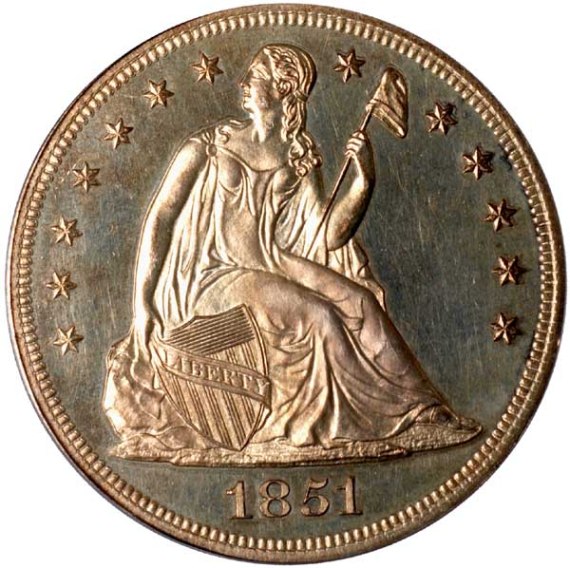
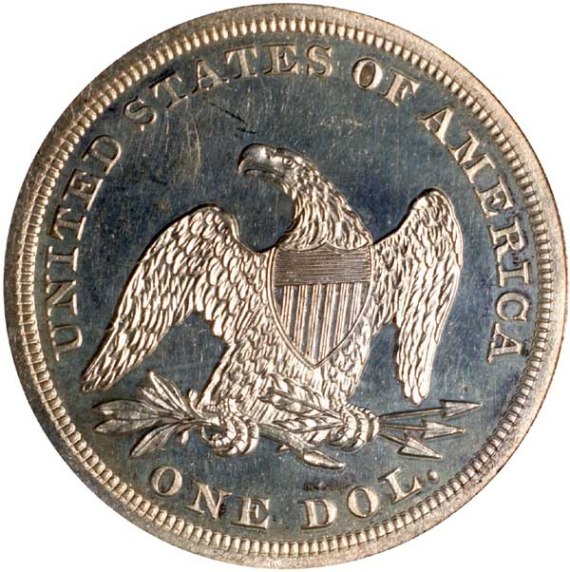
1851 Restrike. Proof-63 Cameo (PCGS).
A pale champagne specimen with frosty motifs, mirrored fields, and a sharp strike. Indeed, the strike couldn't be anything but sharp, as the coin was carefully struck, multiple times in an effort to remove its 1846-dated undertype.
The present coin is clearly and unequivocally struck over a pre-existing silver dollar of an earlier date, in this instance 1846. This seems to be an 1846 Philadelphia Mint dollar, rather than an 1846-O, for there is no trace of a "ghost" O mintmark below the eagle on the reverse (as there is in the case of another 1851 silver dollar restrike, sometimes called a Proof "1851-O." That piece is listed in Guth and Garrett's Top 100 U.S. Coins and was last sold by the Goldberg's in their sale of September 2003).
The present variety, identified by Frank Van Valen of our staff, January 26, 2004 (in case anyone is keeping track!), is the missing link, for the other known overstrike, seemingly has the date undertype blanked out, or such is said to be the case (we would be pleased to examine the other coin to render a modern opinion, if the owner reads this and so desires).
The Restrike 1851 dollars were produced at an unknown time under unknown circumstances, per conventional wisdom by someone on the Mint staff after Spring 1859 when Director James Ross Snowden decided to take commercial advantage of the current growing numismatic interest in patterns, restrikes of earlier dates, and so on, and openly stated that they could be supplied to one's heart's content. However, after spring 1859 the whole matter went underground, and today we can only surmise by examining the coins.
To produce the coin struck here, the minter would have had to use an already struck 1846 dollar on hand, rather than a blank planchet. This might mean that it was produced in some section of the Mint, where planners or someone else kept track of planchets—or otherwise it would have been easy to have used a blank. Alternatively, it could have been an accounting function to use a previously-coined dollar, and not a fresh planchet that would have been purchased with the Mint's Bullion Fund and, thus, kept track of. During the 1850s such arrangements were quite casual, and as Don Taxay and others have said of those working there, the Mint was a "workshop for their gain" during this period, with the activities of Chief Coiner Franklin Peale being particularly egregious in that regard.
The present coin, a superb piece in terms of an 1851 Proof Restrike dollar with centered date, itself a classic rarity, elevates itself to special importance to the collector and historian, joining the "1851-O" dollar earlier mentioned and also a
Gobrecht silver dollar discovered by Art Kagin about two decades ago, with obvious striking over a pre-existing 1859 Liberty
Seated dollar. How interesting all of this is! With the famed "1851-O" Proof dollar now effectively proven to be an overstrike (as we and many others had previously considered the odds-on explanation, and as cataloguer Ron Guth called "a distinct possibility," leaning that way in his last treatment of the coin), the present piece takes on a significance close to that famed and fascinating item—and that coin realized $276,000 last year! While we do not expect that sort of number to be realized for this very similar specimen, we do know that savvy connoisseurs and those fascinated by the intricate history of the Mint in this period will render a premium bid for this simply lovely 1851 Restrike dollar.
FYI - the easiest way to eliminate 90% of the counterfeits is by weight. An MS or Proof should weigh 26.73 grams










 Posted 02/14/2008 3:09 pm


