| Author |
 Replies: 8 / Views: 2,873 Replies: 8 / Views: 2,873 |
|
|
Pillar of the Community
United States
1490 Posts |
I just got this 1917 Mercury dime and I noticed a line in the right reverse field that extends from the top of the oak leaves down to E Pluribus Unum. This line seems to follow the outline of the back of liberty's head. Is Liberty's head clashed onto the reverse? 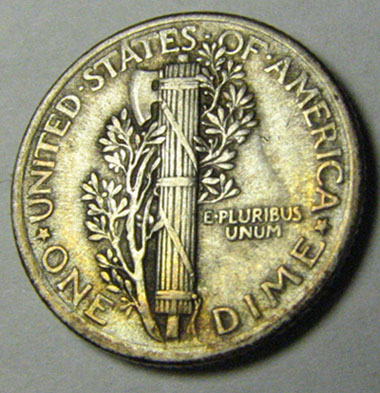 |
|
|
|
Pillar of the Community
United States
3507 Posts |
No...This is tough to describe but this is not a die clash. I'll take a crack at it. When a coin is struck the pressure used by the press is enormous. The features of the coin actually are pushed through the metal of a planchet when the coin is struck. If you ever see a coin that has split as in the case of a split planchet error, you can still see a faint image of the details of the coin on what is really the inside of the planchet.
What you are seeing on this coin is an impression of the obverse that due to the movement of metal through the planchet, is slightly visible on the reverse of the coin.
Examples are most often seen on early Winged Liberty (Mercury) dimes and for some reason, I see it a lot on Lincoln cents of the 1920s.
|
|
Pillar of the Community
 United States
1490 Posts |
Thank for the explanation. So it is an impression of the obverse being seen on the reverse but not a die clash. How does this differ from the impressions or die clashes you see on Three Cent Pieces? |
|
Bedrock of the Community
United States
12437 Posts |
The common 3CN clashes are caused by the dies colliding without a planchet, i.e. clashing, whereas your dime is a function of striking pressure and the thinness of the planchet. I personally have seen the effect of your coin on Roosies and Mercs, Lincoln cents, and even the 3CS and 3CN, basically the small thin coins. They are commonly confused with clash marks but clashes usually have sharper, distinct lines but notice that yours is more of a "ghost" image.
|
|
Pillar of the Community
United States
1490 Posts |
Thanks Biokemist that clears it up.
|
|
Bedrock of the Community
United States
20753 Posts |
You stated the line appears to follow the outlines of the back of Liberty's Head. I think you mean her nose. In order to verify that what you see is in fact a pushed through outline of the obverse, try comparing the curvature of that line with a obverse facial portion of another Mercury dime. Prior to doing this though, place the coin in a 2x2 and flip it over top to bottom. This is to verify that the reverse is not rotated. A large quantity of Mercury dimes have rotated reverses. If not rotated, then compare the nasal curvature with that line. |
|
Pillar of the Community
United States
1490 Posts |
justcarl,
It appears that if it was the curvature of the nose it would be in the left field of the reverse?
Is it possible for an obverse feature to show on the opposite side of the reverse?
|
|
Bedrock of the Community
United States
20753 Posts |
justcarl, It appears that if it was the curvature of the nose it would be in the left field of the reverse? Is it possible for an obverse feature to show on the opposite side of the reverse? JimR You got me there. I forgot that the coin stays upright as you turn it over top to bottom. What I should have done is turn it over and then hold it to a mirror. YOUR RIGHT. That line is equal to the back of her head. However, and again I may be looking at this wrong, but the curvature of that line is inwards towards the leaves and the back of her head would be outwards, I think. I'll be looking at Mercury dimes in the mirrors all day now. Maybe it's just me but that line does appear to look like the nose line from the other side. |
|
Bedrock of the Community
United States
62064 Posts |
Ok, I think I have the solution to the question. The position of the dies are the key. The pattern to what they look like from each angle is different. Always rotated 180 degrees from each other and flipped horizontally because the dies are negatives. So view the coins they are a positive of the dies, the reverse would look normal and the reverse would still look as a negative to see the alignment of where they would touch each other. 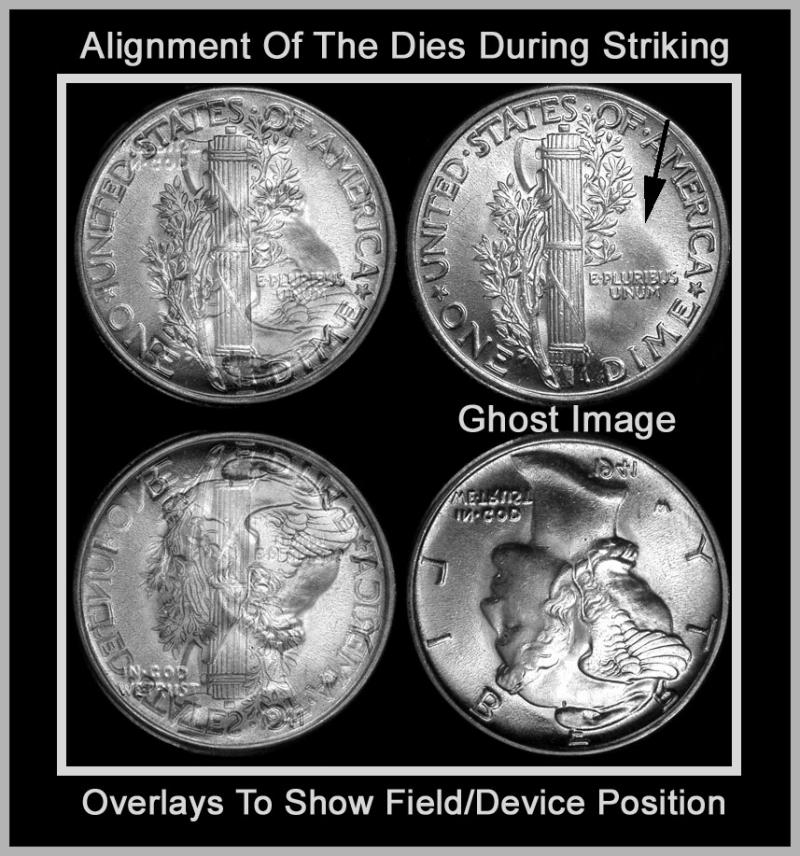 So what was viewed as a nose is actually the negative of the back side of the head. The mark on the reverse I feel is not a bend in the coin and not a die clash. Well what is it? It is from a previous die clash/clashes. The die after a clash is taken off and cleaned/polished to remove the clash from the field. This removes metal from the die. After a few happenings of this over and over after each clash, there is a lower part of wear from the cleanings. These ghost images of the reverses are a result from several polishings to remove die clashes. When the field get worn down, the area in the outline makes a higher image instead of flat. So instead of appearing bent the die was worn by cleaning to produce a raised area in that location of the out line of the bust. So that is my take on it. |
| |
Replies: 8 / Views: 2,873 |
|










 Posted 03/04/2008 08:27 am


