| Author |
 Replies: 56 / Views: 7,334 Replies: 56 / Views: 7,334 |
|
Pillar of the Community
United States
790 Posts |
I have to think this has been covered somewhere, but I don't see it. Feel free to tack this onto another topic if there is one already.
I'm confused about cleaned coins. I've read that many if not most really old coins have probably been cleaned, and I've seen graded coins that note they were cleaned.
But I've also been told that if a coin was cleaned, that pretty much stripped it down to its melt value (of course, the folks that said that were dealers, and I suspect that they may say things like that to manage expectations from people who have a collection they might sell).
I imagine it probably depends on a lot of factors, but does anybody have a general opinion as to how much a past cleaning (not with a Brillo pad, just enough to affect luster on an otherwise nice coin) affects value?
Thanks!
|
|
|
|
New Member
United States
22 Posts |
I have heard 30-40% reduction in value from that of a non cleaned coin at the same grade. My 2 cents
My 1821 small date dime came back from PCGS with the dreaded XF Details Cleaned on it.
Sean
|
|
Bedrock of the Community
United States
12057 Posts |
Depends on how much the eye appeal has been damaged. Originality rules the Coin World these days. For a quick dip on a MS or higher AU coin that left luster relatively intact, I would say maybe 60-85+% of normal book value depending on the collector. Anything else, except certain early 19th c. coinage (Bust halves/quarters & earlier) I value at 10-20% of book, or melt for silver/gold, whichever is higher. The only coins that still maintain a fair bit of value even when harshly cleaned or otherwise abused are certain very key dates (1877/1909S IHC, 1856 FEC, 1909-S VDB/1914-D LWC's, 1916 SLQ, 1893-S Morgan $1, CC/C/D minted 19th c. gold, so on and so forth) and other coins that will always carry a premium in ANY grade (Chain/Wreath large cents, Small Eagle early bust coins, patterns, proofs, exceptionally rare die varieties, overdates, etc.) Ultimately it's going to be up to whomever is looking at the coin to decide how much the cleaning has affected the value. Some collectors are slightly more tolerant than others who will not accept any non-original coin of any sort at all. There is no "hard and fast" rule, unfortunately. A good guide is to search completed ebay auctions for cleaned examples of given coins in a series and see what they tend to sell for. Member ANA - EAC - TNA - SSDC - CCT #890 "Most of the things worth doing in the world had been declared impossible before they were done." -- Louis D. Brandeis Edited by paralyse
10/21/2016 9:19 pm
|
|
Pillar of the Community
United States
3355 Posts |
If you're selling -50%. If you're buying -25%. Or so.
It depends a lot more on whether you want the coin. If it's rare and you want it you'll pay more, because you're keeping it. But on the dealer side it's likely to always be discounted off wholesale book, and less if they can't turn it over.
"Two minutes ago I would have sold my chances for a tired dime." Fred Astaire
Edited by thq
10/21/2016 10:15 pm
|
|
Pillar of the Community
 United States
790 Posts |
Is it true that cleaning coins was a "thing" in the '50s?
|
|
Pillar of the Community
United States
1450 Posts |
Define "cleaned coin". Is quickly dipping a coin to get off surface grim in acetone considered cleaning it? I look at raw coins and I can spot coins that have been polished, but some that may have been cleaned I can't see unless I see marks or evidence of being rubbed clean. I, frankly, cannot tell the difference in AU58 Morgan and MS60. This is why I usually buy graded coins.
|
|
Pillar of the Community
United States
790 Posts |
For that matter, how damaging is it to use a microfiber cloth and some pressure to get that tarry gunk off an otherwise fairly, clean coin? I've been afraid to do it with a couple of fair finds from pocket change, in case it damages the coin. I've tried it on a couple spenders just to see if it works. It gets the stuff off, but the coins are lighter where it used to be. I didn't see any scratches, but I'm not looking with a stereoscope.
Edited by twslisa
10/22/2016 6:23 pm
|
|
Pillar of the Community
United States
1697 Posts |
How rampant is coin cleaning? Try finding a slabbed circulated coin with a fingerprint. Evidently our ancestors only touched coins by the edges...
|
|
Pillar of the Community
United States
790 Posts |
I have one with a fingerprint! Just there on Liberty's cheek. 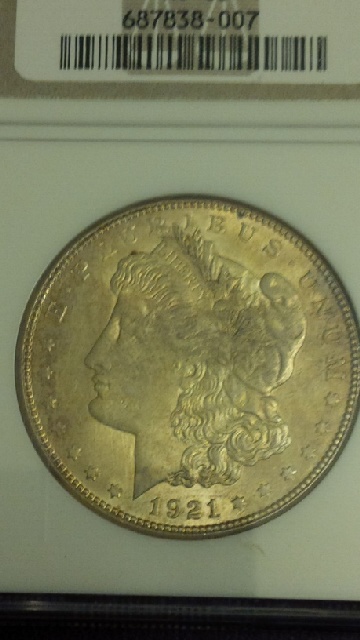 |
|
Pillar of the Community
United States
790 Posts |
Anyway, so here's what I think I should look for to know if a coin is cleaned...
A) obvious lighter patches on the coin, as if one particular area hasn't "lived" as much as the rest.
B) a coin in otherwise good condition, but flat, no luster at all.
C) lots of gunk in the grooves and crannies (stars and denticles, for example), but pristine in the important details (hair, feathers, etc.)
D) weird luster--not the cartwheel kind--or a coin that is suspiciously shiny for its age and level of wear.
Is there anything I've missed?
The thing is, I've seen many of these things in graded coins that are NOT noted as cleaned. So I'm still not quite sure how I'd KNOW.
|
|
Pillar of the Community
United States
1499 Posts |
Quote:
Is it true that cleaning coins was a "thing" in the '50s? Dipping was certainly "a thing" in the 1960s when I started collecting. Silver coins, regardless of their age, were supposed to "white" for many collectors. Most every Bust Dollar you saw offered for sale was white even in the circulated grades. There were collectors who collected toned coins, but some people thought that they were a bit "odd." Many collectors had the attitude that toning hid wear and was therefore a way to push AUs or "sliders" on to unsuspecting collectors as Uncirculated. My first really old silver coin was a 1799 Bust Dollar, which I bought circa 1969. It graded Choice VF by sharpness, but it had been dipped white. It was not whizzed or polished however. What's the difference? Whizzed, cleaned or polished coins have had the metal on their surfaces moved around. That is now and long has been a big no-no. Dipping removes a very small amount of oxidized metal with a weak acid. Purists will tell you that is just as bad as cleaning, but they are wrong in my opinion. Dipping, if it is done properly and not too often can restore some beauty to a coin. Some naturally toned pieces can be very ugly and almost unsalable. Dipping can bring them back to life. BUT you have to be able to judge which coins will benefit and which ones will not. That is where experience and knowledge come in. |
|
Bedrock of the Community
United States
20753 Posts |
Quote:
Is it true that cleaning coins was a "thing" in the '50s? Of course it was a thing to do back then. People just didn't care or know it made a difference. Showing someone a coin collection and the coins were all dirty, first thing said was why don't you clean those things. |
|
Pillar of the Community
United States
3355 Posts |
@billjones the term was I remember from Coin World was "Blast White Stunner!". Dealers listed them by the hundreds. "Two minutes ago I would have sold my chances for a tired dime." Fred Astaire
|
|
Pillar of the Community
United States
5984 Posts |
Here's where I get confused... On one hand, I've been told (especially by dealers at coin shows) that any silver coin that is still "blast white" after 100+ years has to have been cleaned at one point or another, due to the simple fact that silver tarnishes over time. On the other hand, I see plenty of ""blast white" Morgan dollars, Seated Liberty coinage, etc., that have been certified and graded by NGC and PSGS as MS with no indication of "improper cleaning". So, is it really true that any old silver coin that still looks blast white must have been cleaned? Or do the grading companies only care about cleaning if it is done "improperly" (which implies there is a proper way to do it)? |
|
Pillar of the Community
United States
3355 Posts |
Because there were so many of them in the 80's and 90's I wonder whether there was a wink wink nudge nudge by the TPG's in return for bulk submissions. Or whether, like Tour de France riders of the time, dealers got so good at dipping them that they passed detection. "Two minutes ago I would have sold my chances for a tired dime." Fred Astaire
|
|
Pillar of the Community
United States
1697 Posts |
Quote:
So, is it really true that any old silver coin that still looks blast white must have been cleaned? Silver + sulfides in the air = tarnish. Silver without tarnish has either been kept away from air, or has been cleaned. |
| |
Replies: 56 / Views: 7,334 |










 Posted 10/21/2016 9:18 pm


