| Author |
 Replies: 14 / Views: 2,279 Replies: 14 / Views: 2,279 |
|
|
Valued Member
Australia
210 Posts |
What are your opinions of these coins' grades and value? I like the details, but there seems to be a bit of porosity (shipwreck coins?) I saw an (AU details) on ebay for $120, and an NGC EF for $60. I think the 2 would be worth $150, what do you think? 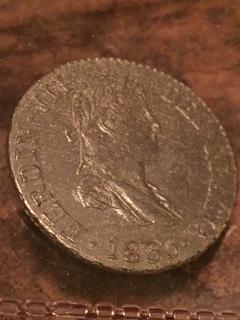 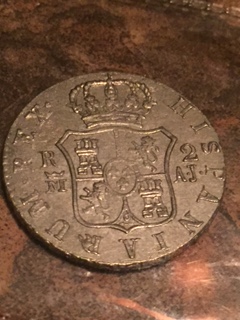 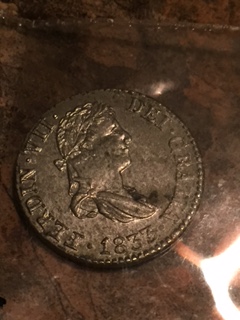 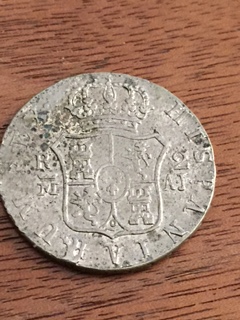 Edited by Misterpostman
01/08/2017 2:32 pm
|
|
|
|
Pillar of the Community
United States
1962 Posts |
Two more of this plentiful old counterfeit (or gaming token, or whatever kind of non-regal imitation it is) - see: http://goccf.com/t/115901 |
|
Valued Member
 Australia
210 Posts |
Thanks, Realeswatcher. I read the link. My coins weighed 5.7 and 5.6 grams, so it looks like you are right.
|
|
Pillar of the Community
United States
1962 Posts |
No, it's not because of the weights - those figures would be correct for a Spain 1833 2R (Krause is incorrect). It's simply from observing the pieces and seeing what they are...
|
|
Pillar of the Community
United States
1761 Posts |
The 1833's are the most common portrait pistareen's which are counterfeited. I own a GEM UNC I purchased from Karl Stephens ... these are tough in high grade and SOME come with Cuban lattice counter-stamps. Not sure if I included this one in my new book but too late for this great realeswatcher update. Must be getting old like Bob said I believe ALL are plated but still not sure if I have seen a few with mercuric wash of silver? No doubt I owned a few withe the Cuban lattice and some collectors go a little crazy with this stamp for a CC. Crazy being just into THREE figures for this common CC.
|
|
Valued Member
Australia
210 Posts |
So, even being counterfeits, what is a realistic value for them?
|
|
Pillar of the Community
United States
1962 Posts |
The problem is that more times than not when this counterfeit type appears, it is mistaken for genuine (and have seen more than a few slabbed as genuine, AU cleaned, AU environental issues, or similar)... in those cases, any data point where a sucker was snagged at some price approx. that of an AU-UNC genuine piece is, well, fraudulent. Othertimes, they are dismissed as almost junk -- apparent fake of an obscure foreign coin equating to I don't care -- and they get junk boxed. And then, those who know what they are... maybe have more appreciation for them, but know that they're plentiful and all high grade and thus not worth much.
Ya know, John and Bob, given how so many of these are out there, barely used... you think there's some chance they were made as gaming tokens, a la spade guineas? Note that in the Spanish sphere, there are a good amount of brass imitations of 1860s Isabella II gold pieces that are typically described as such.
|
|
Pillar of the Community
United States
1962 Posts |
"these are tough in high grade" John, they're almost ALL high grade... are you thinking of the right piece? Would like to see one with the Cuban lattice C/S... I don't recall seeing any myself. I HAVE seen this piece... on a CC of a SEVILLE 1833 2R (or perhaps done all as one). There is also a another Seville 1833 I have seen at least (2) diff. specimens of. 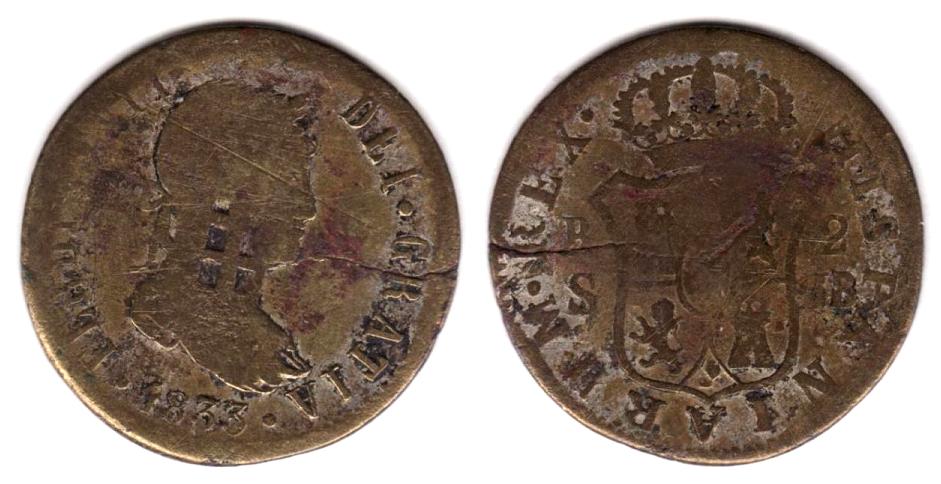 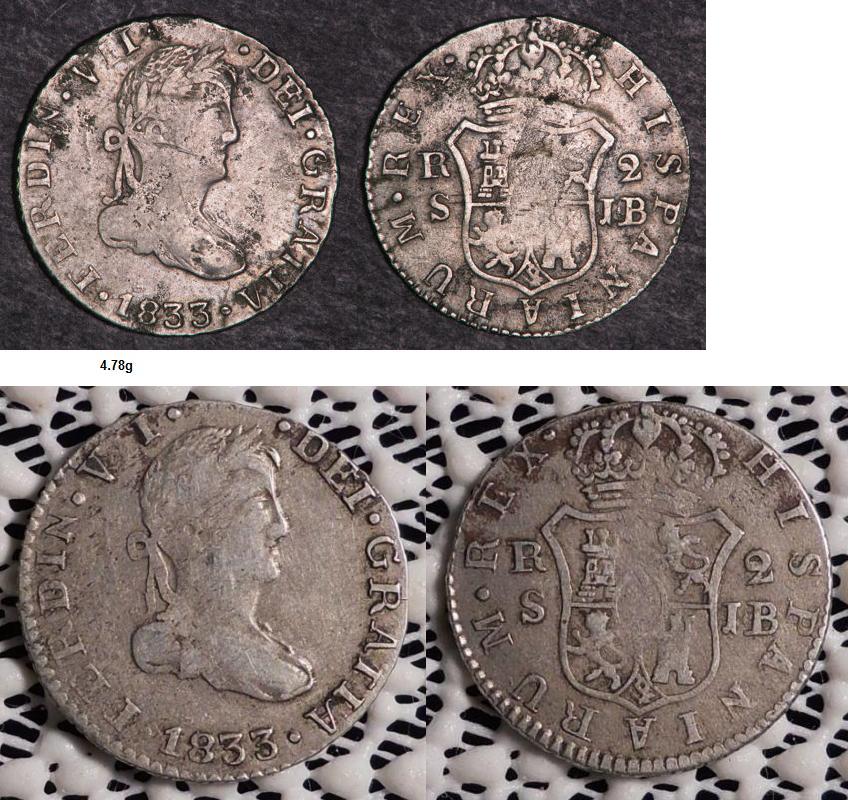 |
|
Pillar of the Community
Australia
7096 Posts |
Quote:
So, even being counterfeits, what is a realistic value for them? Knowing that these are counterfeit, Would you actually Sell them ? |
|
Pillar of the Community
United States
1761 Posts |
Yes your top photo lattice counter-stamp was my reference coin being discussed. There was a time say 20 years ago I did see many of them but now they must all be in collections - they don't appear as often. As an example its been a awhile (i.e., around a year) since I have seen just one in ebay - Spain withe the lattice on a 1833 silvered brass host. There always silver wash. I will even stick my neck out and say 100% (i.e., never silver plated). There has been some newspaper article evidence that Central American counterfeits of this general time period did originate and were manufactured from Belleville, NJ. An article shows a confiscation with hundreds if not thousands of counterfeit planchets silvered waiting to be struck or are already struck being shipped to Central American region. The collector finding this evidence was Julia Purdy. Her E-Bay name is Chullie as an easy point of contact. Just mention Belleville, NJ and ship confiscation articles. You know those 1833 Haiti CC2R's that come in brass and German Silver. Coincidence? <VVBG>. This may also have been the up the Hudson River for some of the Canadian Blacksmiths in the 1830/1840's. Same M..O ... so to speak ... JPL Edited by colonialjohn
01/12/2017 1:52 pm
|
|
Pillar of the Community
United States
1761 Posts |
Without lattice - VF - $50; With lattice - VF ~$100 IMO.
|
|
Valued Member
United States
264 Posts |
Quote:
Ya know, John and Bob, given how so many of these are out there, barely used... you think there's some chance they were made as gaming tokens, a la spade guineas? Note that in the Spanish sphere, there are a good amount of brass imitations of 1860s Isabella II gold pieces that are typically described as such. Just a minor point of clarification. The brass Isabella II gold 100 reales and 10 escudos are remnants of contemporary counterfeits that lost their gold coating. After they were identified as counterfeits they were commonly holed and worn as jewelry and could, conceivably, have seen other uses. However, the practice of ebay sellers referring to them as tokens or medals is most likely a marketing decision. |
|
Pillar of the Community
United States
1761 Posts |
In terms of Isabel II and the platinum and gold plated platinum issues I discuss these in some detail in my new book with several specimens in my collection. These of course even going through some Jesus Vico auctions appear in all denominations and quite easily obtained with just some spare cash - <BG>.. In the interim although a bit pricey read "A History of Platinum and its Allied Metals" by McDonald & Hunt. The authoritative book on this subject and its references to numismatics. It explain why a lot of these platinum Contemporary Circulating Counterfeits have a so-called South American origin or mint assigned to these species. These are for all intents and purposes a totally different animal than these 1833 Portrait Pistareens (Belleville, NJ - issues?) ... IMO.
JPL
|
|
Pillar of the Community
United States
1962 Posts |
|
|
Pillar of the Community
United States
1761 Posts |
Just some rambling ...
With all contemporary circulating counterfeits there are different levels of workmanship as you know ... as numismatists we always feel the urge to classify everything to a certain group. In this realm the level of desirability moving downward IMO goes from pure platinum issues (i.e., most desirable)/ gold mercuric amalgamated wash over platinum issues/ gold/ MIXED with brass/bronze issues (JPL confirmed)/brass, bronze or brass/bronze mixture with high end dies to eventually cartoonish type brass or high end brass issues (i.e., least desirable) as we see most of these types listed in Coronado.
For me I prefer the more crude the better so I would prefer the cartoonish type to the well made brass type with close to regal dies. But I am in a distinct minority. Like the Spade guineas which many people call gaming tokens as they are its simply a tag put on certain types of CCs. - IMO in error for Isabel II types. No harm/no foul.
In the world of English/Irish CCs sometimes the most severe cartoonish pieces like the infamous Mike Ringo (Stack's Americana Sale - 2008) cartoonish piece brought over $15,000!
The world of Isabel II issues as with most Spanish cataloging by Cayon, Aureo & Calico and Jesus Vico is quite CRUDE and in terms of cataloging to say Stacks/ Bowers English/Irish 18thC 1/2d's and 1/4d's are still back in the 1950's as when w Eric P. Newman and Bob Vlack first introduced the term "bungtown" to collectors to describe CCs. These Spanish firms have a long way to go but they are stubborn, set in their ways and unusually resistant to any change in their one line cataloging.
Unusual.
IMO.
JPL
|
| |
Replies: 14 / Views: 2,279 |
|






 Posted 01/11/2017 09:28 am





