| Author |
 Replies: 11 / Views: 1,731 Replies: 11 / Views: 1,731 |
|
|
Press Manager
 United States
1420 Posts |
CoinWorld - Though modern scholars have learned a great deal about ancient coinage, there are still more mysteries than there are confirmed facts. 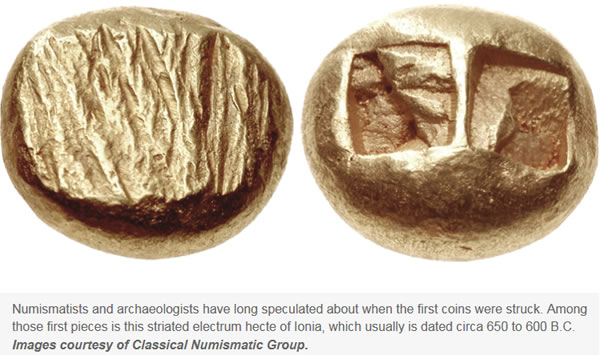 When one digs deep enough, it becomes apparent that many of the "facts" presented in auction catalogs and standard references are simply educated guesses that are prone to future adjustment (or outright abandonment) as new information comes to light. A single column doesn't have enough space to touch upon even a small fraction of those subjects, so we'll have to content ourselves with brief examinations of five important coin mysteries. Read the Entire Article
|
|
|
|
Pillar of the Community
 United States
2843 Posts |
Curious if anyone considers that the Bible has a record of coins being used well before 650 BCE. Are we just talking about coins with designs? (Which we do not know for certain existed back then) Minted by a specific governing body? (Also do not know if that was a thing.)
Or is this article only accounting for coins that have physical record of, as opposed to written record of.
|
|
Pillar of the Community
United States
6130 Posts |
Very good article!
Expanding upon the invention of coinage, what puzzles me the most is the near-concurrency of the invention in Asia Minor, NW India, and China, all within about 150 years. The concept of correlating precious metal weight with value is an ancient one, even compared to the advent of struck or cast "coinage". Weights of silver as currency were mentioned in the Book of Genesis, and I'm sure some quick googling will turn up even more ancient references. How three separate civilizations had the same "Aha!" moment in practically the same century is beyond me.
And although there are a lot of blanks in our knowledge of Greek and Roman currency, those pale in comparison to the "fringe" areas of ancients collecting. Some of my favorite mysteries:
1. Who made the "barbarous radiates", when and why?
2. The "Indo-Sassanian" coins come in several hundred varieties. We don't 100% know who made most of those varieties, but there are enough to maybe entertain the idea that we could assign some to a particular ruler. Maybe. For now, the margin of uncertainty for most issues is 200-300 years.
3. Likewise, despite the vast number of Indian, Hunnic, and indigenous Central Asian coins out there, there simply isn't enough scholarly interest to even scratch the surface.
|
|
Pillar of the Community
United States
616 Posts |
Fascinating article. Thanks for the post!
|
|
Pillar of the Community
United States
949 Posts |
Quote:
Curious if anyone considers that the Bible has a record of coins being used well before 650 BCE. Such as? The shekel was a unit of weight long before it was ever a coin. Precious metals were used as currency, but were weighed out on scales from scraps to whole vessels. Quote:
How three separate civilizations had the same "Aha!" moment in practically the same century is beyond me. Don't you suppose they traded with each other, or at least that voyagers brought back samples? Edited by lrbguy
01/26/2017 3:50 pm
|
|
Moderator
Australia
16991 Posts |
Quote:
Are we just talking about coins with designs? (Which we do not know for certain existed back then) Minted by a specific governing body? (Also do not know if that was a thing.) Well, part of the debate as to "which civilization invented coins first" is the actual definition of "coin". At what point, in the generally evolutionary continuum between bartered bits of metal and modern-day coins, do you say "these are coins, but those aren't"? The standard working definition of a "coin" is a piece of metal that is: - produced under government authority for use as money; - impressed with some sort of mark originally intended to indicate that authority; - these markings attested to the genuineness of the coin and the weight and purity of the metal it is made of. Thus, the stamped pieces of metal issued in Lydia and the contemporary cast pieces in China are definitely "coins"; the occasional irregular lumps of silver unearthed in Israel and elsewhere that might or might not weigh about a shekel are not "coins". Quote:
Don't you suppose they traded with each other, or at least that voyagers brought back samples? There's no evidence that physical coins travelled between civilizations that early. But in a sense, they didn't need to. The idea, the "meme", of coins - authorized pieces of metal with officially recognized value - could spread much faster than the physical coins could. And history has shown that the coin meme is very contagious - once caught, a civilization adopts and adapts to coinage very quickly. Don't say "infinitely" when you mean "very"; otherwise, you'll have no word left when you want to talk about something really infinite. - C. S. Lewis
|
|
Moderator
United States
34549 Posts |
interesting discussion!
"If you climb a good tree, you get a push."
-----Ghanaian proverb
"The danger we all now face is distinguishing between what is authentic and what is performed."
-----King Adz
|
|
Pillar of the Community
United States
582 Posts |
|
|
Pillar of the Community
United States
6130 Posts |
Got around to looking it up. Genesis 23 gives the account of the purchase of the Cave of the Patriarchs by Abraham, and I think is regarded as one of the earlier records of a specific transaction in terms of a precise number of measures of silver. In the passage, Abraham expresses his wish to purchase the land that contains the cave from the Hittites, and is told the price is 400 shekels of silver. He then fetches said silver and *weighs* it before them, allowing them to agree that the silver is current for 400 shekels. In the passage, shekel simply means a unit of weight (albeit odd that they don't have a word for 10, 12, or however many shekels) and does not imply 400 pieces of shekel-weight coin. Very likely the transaction was done with ingots, scraps, jewelry, and whatever else people made from silver in those days.
|
|
Pillar of the Community
United States
616 Posts |
So what about Aes Rude and Aes Grave?
Coin or not coin?
|
|
Pillar of the Community
United States
6130 Posts |
I'd be inclined to say that aes rude should be counted as an ingot, not a coin. Aes grave have designs, so I think everyone would agree that they count.
Along the same notes, the first Indian "coins" were the Shatamana from the Gandhara region--ca. 11 gram curved bars stamped on either end with a geometric shape. The round fractions much more closely resemble coins as we think of them.
A few more to ponder:
- Chinese cast metal cowries?
- Chinese "ant nose money" (which I think can predate the 650 BC mark)
- Rai stones from Yap (the only example outside of Eurasia accepted as an independent invention of "coins")
- Egyptian gold rings used as weights and units of barter?
|
|
Pillar of the Community
United States
949 Posts |
Quote:
In the passage, shekel simply means a unit of weight (albeit odd that they don't have a word for 10, 12, or however many shekels) Permit me to tweek what you said a bit Steve. The ESV English text of Genesis 23:16 reads: Abraham listened to Ephron, and Abraham weighed out for Ephron the silver that he had named in the hearing of the Hittites, four hundred shekels of silver, according to the weights current among the merchants. (Gen 23:16 ESV) At the point where the amount of silver is given, the Hebrew reads (in loose transcription) "arbah meot shekel keseph" = 400 shekel of silver. If this had been four hundred one-shekel coins the word shekel would have been plural; "(shekalim)". However, since it is a reference to the aggregate weight of silver, it is singular. But note that the final mass of the weight is given, not the number of pieces required to make it. This was to establish the concurrence of the mass paid with the mass Ephron had specified as the value of the land/cave in the previous verse. The last two words of the Hebrew read " `o-ver' lasocher" which literally reads "which passes over to the merchant." By virtue of a similar parallel idiom in Old Babylonian this expression is construed as a reference to the weight standard then current among merchants for transactions at the time. I have never seen a speculation over which standard that was. Less idiomatically, and in keeping with the actual words, we might read, "...which passes for the merchant." In the end, the point is that here the word shekel cannot be construed to be the name of a coin. It is, as Steve concluded, a unit of weight applied to a precious metal currency; i.e. silver. Edited by lrbguy
01/27/2017 5:01 pm
|
| |
Replies: 11 / Views: 1,731 |
|









 Posted 01/26/2017 12:01 pm


