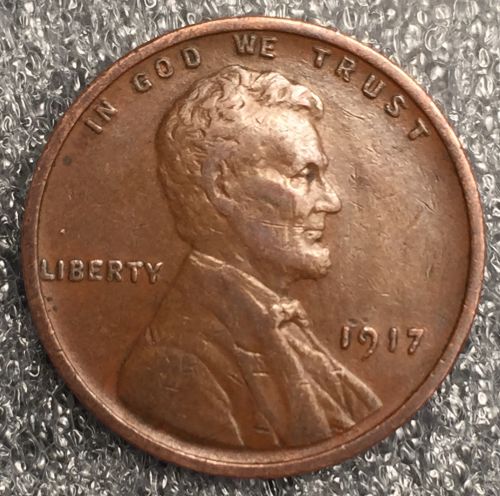
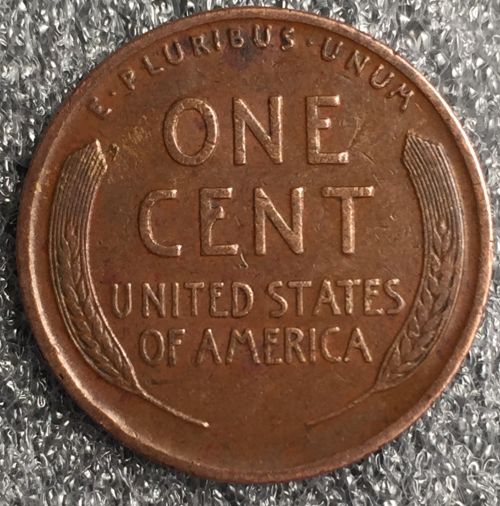
Why wouldn't this coin be VF-30, or even VF-35?
By asking this question, I don't mean to be 'confrontational' or the like. I really want to understand these critical, albeit often subtle, distinctions in the range of VF-20 to EF-40 as applied to Lincoln wheat cents. In fact, I try to answer my own question below, to see if I understand why y'all are saying VF-25.
For reference, here's what the
ANA Grading Standards (Bressett & Bowers, 2006), and Bowers (2012), say about these
LWC grades. I tried to use the same formatting (
italics,
bold text, etc.) as in the books.
First the
ANA Grading Standards (Bressett & Bowers, 2006):
Quote:FINE Moderate to heavy even wear. Entire design is clear and bold.F-12 OBVERSE: Some details show in the hair. Cheek and jaw are worn nearly smooth. LIBERTY shows with no letters missing. The ear and bow are visible. REVERSE: Most details are visible in the stalks. Top wheat lines are worn but separated.
VERY FINE Light to moderate even wear. All major features are sharp.VF-20 (Typical) OBVERSE: Head shows considerable flatness. Nearly all the details still show in hair and on the face. Ear and bow tie are worn but bold. REVERSE: Lines in wheat are worn flat and show very few details.
VF-30 (Choice) OBVERSE: There are small flat spots of wear on cheek and jaw. Hair still shows details. Ear and bow tie are slightly worn but show clearly. REVERSE: Lines in wheat stalks are lightly worn but fully detailed.
EXTREMELY FINE Very light wear on only the highest points.EF-40 (Typical) OBVERSE: Wear shows on the hair above ear, on the cheek, and on the jaw. REVERSE: High points of wheat stalks are worn, but each line is clearly defined. SURFACE: Traces of mint luster may show.
EF-45 (Choice) OBVERSE: Slight wear shows on hair above ear, on the cheek, and on the jaw. REVERSE: High points of wheat stalks are lightly worn, but each line is clearly defined. SURFACE: Some of the mint luster may show.
ReferenceBressett, K. E. & Bowers, Q. D. (2006).
The official American Numismatic Association grading standards for United States coins (6th Ed.). Atlanta, GA: Whitman Publishing. [ISBN-13: 978-0794819934]
Second, Bowers (2012):
Quote:
F-12, 15 (Fine)
Obverse. More wear is seen overall. Hair definition is less. The center of the ear is partially visible The jaw outline and bowtie are clear.
Reverse. Most lines in the wheat stalks are either weak or blended with others, but more than half of the separating lines are clear.
VF-20, 30 (Very Fine)
Obverse. Lincoln's portrait is worn all over, with most hair detail gone at the center. Hair separation is seen at the back and the top of the head, but hairs are blended together. The jaw outline is clear. The center of the ear is defined and the bowtie is clear. The date and lettering is sharp.
Reverse. More wear is seen, but still the lines in the wheat stalks are separated. Lettering shows wear but is very clear.
EF-40, 45 (Extremely Fine)
Obverse. Light wear is seen on Lincoln's portrait, and hair detail is gone on the higher areas, especially above the ear.
Reverse. Light wear is seen overall, but the parallel lines in the wheat stalks are clearly separated.
Reference
Bowers, Q. D. (2012). Grading coins by photographs (2nd Ed.). Atlanta, GA: Whitman Publishing.Here are two reasons I think y'all are saying VF-25 for this coin. Please let me know if I'm on target.
* The summary
ANA Grading Standard definitions are very important. For example, "
EXTREMELY FINE Very light wear on only the highest points."
* The clarity of the
jaw outline is crucial, and poor scarred Abe's jaw is just not distinct enough for Extremely Fine.
Thank you!
Mark












 Posted 02/06/2017 6:31 pm


