| Author |
 Replies: 22 / Views: 5,510 Replies: 22 / Views: 5,510 |
|
Moderator
 Canada
10473 Posts |
Poll Question
I recently acquired this coin. It is in a PCGS holder as "struck on a foreign planchet" The mint did not strike coins or supply planchets for other countries in 1965. This is a 1965 1-cent, struck with full collar, full strike, but on a Cu-Ni 3.2 gram planchet. This planchet is the same size as the bronze 3.24 gram planchet (identical size planchet, specific gravity of 75/25 Cu-Ni is almost the same as bronze). The more I look at this coin, the more I want to think it is a pattern piece. This item is not in any catalogue, but here it is... I don't know the provenance from the time it left Mint Master Parkers office in 1965 until it ended up in an Ottawa coin shop. The dealer I bought it from, had it "forever" and cannot remember where he picked it up. 
"Discovery follows discovery, each both raising and answering questions, each ending a long search, and each providing the new instruments for a new search." -- J. Robert OppenheimerContent of this post is licensed under a Creative Commons Attribution-NonCommercial 3.0 Unported License. See: http://creativecommons.org/licenses...0/deed.en_USMy eBay store
|
|
|
|
Pillar of the Community
Canada
4911 Posts |
i don't know the difference between trial and pattern, I voted pattern...definitely some kind of test strike in my opinion, like the 1967 aluminum cent..only my opinions though.
Feel free to call me Will.
|
|
Moderator
 Canada
10473 Posts |
My guess is that a pattern usually means a new design or die, trials mean taking an existing die, and striking it on rough stock, uniface or other metals... The 1911 silver dollar is a pattern, but the 1911 dollar struck on the lead planchet would be a trial strike... (again, my interpretation - I suspect Jim Haxby can set us straight on that one.)
"Discovery follows discovery, each both raising and answering questions, each ending a long search, and each providing the new instruments for a new search." -- J. Robert OppenheimerContent of this post is licensed under a Creative Commons Attribution-NonCommercial 3.0 Unported License. See: http://creativecommons.org/licenses...0/deed.en_USMy eBay store
|
|
Pillar of the Community
Canada
4911 Posts |
that makes some sense, i'd call it a trial then..interesting coin SPP! I think it could be related to the 1967 aluminum cent discovered not too long ago, the time period was right for them to be testing new metals for circulation coin. you have the 1967 nickel dimes and quarters, the 1967 aluminum cent, and this 1965 cent..i think they're related. I'm nothing near an expert though.
Feel free to call me Will.
|
|
Valued Member
Canada
496 Posts |
1965 has 4 types of obverse/reverse combinations.Which one is this.Could it be a test piece for one of those die sets?
|
|
Rest in Peace
10197 Posts |
If as a test piece, wouldn't it be wiser to use a softer metal than CuNi, such as your example of lead on 1911 $?
|
|
Valued Member
Canada
395 Posts |
I went ahead and went with mint sport. With all the not so above board stuff going on at the mint around this time it seems the most likely to me.
I can't see it being a genuine foreign planchet strike if the mint did not strike coins or supply planchets for other countries in 1965. As well as I would think it would not have survived it such nice condition.
Pattern or trial piece doesn't make sense to me either with cu-ni being harder and more expensive then the original metal. I only remember offhand trial or pattern pieces in Cu-Ni from 1858 and 1859 but I'm no expert.
It's a nice coin regardless, would be nice to peg down it's origins.
|
|
Pillar of the Community
Canada
1505 Posts |
Did the mint supply foreign coins to anyone in 1964 or 1966, maybe this got mixed in the batch somehow. However, would someone be able to distinguish this from a regular copper cent and pull it out of circulation? The color looks similar to what a normal cent would look like.
A trial or pattern piece makes sense.
|
|
Pillar of the Community
 Canada
9902 Posts |
Obverse pics please ?
What grade did PCGS give it ?
"Dipping" is not considered cleaning...
-from PCGS website
Edited by DBM
02/16/2017 5:24 pm
|
|
Pillar of the Community
Canada
1984 Posts |
Very interesting. In 1965 copper and nickel were both broadly available. Copper was $0.40 a pound and nickel was $0.80 a pound. So there was no real reason for Canada to look at switching out copper for nickel.
There may have been some other reason for a test. Perhaps another country that used cupro-nickel was interested in having Canada mint their coins and this coin was struck as some kind of test.
Regardless, given the quality of the strike, I am inclined to think that this was some sort of official test rather than a back door job.
Or maybe it is just some kind of alloying error that slipped through the cracks.
|
|
Moderator
Canada
10473 Posts |
Quote:
Did the mint supply foreign coins to anyone in 1964 or 1966, The Sherritt Mint supplied 100% nickel blanks to the RCM in 1964. Also, the Sherritt Mint supplied 100% nickel blanks (2.5 grams) to South Africa in 1964 for their new 1965 5-cent coin (KM#67), and some of those planchets were mixed up and sent to the RCM. That is where this one came from (Zonad has one of these as well): http://www.PCGS.com/cert/33950447But, this one is Cu-Ni. Quote:
Obverse pics please ?
What grade did PCGS give it ? http://www.PCGS.com/cert/33950463"Discovery follows discovery, each both raising and answering questions, each ending a long search, and each providing the new instruments for a new search." -- J. Robert OppenheimerContent of this post is licensed under a Creative Commons Attribution-NonCommercial 3.0 Unported License. See: http://creativecommons.org/licenses...0/deed.en_USMy eBay store
|
|
Pillar of the Community
Canada
9902 Posts |
Thanks for that link.
Unlike our southern neighbors have demonstrated I like to be sufficiently informed before I cast my vote.
"Dipping" is not considered cleaning...
-from PCGS website
|
|
Pillar of the Community
Canada
1164 Posts |
The nickle story from the Sherritt Mint.Your blank might have looked like this. Great errors you guys have!! 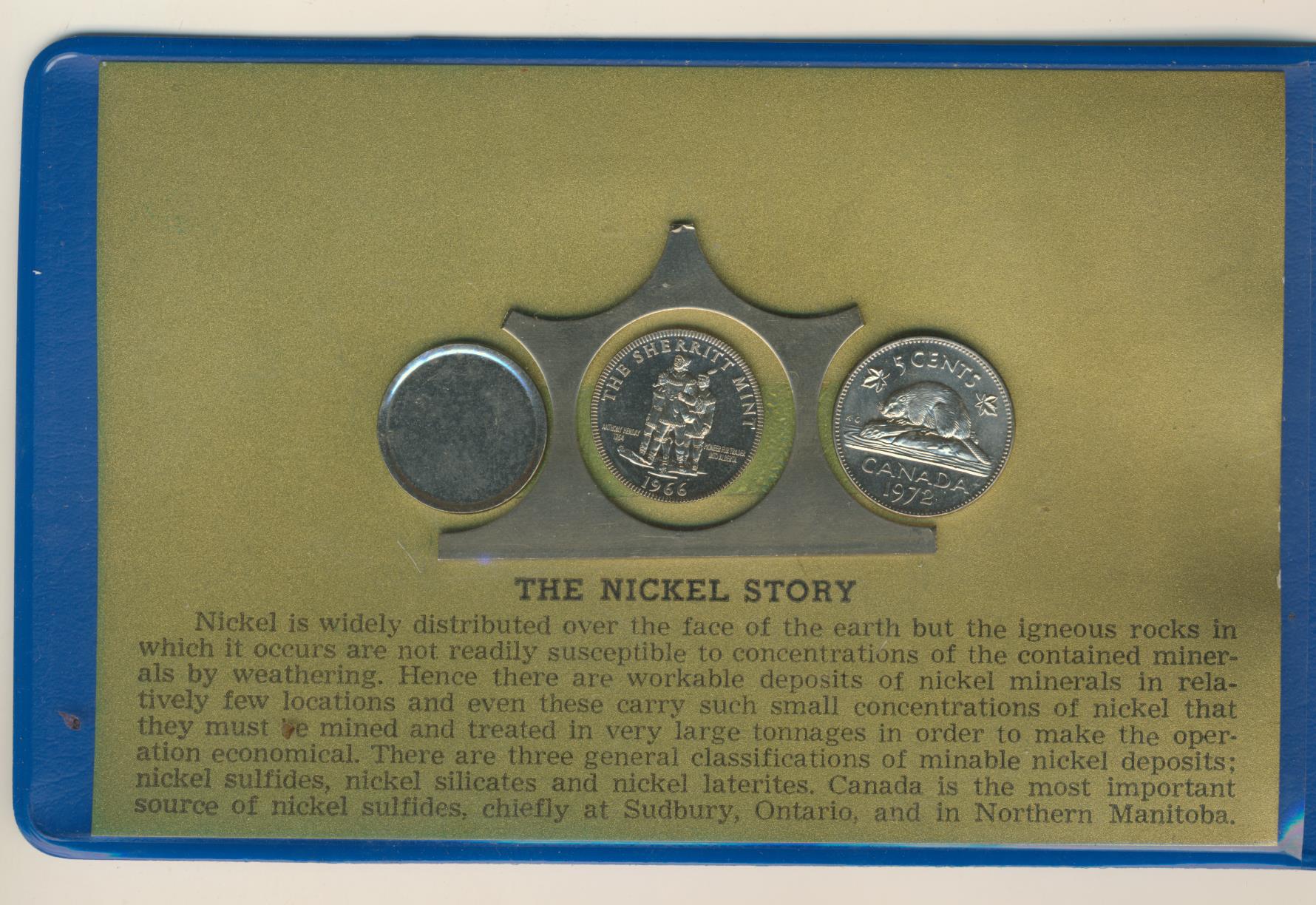 |
|
Pillar of the Community
Canada
1463 Posts |
I chose mint sport. Though, I'd like to believe pattern because that was the first year for that bust. To begin a process of elimination, does anyone know if the blunt 5 small beads was the first die pairing for the 4 varieties for 1965. I think the pointed 5 is later because it's actually deterioration? I believe a pattern would be the earliest die pairing and show no signs of die usage, it looks pretty crisp. any clashes, or Die Deterioration visible? If so, I think we could agree it would rule out pattern. It would lend to it being a pattern if you could find that same metal compisiton used on any other patterns that the mint struck? Or a historic record of the mint considering a different metal for use in 1965, though that may have been more costly, seeing the composition, so may not make sense. What makes me think it's not a pattern is that weren't most patterns specimen strikes? To confirm it's a pattern may prove difficult? Edited by Alan
02/17/2017 12:28 am
|
|
Pillar of the Community
Canada
5341 Posts |
Since it's resided with the mint master for a long time, I would say trial piece. As for mint sport one would expect much cooler examples like wrong metal, or penny on quarter, etc.
|
|
Pillar of the Community
Canada
1747 Posts |
Well I don't know how it could be mint sport or off metal foreign strike. there were no Cu-Ni planchets the size of our penny being used. the closest would have been the USA nickel, but that would be well oversized.
it would have to be a test of some sort either a pattern or trial piece. the question is if it sat with the mint master is there no way one could track this down? There must be some kind of documentation for this coins existence.
|
| |
Replies: 22 / Views: 5,510 |










 Posted 02/16/2017 2:36 pm


