| Author |
 Replies: 13 / Views: 2,025 Replies: 13 / Views: 2,025 |
|
|
Pillar of the Community
Belgium
1194 Posts |
As usually I buy only silver coins , I made an exception for this Constantine coin,mint Constantinopolis . obv:CONSTANTINUS MAX AUG : rosette-diademed,draped and cuirassed bust right. rev : CONSTANTINI ANI DAFNE : Victoria seated left on cippus,looking right,holding palm branch in each hand,trophy in left field,captive seated left at foot , officina letter E left between trop^hy and captive. mint: Constantinopolis , 5th officina : AD 328/329 18 mm , 2.59 gr , 12h . RICVII,38E . For the DAFNE coins : http://www.constantinethegreatcoins.com//DAFNE/albert . 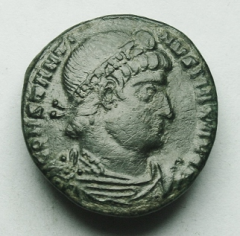 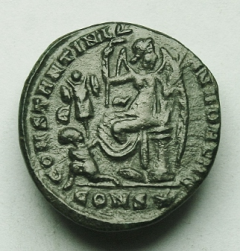 |
|
|
|
Pillar of the Community
United States
1304 Posts |
Cool type. I like the reverses with captives and trophy's. Nice historical tie in at the link regarding DAFNE coinage. Thanks for posting!
|
|
Pillar of the Community
United States
949 Posts |
I have always thought the Dafne has an elegant design. Thanks for showing this. But you didn't mention what is going on in the exergue. I read CONS followed by a star. That would be consistent with RIC VII 38 for Constantinople.
|
|
Pillar of the Community
 United States
984 Posts |
"But you didn't mention what is going on in the exergue. I read CONS followed by a star. That would be consistent with RIC VII 38 for Constantinople."
he didn't mention the mintmark, but he said RICVII,38E
I would also like to mention (also on my page linked to in the first post) "RIC describes the reverse of the Dafne coinage as Victory holding a palm branch in each hand; but Victory is actually only holding a palm branch in her left. In her right hand she is holding a laurel branch." This is not evident on every coin, but on clear examples you can see the difference.
|
|
Pillar of the Community
United States
949 Posts |
Quote:
Victory is actually only holding a palm branch in her left. In her right hand she is holding a laurel branch. I can see the palm frond in her left, which is like palm fronds I have seen elsewhere. And I can see that the leaf pattern for the branch in her right hand is different. But how did you narrow it down to a laurel? Laureate wreaths are "worked" branches. Other examples of laurel branches? Just curious. As for my note on the exergue: on my screen the spot just to the right of the lettering is not entirely clear and could have been a speck of encrustation. So I wanted to get that verified. His attribution helped, but I like to confirm things if possible. Albert knows what he's doing, so I was pretty sure of how it would come out. |
|
Moderator
United States
34549 Posts |
Great pick-up Albert!  I wasn't aware of the significance of the DAFNE. "If you climb a good tree, you get a push."
-----Ghanaian proverb
"The danger we all now face is distinguishing between what is authentic and what is performed."
-----King Adz
|
|
Pillar of the Community
 Belgium
1194 Posts |
thanks for the comments . I forgot the exergue : it is CONS * (star), as Victor wrote .For the palm branch , I toke the description of RIC .I found this coin last week in a small shop in northern Italy . It was a shop selling ancient books , maps etc . He had a book :Studies in Constantinian Chronology by Patrick Bruun in the window for 1 € , so I entered and asked for it .The man also also some coins wich I bought also .The branch question is very interesting, I hope to look closer tomorrow afternoon , I will keep you informed . albert .
|
|
Pillar of the Community
United States
984 Posts |
"The branch question is very interesting" I was not questioning, only making a statement based on observation. I am also not the first to notice the difference. On my previously linked page http://www.constantinethegreatcoins.com//DAFNE/ here is a quote - Otto Voetter recognized the difference between the two branches and in his 1921 catalogue on the Gerin collection described the reverse as "Victoria mit Zweig und Palmzweig" (Victory with branch and palmbranch) Voetter was not confident enough to say what kind of branch; but others since then have decided it must be a laurel branch. There are many errors in RIC VII. Another issue for this series -- Bruun thought it commemorated a fort on the Danube. I talk about that at length on my page and explain why it is indeed a commemoration type; but rather commemorates his recent victory over Licinius. From RIC VII-- "Four entirely new types were created for Constantine, GLORIA EXERCITVS, GLORIA ROMANORVM, LIBERTAS PVBLICA, and SPES PVBLIC.Here the reverses record a summing up of the Civil War II, the glory of the army constituting the glory of the Empire, the death of the tyrant (SPES PVBLIC) granting liberty for all." RIC VII pg 567. Bruun left the DAFNE issue out of the series of coins that summed up the civil war, despite the fact it was also a new type only issued for Constantine and was also issued chronologically with the others, the last one. "This coin most likely symbolized the defeat of Licinius because the Greek word for laurel is daphne, and laurel wreaths were signs of victory. The legend of the Dafne coin would actually translate as 'Constantinian Laurel/Victory'." There is more, but I don't want to reiterate my whole page here. |
|
Pillar of the Community
United States
949 Posts |
Albert, congratulations on landing a copy of Bruun's Constantinian Chronology for a single Euro. Back in 2001 I paid US $25 for a copy. It is online now for free download ( https://www.scribd.com/document/158...trick-Bruun) but I still think you got a good deal. |
|
Pillar of the Community
Belgium
1194 Posts |
Thanks Irbguy , I always prefer to hold a book in my hands, maybe because I am getting old  Congrats Victor with your work on the coins of Constantine . I still have some problems with this Dafne coin . The mint of Constatinolopis was created in AD 326, when Constantine was sole emperor .He created then 4 new inscriptions on coins,wich were used in the different mints . In one sence , it was normal he would change the coinage : he did it already before and the coins were very important for his propaganda . He created also the legend : Constantiniana dafne , wich was used only in Constantinopel . 1:Why this coin was only used in one mint and only by him ?If it was created for the same purpose at the same time, , then why the other mints didn t use it ? 2:Constantiniani :it is the adjective of his name Constantinus . Why didn t he use the genitive Constantini , as he did on other coins : soli comiti Constantini .I always learned there is a difference in Latin using an adjective or a genitive .In my opinion , if he had meaned : the victory of Constantine , he had wroten Constantini dafne , now ,for me , he means on object or a fact he has realised . 3:dafne .You are right Victory has two different branches : a palm and an olive branch . The word dafne is a Greek word and doesn't exist in Latin .If you make a Latin transcription , you have to write : Daphne (Greek Efesos , Latin Ephesus) .Roman provincial coins with Greek inscriptions ended about AD 275 ,50 years earlier.So it is unusual to use now Greek , even in a (wrong) Latin transcription .It has also no sense to use a Greek word in the Western mints , there Latin was the language .IMO with Dafne , he means a fact or event ,maybe his wars with the Sarmatae AD 322.They lived at the other side of the Danube , so the word Dafne can refer to a bridge ( Aurelius Victor) or a fort , named Dafne : local name or choosen because there were mane olive trees. 4:in this meaning the captive is an commen everyday barbarian captive,as is represented on many coins and used in the same way . 5:with this explanation , it is normal the coin was only minted in Constantinople and for few years . albert |
|
Pillar of the Community
United States
949 Posts |
The coin inscription in question is CONSTANTINIANA DAFNE, not constantiniani dafne.
Secondly, Latin had the word/name Daphne, and its principal reference appears to follow the Greek as the name of a mythical figure, the daughter of the river-god Peneus who was changed into a laurel tree. In the Greek this word as a plant name had been associated with the laurel and its use in the worship of Apollo. As a parallel I think there is reason to suppose along with Victor that the spelling DAFNE retained that connotation and that the figure in the coin imagery is holding a palm frond and a laurel branch.
Is there an alternative Latin connotation for Dafne, which is the word on the coin?
Edited by lrbguy
02/21/2017 11:07 am
|
|
Pillar of the Community
Belgium
1194 Posts |
sorry for the constantiniani error , of course it is an A because dafne is a female word.
second error : it is a laurel not a olive .
Latin has the word Daphne as loanword just as it had the word Athena for the Greek city Athene .
The coin is minted in Constantinople , it is in Byzantium , a Greek city .It is logic that Constantine made use of the knowledge of Greek in this case : Victoria : the winner with a palm branch : synbol of victory and a laurel branch : symbol of ratification of his victory
The latin word for the Greek Dafne is Laurus = Laurel but also triumpf ( remenber English laureate : winner).
As far as I know , there is no Latin word ressembling dafne.
albert
|
|
Pillar of the Community
United States
949 Posts |
I do not have an authoritative Latin lexicon as I do for Greek, but my Cassell's does not have an entry for "dafne," although it does have Daphne as a Greek loanword. It has laurus for the laurel plant and also laureus as an attributive adjective for the laurel tree and laurel crown. However, the coin depicts the Daphne/Dafne character holding branches, and is therefore an allusive reference. In that situation, I tend to agree with Victor's implication that the figure depicts more than what the words alone might mean. Be that as it may, I cannot account for the spelling "Dafne" except to suggest they were intentionally not trying to reproduce a Latin word. The figure is a reference to the Constantinian "Dafne" which was a twist on an old theme. Is the twist to be found in the use of the two branches? The thought has some basis in the way Rome was turning to Christianity from paganism at this time, i.e. right after the Council of Nicea. While her body is angled toward the trophy and captive, the Constantinian Dafne has her face to the palm, not the laurel. The Christian association of the palm with the triumph of Jesus is centuries old.
Edited by lrbguy
02/21/2017 1:30 pm
|
|
Pillar of the Community
Belgium
1194 Posts |
I am not discussing the theological signification of this coin because I think it is very difficult and you can see in it what you want . I limit myself for this coin to what is represented : a classic representation of a victory over barbarians and a reminder of the works he undertook .In this vision , the coin is not a 5th new type as Victor thinks . As Latin lexicon , I use that one of my great-great-grandfather , edited in 1878 .It is very intersting as it gives a translation of the word and often one or more exemples of the word in a Latin text .albert 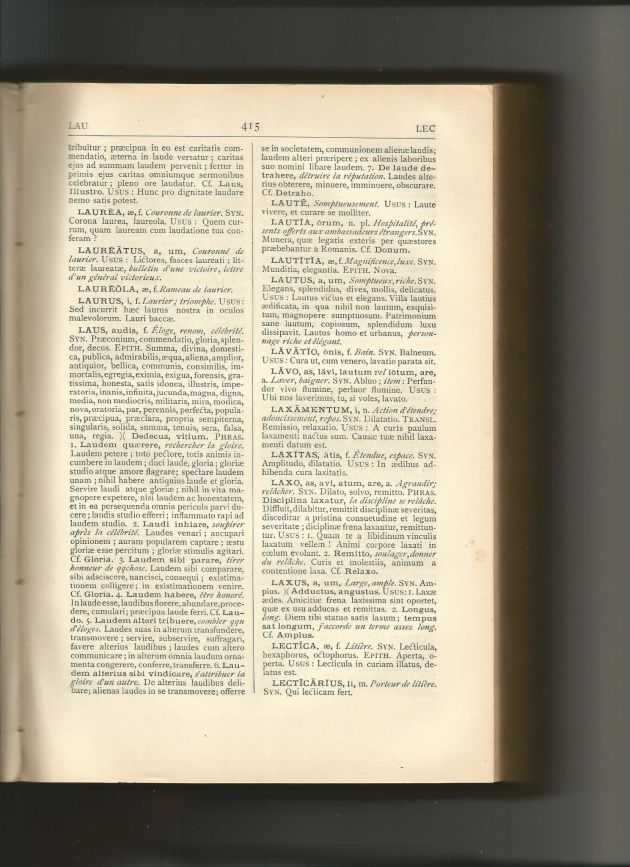 |
| |
Replies: 13 / Views: 2,025 |
|









 Posted 02/20/2017 10:38 am


