Posted 03/09/2017 07:56 am


This post has the following conclusions:
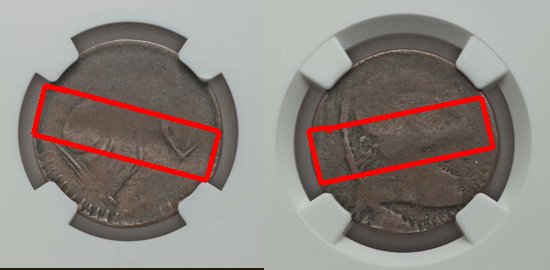
1. The coin is not damaged. 100% certainty. Its the same scenario we hear all the time (ANACS,PCGS and NGC graders can not grade Colonial type coinage, emergency money, esoteric exonumia or any other form of irregularly struck pieces other than modern mint pieces without messing up the grade and sometimes their identification as a particular variety.
2. When an obverse or reverse die starts to become very worn or severely crack the corresponding side normally bulges or sinks or some of its motifs are effected - normally on the corresponding opposite side. We see here this orange peel texture in the lower parts of these large indentations and motifs (i.e., lettering or in this case the edges) around these areas which lost their details ALL suggesting these are just severely overused dies by the counterfeiter of this Canadian Blacksmith variety Howland Wood variety Wood 23 (W23).
3. We also see that based on the obverse state of Wood 23 it may have been struck concurrently with the other more rare Wood 24-28 varieties since the obverse of these coins do mimic the same level of break seen on this obverse of this Heritage W23 piece. But - We can't be sure. From this example from Heritage and the 1968 donated Warren Baker coin (i.e., Tray 4 piece linked in my previous post) we can also deduce that due to the total reverse die failure of W23 it was retired since it was severely affecting the obverse die motifs. Obviously the BOC piece is a LATER reverse die IMO than this Heritage coin piece.
4. This writer has never seen another Wood 23 outside of this Bank of Canada 1968 piece (i.e., see the coins I.D. and personal knowledge that Baker did donate this year to the BOC) with these late die state sinking effects on both the obverse and reverse.
5. Wood 23 is important along withe other True Wood 24-28 Family of dies because it links New York (Albany, NY not Troy, NY - See Al Reed article)) or Lower Canada with these pieces as their manufacturing location - possibly both areas (Albany, NY and Lower Canada).
6. In my new book I prove not only are these dies (W23-29) used or discarded by True but also Hard Times Tokens blanks were used for Blacksmith coinage.
7. This is just another important bit of evidence that the reverse die of W23 was RETIRED first. A counterfeiter obviously will use a DIE until the last possible scenario - for obvious reasons.
8. Interestingly if you go into the Weinberg, Diamond and Sullivan U.S. Error coin site you will see a Roosevelt dime which is considered the most overused dies in U.S. Federal coinage. Both the obverse/reverse are in a massive bulging state. So? U.S. Federal coin slabbing companies are simply not geared for properly assessing damaged dies, severe late state dies in most cases. As we all know some neophyte? at Heritage just mimic the NGC label. A disastrous BLUNDER IMO!
JPL
1. The coin is not damaged. 100% certainty. Its the same scenario we hear all the time (ANACS,PCGS and NGC graders can not grade Colonial type coinage, emergency money, esoteric exonumia or any other form of irregularly struck pieces other than modern mint pieces without messing up the grade and sometimes their identification as a particular variety.
2. When an obverse or reverse die starts to become very worn or severely crack the corresponding side normally bulges or sinks or some of its motifs are effected - normally on the corresponding opposite side. We see here this orange peel texture in the lower parts of these large indentations and motifs (i.e., lettering or in this case the edges) around these areas which lost their details ALL suggesting these are just severely overused dies by the counterfeiter of this Canadian Blacksmith variety Howland Wood variety Wood 23 (W23).
3. We also see that based on the obverse state of Wood 23 it may have been struck concurrently with the other more rare Wood 24-28 varieties since the obverse of these coins do mimic the same level of break seen on this obverse of this Heritage W23 piece. But - We can't be sure. From this example from Heritage and the 1968 donated Warren Baker coin (i.e., Tray 4 piece linked in my previous post) we can also deduce that due to the total reverse die failure of W23 it was retired since it was severely affecting the obverse die motifs. Obviously the BOC piece is a LATER reverse die IMO than this Heritage coin piece.
4. This writer has never seen another Wood 23 outside of this Bank of Canada 1968 piece (i.e., see the coins I.D. and personal knowledge that Baker did donate this year to the BOC) with these late die state sinking effects on both the obverse and reverse.
5. Wood 23 is important along withe other True Wood 24-28 Family of dies because it links New York (Albany, NY not Troy, NY - See Al Reed article)) or Lower Canada with these pieces as their manufacturing location - possibly both areas (Albany, NY and Lower Canada).
6. In my new book I prove not only are these dies (W23-29) used or discarded by True but also Hard Times Tokens blanks were used for Blacksmith coinage.
7. This is just another important bit of evidence that the reverse die of W23 was RETIRED first. A counterfeiter obviously will use a DIE until the last possible scenario - for obvious reasons.
8. Interestingly if you go into the Weinberg, Diamond and Sullivan U.S. Error coin site you will see a Roosevelt dime which is considered the most overused dies in U.S. Federal coinage. Both the obverse/reverse are in a massive bulging state. So? U.S. Federal coin slabbing companies are simply not geared for properly assessing damaged dies, severe late state dies in most cases. As we all know some neophyte? at Heritage just mimic the NGC label. A disastrous BLUNDER IMO!
JPL
Edited by colonialjohn
03/09/2017 2:44 pm
03/09/2017 2:44 pm