| Author |
 Replies: 15 / Views: 2,260 Replies: 15 / Views: 2,260 |
|
|
Pillar of the Community
Canada
2786 Posts |
OBV (dragon side) showing signs of high AU, possibly MS, but the REV (coat of arms) is sending me mixed messages. Areas of concerns (XF) in yellow, AU/MS in green. It's hard to find this year in high grades (compared to other years), and even at XF40 it would be 10-20 points higher than my current example so I am pleased to have it. Just curious where it might land on the scale of 1-70 Opinions greatly appreciated 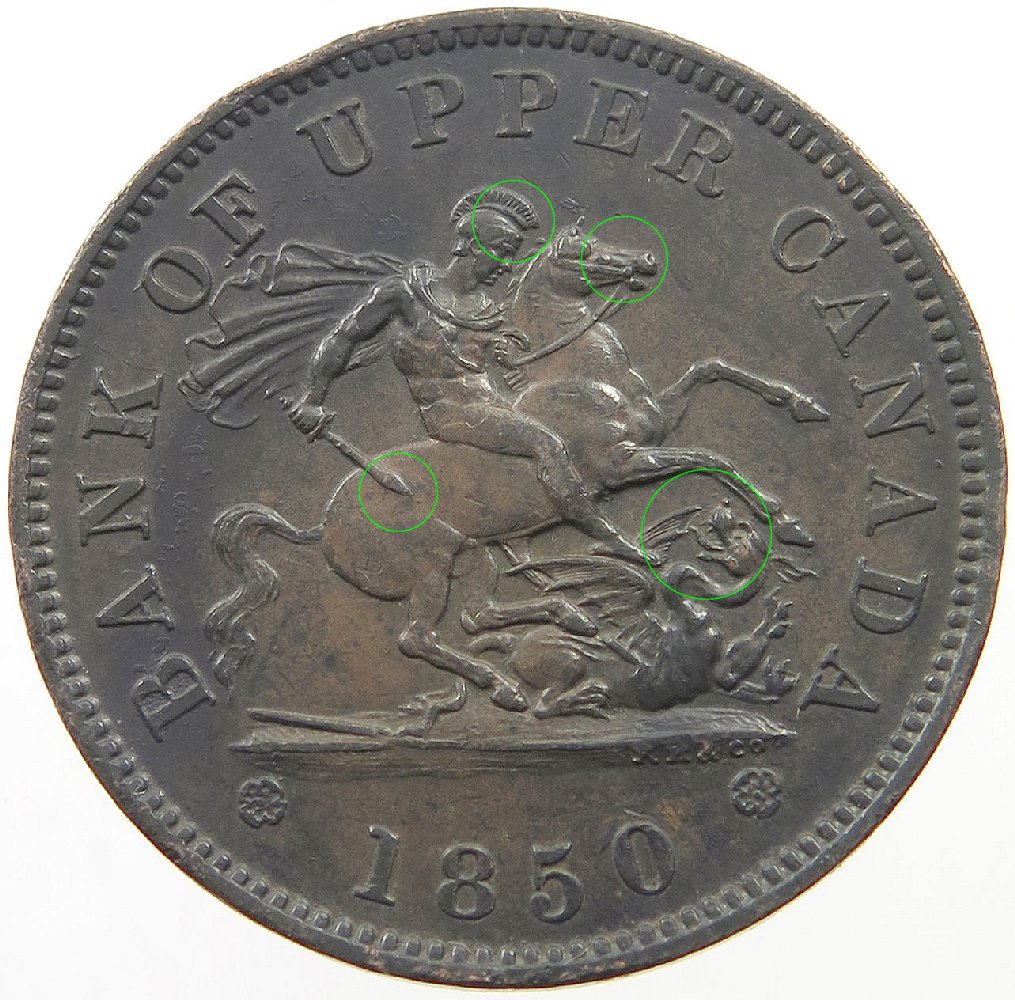 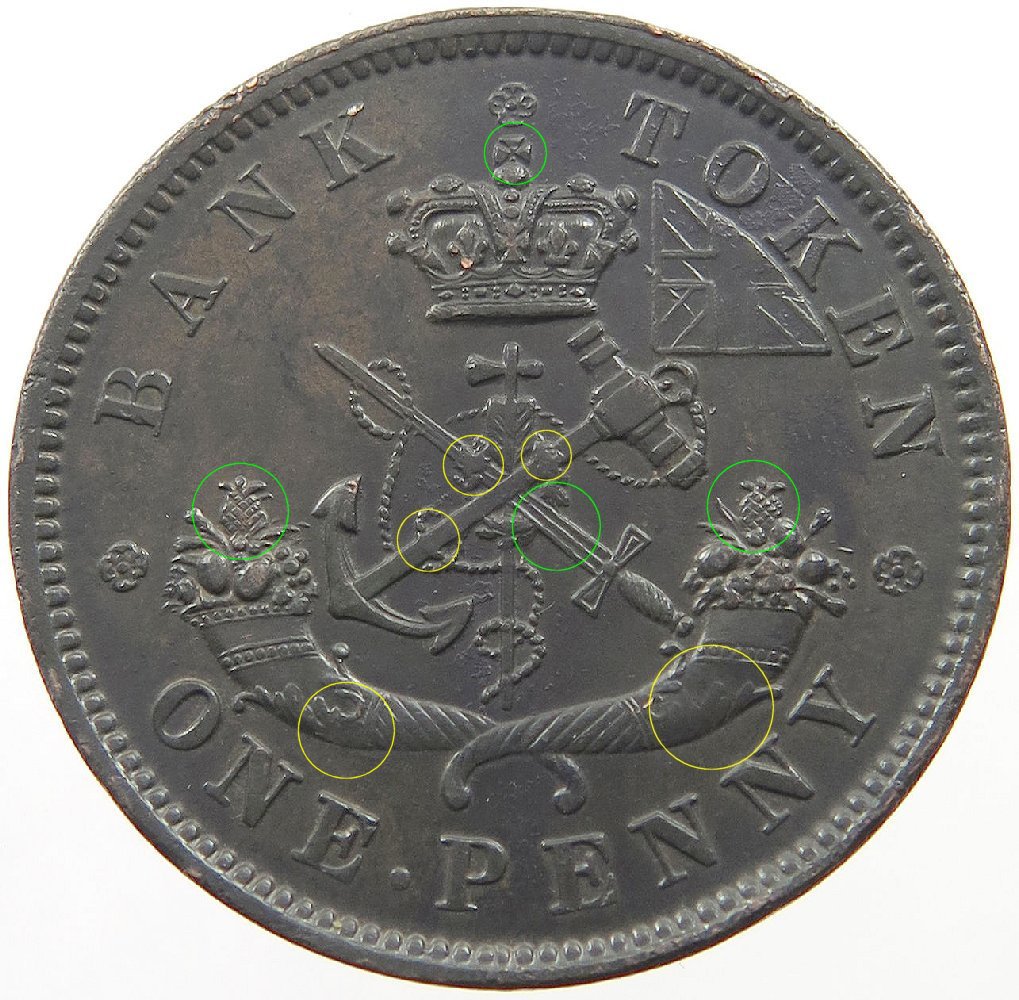 |
|
|
|
Pillar of the Community
 Canada
5646 Posts |
A general rule of thumb is that, with a weak strike showing on one side, the other will be nice and crisp ... if the coin has been minimally circulated. I haven't studied the the tokens enough to know which part of the design is the most pronounced (or the incuse into the die is the deepest). The Rev die could also be partially worn
|
|
Pillar of the Community
Canada
3234 Posts |
I'm no expert but I always look at the rim on both sides for hits or slight wear when looking for very high grade coins.
The rim at the "U" has a very heavy hit that flattened the rim.
Many noticeable scuffs and abrasions around both rims..
Details to take note of when looking for an accurate grade.
For me, the highest points would be the yellow rings and the "round balls" below the green ringed pineapples..
Not much wear on it for sure though..and at least AU for me with a note about the rim hit at the U..
|
|
Pillar of the Community
United States
1101 Posts |
Wade, I have an 1854 with the left cornucopia well defined and the right one almost smooth. I know the coin has a few dings on it, but I've assumed this is an area of weak strike. Maybe some varieties are more likely to have these weakly struck areas? Doug may know. 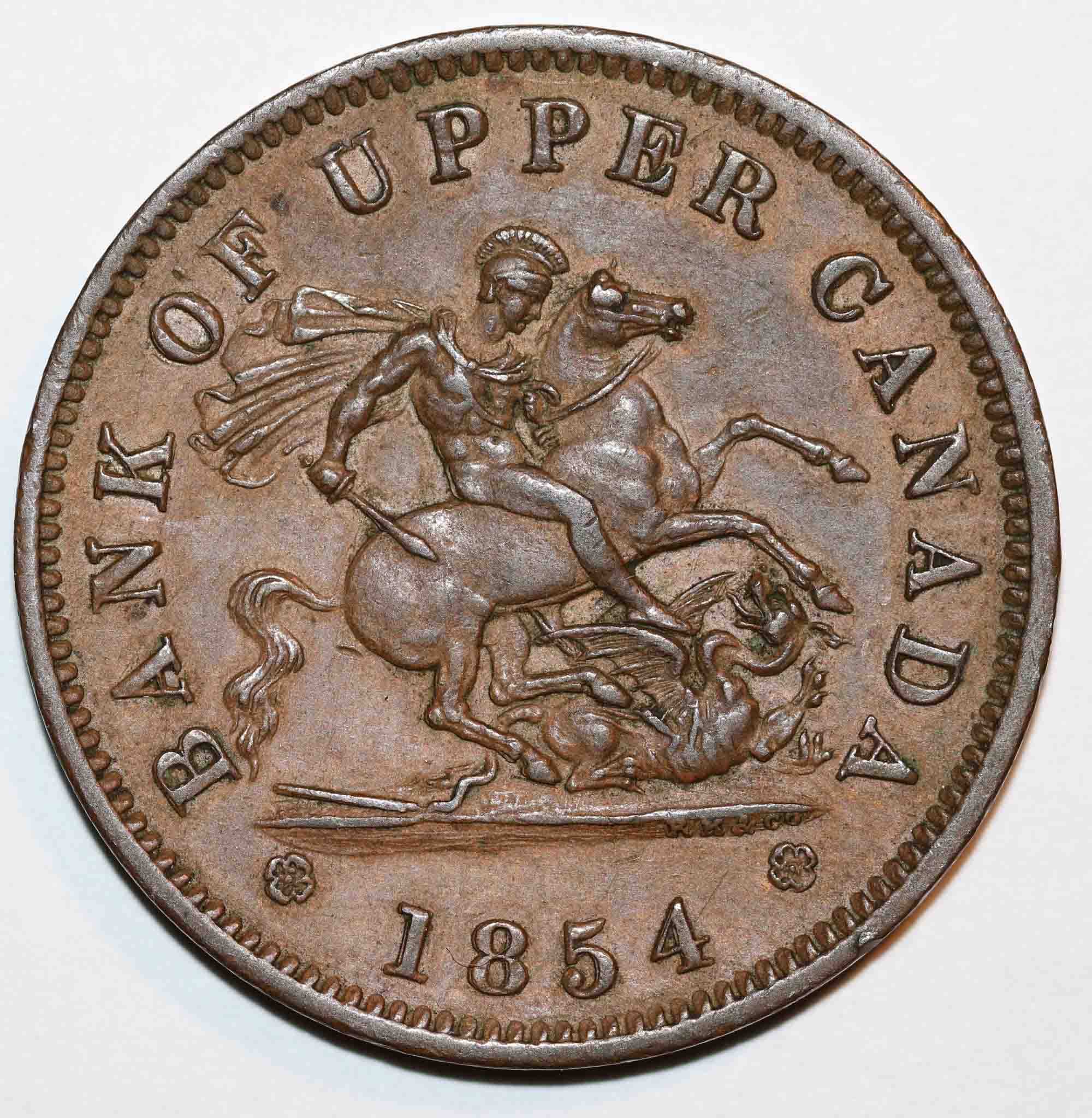 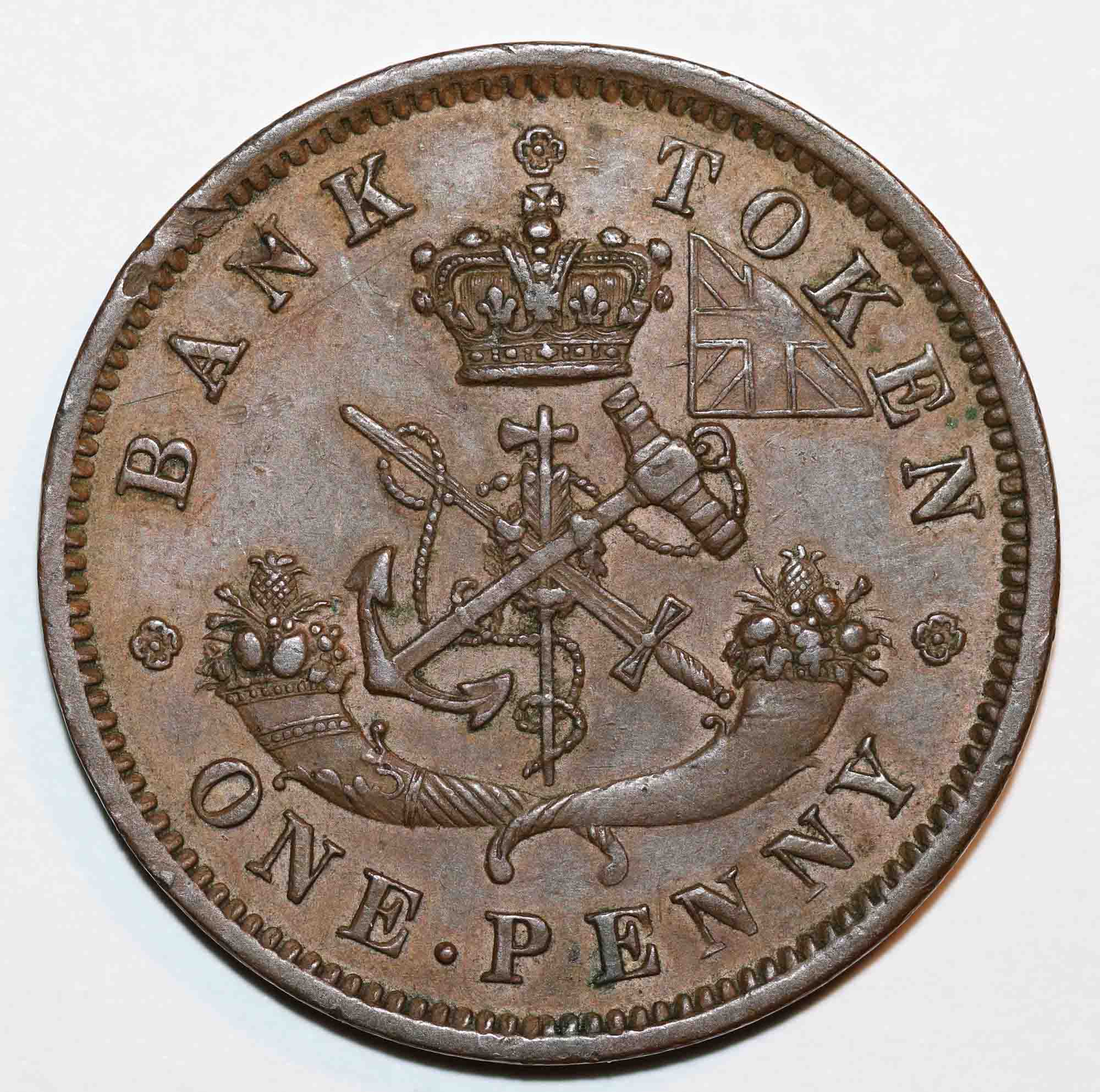 |
|
Bedrock of the Community
United States
94367 Posts |
I'm no expert, but either way it's a beautiful coin.
|
|
Bedrock of the Community
Canada
10743 Posts |
Nice coin Wade..  I have a couple of these and call one of them like this one AU |
|
Pillar of the Community
 Canada
2786 Posts |
Phil OBV of your '54 shows all the signs of mid AU (imho) REV high XF / low AU with the exception of the anomaly of the right cornucopia. Perplexed as to the cause as the rest looks really good in comparison. The only other thing I can note is the lower left serifs of both Ns in peNNy look a little weak, and the denticles directly below them seem shifted diagonally. I don't have pictures of my own 54 but looking at it the serifs of the Ns are strong and the denticles are straight. That being said I did a quick google image search, and while there are few examples available (seems the 54 as elusive as the 1850) there is this example that shows similar characteristics (right side worn more than the left and denticles shifted slightly). It may be too well worn to make a fair comparison, but ? 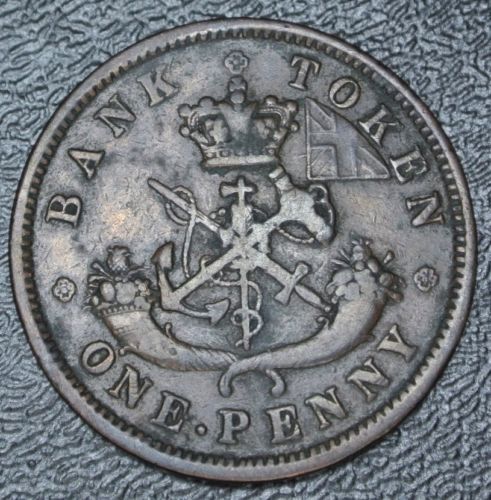 |
|
Pillar of the Community
United States
1101 Posts |
Wade, Thanks for coming up with that picture. Even with the wear, the example you posted shows the same weakness on the right cornucopia. I think it is the same die. It has the same short line from the Union Jack pointing to the right base of the crown.
The weakness on the N serifs and denticles on my coin could possibly be die clogs which are pretty common on 1859 cents, but I don't know if they are seen as much on the St. George tokens.
Your 1850 token is a nice one. Generally, I don't think areas of weak strike should lower the overall grade.
|
|
Pillar of the Community
United States
840 Posts |
Concerning Phil's 1854:
Great photo.
Courteau variety 261. XF 45.
Below are cuts and pastes of my lengthy narratives of this series.
The first section is an overview of the series, the second section of
this thread is the specific
diagnostic characteristics of variety 261.
Forgive the presentation and layout as the format was distorted in the
conversion process. I am not adroit in computers.
Doctor Courteau identifies seventeen different major die varieties of The St. George Bank of Upper Canada 1854 ONE PENNY tokens and identified them as numbers 258-274 inclusive. Of this number, Doctor Courteau also identifies noted Die-Cracks. The Die-Cracks noted by Doctor Courteau, were not provided an independent designator. Doctor Courteau oftentimes uses the phrase perf. and book. dies (perfect and broken dies). On some tokens the identified Die-Crack is germane to the entire specific variety.
Concerning the 1854 ONE PENNY:
Doctor Courteau's major areas of focus was the positioning of the 4. Doctor Courteau identifies the completeness of the Mantle to the left of the Man's Arm. Doctor Courteau identifies the various patterns of lines below the Man's right Arm. Doctor Courteau identifies the number of Reins to the Bridle. Doctor Courteau identifies the completeness of the Dragon's left Leg. Doctor Courteau identifies the Anchor Rope Dot pattern betwixt the Sword and Fledgling. Doctor Courteau identifies whether the Anchor Ring is perfect or broken. Doctor Courteau also identifies defective lettering. Doctor Courteau also identifies stray specks, dots, and lines. Doctor Courteau identifies various Die-Cracks.
Doctor Courteau provided no information concerning:
The Knobs on the Dagger Hilt.
Whether the F in OF is re-cut.
The number of Oak Leaves betwixt the Sword and Anchor Shaft.
Whereas, concerning the 1850 ONE PENNY:
Doctor Courteau's major areas of focus was whether the obverse legend had perfect or defective lettering. Normally, Doctor Courteau identifies whether the Anchor Ring is perfect or broken. Doctor Courteau also identifies stray specks, dots, and lines. Doctor Courteau identifies various Die-Cracks.
Doctor Courteau provided no information concerning:
The patten of lines below the Man's right Arm as all varieties have the same line pattern.
The completeness of the Mantle to the left of the Man's Arm as all varieties have incomplete Mantles.
The Knobs on the Dagger Hilt, as all varieties have two Knobs.
The Reins to the Bridle, as all varieties have full Reins.
The left Leg of the Dragon as all varieties have the left Leg disconnected from the right.
Whether the F in OF is re-cut, as all varieties have the re-cut F.
The number of Anchor Rope Dots betwixt the Sword and Fledgling as all varieties have the same Anchor Rope Dot pattern.
The number of Oak Leaves betwixt the Sword and Anchor Shaft.
The completeness of the Grass Blades.
Whereas, concerning the 1852 ONE PENNY:
Doctor Courteau's major areas of focus was the size, shape, and positioning of the 2, the size and shapes of the reverse Grass Blades, and whether the Die-Axis was coinage or medal. Doctor Courteau identifies whether the Anchor Ring is perfect or broken. Doctor Courteau identifies defective lettering. Doctor Courteau identifies stray specks, dots, and lines. Doctor Courteau identifies various Die-Cracks.
Doctor Courteau provided no information concerning:
The patten of lines below the Man's right Arm as all varieties have the same line pattern.
The completeness of the Mantle to the left of the Man's Arm as all varieties have incomplete Mantles.
The Knobs on the Dagger Hilt, as all varieties have two Knobs.
The Reins to the Bridle, as all varieties have full Reins.
The left Leg of the Dragon as all varieties have the left Leg disconnected from the right.
Whether the F in OF is re-cut, as all varieties have the re-cut F.
The number of Anchor Rope Dots betwixt the Sword and Fledgling as all varieties have the same Anchor Rope Dot pattern.
The number of Oak Leaves betwixt the Sword and Anchor Shaft as all varieties have three Oak Leaves.
Whereas, concerning the 1857 ONE PENNY:
Doctor Courteau's major areas of focus is the Anchor Rope Dot patterns and the size of the Dots within the obverse Rosettes. Doctor Courteau identifies the positioning of the 7. Doctor Courteau identifies the number, size, and shapes of the Knobs on the Dagger Hilt. Doctor Courteau identifies the completeness of the Mantle to the left of the Man's Arm. Doctor Courteau identifies the various pattern of lines below the Man's right Arm. Doctor Courteau identifies the number of Reins to the Bridle. Doctor Courteau identifies the completeness of the Dragon's left Leg. Doctor Courteau identifies whether the F in OF is re-cut to the left. Doctor Courteau identifies the number of Oak Leaves betwixt he Sword and Anchor Shaft. Doctor Courteau identifies the completeness of the Grass Blades. Doctor Courteau identifies whether the Anchor Ring is perfect or broken. Doctor Courteau identifies defective lettering. Doctor Courteau identifies stray specks, dots, and lines. Doctor Courteau identifies various Die-Cracks.
261. R-2. 2 LARGE DOTS.
Only varieties 261 and 262 have 2 Large Dots.
Some specimens exhibit shift-entry doubling.
Obverse Characteristics: According to Doctor Courteau, the same as variety 262.
The left-side of the Stand of the numeral 4 is on-line with the right-side of the 3rd Denticle to the immediate right of the numeral 5.
Note - Doctor Courteau could have referenced this as 'betwixt' and had no argument.
The orientation is close enough to go either way. The author opted to go with Doctor Courteau's definition.
Note - Of this series, only varieties 259, 260, 260-1, 261, 262, 264, 266, 269, 270, 270-1, 270-2, and 271 shew the 4 on-line with the right-side of a Denticle. Varieties 263, 265, 267, 268, 272, 273, and 274 shew the 4 on-line with the centre of a Denticle, while variety 258 is on-line betwixt two Denticles.
An imaginary line across the diagonal of the numeral 4 extends to the upper left side of the left Upright of the initial H in the abbreviation below the ground.
An imaginary line across the right-side of the Upright of the numeral 4 extends to the Tip of the Claw of the lower Toe of the right Leg of the Dragon.
The lower outline to the Mantle Drapery is incomplete.
Note - This is similar to variety 260, and easily confused with variety 262.
The outer outline of the 7th Mantle Fold is strongly cut, but abruptly terminates upon exiting the lower curve of the lower outline of the Mantle. A heavy line is in the midst of the void of the 7th Mantle Fold, on-line with the Man's right Hand. A longer thinner line is betwixt this line and the pleat of the 6th and 7th Mantle Folds.
The 7th Mantle Fold overlaps the 6th Mantle Fold.
The outer outline of the 6th Mantle Fold has an indentation.
Four lines are below the Man's right Arm.
Note - This is similar to variety 259.
This is a massing of four independent lines. The primary line runs along the muscle mass of the Man's right Forearm and extends into the field. The line thickens, then thins, and extends diagonally towards the Man's Body. A lower line emerges from below the primary line and this line widens somewhat and continues in a gently horizontal curve and terminates close to the Man's Body. A shorter third line emerges from the Man's right Forearm and extends horizontally distanced above the primary line. A fourth line emerging horizontally from the Man's right Forearm is above all.
Note - The relief of this area was poorly executed. Dependent upon the lighting and viewing angle, the lower line may appear considerably heavier and wider.
Note - On most specimens, nothing but a short stubby line shews as on variety 258. On others, the lines are very faint. This is diagnostic is easily confused with variety 262.
Two Knobs are to the Dagger Hilt.
The lower Knob is larger and oval and well separated from the Man's right Hand. The upper Knob is weakly struck, is angular and has a flat top.
Two Bridle Reins shew.
The left Rein is thin and weakly struck.
The F in OF is re-cut.
Note - The F is not re-cut on variety 262. This is another characteristic diagnostic distinction betwixt varieties 261 and 262 negating congruency.
The left Leg of the Dragon is not connected to the Body of the Dragon.
From perfect dies.
Reverse Characteristics: Similar to variety 262.
Two large Anchor Rope Dots are betwixt the Sword and Fledgling.
The Dot nearest the fledgling is the larger.
A large 3rd Dot sits atop the upper left section of the left-side of the Fledgling.
A short line is from the Union Jack to the Crown.
A short heavy line emerges from the lower left-side of the Union Jack and enters the field on-line with and pointing to the lower right corner of the base of the Crown.
The Anchor Ring is Perfect.
Three Oak Leaves are betwixt the Sword and Anchor Shaft. The lower left Oak leaf is complete.
Note - This is a significant characteristic diagnostic differentiating variety 261 from variety 262, as variety 262 has no discernable lower left Oak Leaf.
The stem of the Oak Leaves is strong and joins to the Anchor Shaft.
Two Grass Blade shew.
The grass blades are distant from the fruit. The lower blade is well struck and situated horizontally in the field. The lower blade is on-line with and points to the right corner of the upper Serif of the right Rosette. The upper blade is lightly struck and situated horizontally above and to the left of the lower blade.
Two medium size well separated terminal Dots are to the Anchor Rope.
On fine specimens a Speck shews to the right of the K in BANK.
Note - Doctor Courteau referenced the 'speck' as before the K. The author believes Doctor Courteau's usage of the word 'before' to be better understood as the old English definition of 'after.' A Speck, or faint Dot is evident in the field below the 2nd Denticle to the right of the K in BANK and on-line with the upper right Serif of the same letter. Under high magnification, and viewed from the proper angle, the 'speck' mimics a lower case letter 'U'.
Note - The Speck is not readily discernable on lower grade specimens.
Die-Clash Marks are to the lower Anchor Arm.
The characteristic mimic of the Man's Back is through the right Anchor Arm.
From perfect dies.
Thus:
261 Perfect - no Die-Cracks.
doug
Edited by colonialtokens
04/23/2017 12:01 am
|
|
Pillar of the Community
United States
840 Posts |
Concerning Wade's 1850:
Courteau variety 209. XF 45.
209 R-2
Obverse Characteristics: Doctor Courteau identifies variety 209 as the same as variety 208, but having either perfect dies, or different Die-Cracks. This is not wholly accurate, as deviations exist betwixt varieties 208 and 209.
A massing of four lines is below the Man's Right Arm.
Full Reins are to the Bridle.
Two Knobs are to the Dagger Hilt.
The left Leg of the Dragon is complete.
The F in OF is re-cut.
The 6th and 7th Mantle Folds meet.
The Legend is complete.
#9758; Unlike variety 208, the O in OF, and the 1st A in CANADA of variety 209 are perfect.
An imaginary line along the right-side of the hollow of the numeral 0 extends to the mid-section of the Claw of the lower Toe of the Dragon.
This is a subtle nuance differentiating variety 209 from variety 208.
From perfect and broken dies:
A forked Die-Crack is to the O in OF, and to the Mantle.
This forked diagonal Die-Crack is from the left-section of the Denticle above the Serif of the Arm of the K in BANK. The primary branch extends to the upper left section of the O in OF. The perpendicular branch is from the upper section of the primary branch (on-line with the Denticle to the immediate right of the K), passing close to the right-side of the Stand of the right Leg of the same letter, and extending to the upper corner of the 6th Mantle Fold.
A Die-Crack is to the 1st A in CANADA.
This Die-Crack is from the base of the left-side of the Denticle above the Stand of the left Leg of the 1st A in CANADA, extending to the upper right corner of the Denticle to the immediate left, and exiting to the upper left corner of the same letter.
Note - This Die-Crack was not mentioned by Doctor Courteau.
Reverse Characteristics: The same as variety 208, but having a Line.
The Anchor Brace extends to the Anchor Fluke.
3 and ½ Anchor Rope Dots betwixt Sword and Fledgling.
Three Oak leaves shew.
1 and ½ Grass blades.
The Legend is Perfect.
The Anchor Ring is Perfect.
A line runs from the O to the K in TOKEN.
This line is from the upper right-section of the right-side of the O in TOKEN, extending to the top of the left-side of the Upright of the K in the same word.
A heavy diagonal line is in the left Arm of the St. Andrew's Cross.
From perfect dies.
Thus:
209 Perfect - No Die-Cracks.
209A A Die-Crack is to the O in OF.
Die-Crack as above, plus a Die-Crack is to the 1st A in CANADA.
Note - The last Die-Crack was not mentioned by Doctor Courteau.
This is the Die-Crack progression.
doug.
|
|
Pillar of the Community
Canada
2786 Posts |
Doug,
you never fail to disappoint, I learn volumes with every post. cheers and thanks
|
|
Pillar of the Community
United States
1101 Posts |
Quote:
Doug, you never fail to disappoint, I learn volumes with every post. I agree! Thank you Doug. Now I see the speck "After" the K. Is the weakly struck right cornucopia a common occurrence on variety 261, and if so, what would be the cause? |
|
Pillar of the Community
United States
840 Posts |
More cut and paste:
The St. George Bank of Upper Canada series are typically full weight and professionally minted. Minor axis rotation is rather common and affords virtually no premium. Likewise, hub doubling or shift entry doubling is also commonly encountered and affords scant premiums. Minor axis rotation and hub doubling are the result of the manufacturing process and do not constitute independent die varieties. For the most part, the St. George Bank of Upper Canada ONE PENNY series are of excellent workmanship.
Of all the Canadian Colonial tokens, the St. George Bank of Upper Canada ONE PENNY series far surpasses all others by their overall beauty, extensive detail, and superb degree of craftsmanship. This anomaly proves the culprit of considerable disappointment amongst typical collectors of Canadian Colonial tokens. The St. George Bank of Upper Canada tokens can not be graded according to the traditional Standards of most typical Canadian Colonial tokens. Many collectors, overawed by the extensive detailing of this series tend to over-grade by several grading levels. The author has seen far too many nice St. George Bank of Upper Canada tokens (except those graded by ICCS, CCCS, PGCS, NCG., or equivalent Third Party Grading firm), being promoted as being in Mint-State condition, when in actuality they are really no better than Extra Fine.
Wear indicates some degree of circulation. An abundance of remaining detail does not a Mint-State make. Are the serrations (diamond cuts) of the Pineapples clear, sharp, and distinct? Are all the Pearls and Jewels in the Royal Crown clear, sharp, and distinct? Is the binding on the Sword Hilt clear, sharp, and distinct? Are the Anchor Rope Dots atop the Sword Blade and Anchor Shaft clear, sharp, and distinct? Is the Man's right boot definitive? Is there a crisp line of demarcation betwixt the Man's hairline, the visor, and the Helmet? Is the upper section of the Mantle Strap across the Man's Chest sharp and distinct, or does it blend into the Man's pectoral muscle? Is the tip of the Tail of the Dragon sharp and distinct, or does it merge into the ground?
Concerning original luster, the authors have seen many of this series grading Very-Fine, having luster still remaining amongst the lettering and devices. Remaining luster does not a mint-state make.
True Mint-state specimens shew:
The individual stones on the ground shew clearly.
On the Man's right Leg, design elements of the Boot will normally shew across the middle of the Man's Calf.
The Shoulder Strap extending downward across the Man's Torso is complete. The Strap will be complete and shewing a line of demarcation betwixt the left-side of the Strap and the Man's right Pectoral.
A line of demarcation will shew betwixt the tops of the initials 'R H & co,' and the ground.
Individual Pearls will shew below the Jewels of the Royal Crown.
The Dots atop the Anchor Shaft and Battle Axe Handle will be crisp.
The serrations of the Pineapple will be sharp.
The pearls of the Crown (especially below the Jewels) and the Cornucopiae will be distinct.
Mint-state specimens are not required to exhibit all the above characteristic diagnostics in order to be Mint-state. The presence of a couple of the diagnostics is sufficient to qualify as Mint-state. Specimens having excessive Die-Cracks may not have sufficient remaining medal mass to sate the full compliment of the remaining design details. Some specimens may have been weakly struck. Some specimens may have been struck on underweight planchets. Such specimens will still exhibit at least one of the characteristic diagnostic. The possession of a characteristic diagnostic is evidence of shewing no wear.
doug
|
|
Pillar of the Community
United States
840 Posts |
Wade has previously posted several high grade ensamples of this series (in the MS 63 range).
It would behoove interested collectors to study Wade's photos of such ensamples an to use these
postings as a bench-mark or standard of reference of what "true" MS's should look like.
p.s. Would it be available for the administrator to provide a separate category or something solely
reserved for tokens. This would be a helpful educational tool to have such a listing for users
to easily access for reference.
doug
doug.
|
|
Pillar of the Community
Canada
2786 Posts |
Quote:
More cut and paste: Doug, Do you mind I ask what material you are cutting and pasting from? Is it your work? or from Dr Courteau's? I ask because as I delve deeper into this series I would like to expand my reference library. |
|
Pillar of the Community
United States
840 Posts |
This is a combination of Dr. Courteau's work and mine, but let me clarify.
Dr. Courteau's objective was to identify varieties, and much was abbreviated (i.e,'the same as # xyz').
The user now has to refer back to a previous description. And oftentimes Dr. Courteau would call
attention to a specific die marker and the user assumes a specimen having this diagnostic is that variety.
But, Dr. Courteau merely failed to mention the same marker when describing a different variety. And much more.
At this time, Dr. Courteau was in failing health and he died a month or so after the initial printing of his
work on this series. It is doubtful that he ever viewed the final product.
What I have done was to expand upon his work by making it as extensive as I am able. I present all available
data within the variety (rather than having to return to a previous listing). For the sake of brevity, Dr.
Courteau did not list all the diagnostics of each variety. I expanded upon this and included all within each
listing. Dr. Courteau used many abbreviations and in some instances employed the Old English terminology. etal.
Publishers typos have been corrected. etc.
In my work, the exact text of Dr. Courteau's information is printed in normal type. My obversation and additions
are in italics, or different fonts. Unfortunately, this nuisance is lost in these cut and pastes. Concerning die-cracks, Dr. Courteau
merely indicates the die-crack, whereas I fully describe the location and description of the crack. And a couple
dozen new varieties have been found which were unknown to Dr. Courteau. I suspect, there are still others lurking.
In any event, Dr. Courteau's work is the benchmark used in my update of his tome.
enough for now.
doug
Edited by colonialtokens
04/23/2017 12:40 pm
|
| |
Replies: 15 / Views: 2,260 |
|
To participate in the forum you must log in or register.
Disclaimer: While a tremendous amount of effort goes into ensuring the accuracy of the information contained in this site, Coin Community assumes no liability for errors. Copyright 2005 - 2026 Coin Community Family- all rights reserved worldwide. Use of any images or content on this website without prior written permission of Coin Community or the original lender is strictly prohibited.
Contact Us | Advertise Here | Privacy Policy / Terms of Use
|
| Coin Community Forum |
© 2005 - 2026 Coin Community Forums |
| It took 0.62 seconds to rattle this change. |
 |
|










 Posted 04/22/2017 09:04 am


