|
This page may contain links that result in small commissions to keep this free site up and running.

Welcome Guest! Registering and/or logging in will remove the anchor (bottom) ads. It's Free!
To participate in the forum you must log in or register. | Author |
 Replies: 26 / Views: 4,389 Replies: 26 / Views: 4,389 |
|
|
|
Pillar of the Community
Canada
1463 Posts |
I can't contribute to as weather it's a proof or not, but that's a beautiful coin. Many have sharp prooflike appearances, but that's over the top, great buy
Edited by Alan
05/04/2017 9:47 pm
|
|
Pillar of the Community
United States
683 Posts |
Nice coin. IMHO not a proof but a full MS strike. Here is an example of a proof strike: http://www.ebay.com/itm/1856-1-2D-N...AOSw-CpYAiqP. A different series but notice the shape of the outer and inner edge of the rim. Every proof I've seen has this squared appearance. I agree with Doug's evaluation and I think PCGS would note Environmental Damage for the spots. For comparison here's my PCGS 1857 MS63BN: http://www.PCGS.com/cert/31497257Gene |
|
Pillar of the Community
 Canada
2785 Posts |
agree not a proof, just haven't seen one myself in this high of a grade and got hopeful. it wont go to PCGS at this point. IF it goes anywhere it would probably go to ICCS who grades on technical only. but since I dont plan to sell it I will probably just spurge on a shiny new 2x2  |
|
Pillar of the Community
Canada
955 Posts |
A little late but... wow.
nice
|
|
Pillar of the Community
United States
840 Posts |
Wade
Any progress on the photo of the shield.
doug
|
|
Pillar of the Community
Canada
2785 Posts |
this weekend |
|
Pillar of the Community
Canada
2785 Posts |
Doug, hopefully this shows enough detail for a proper identification? if not please advise & I will see about getting a better pic. 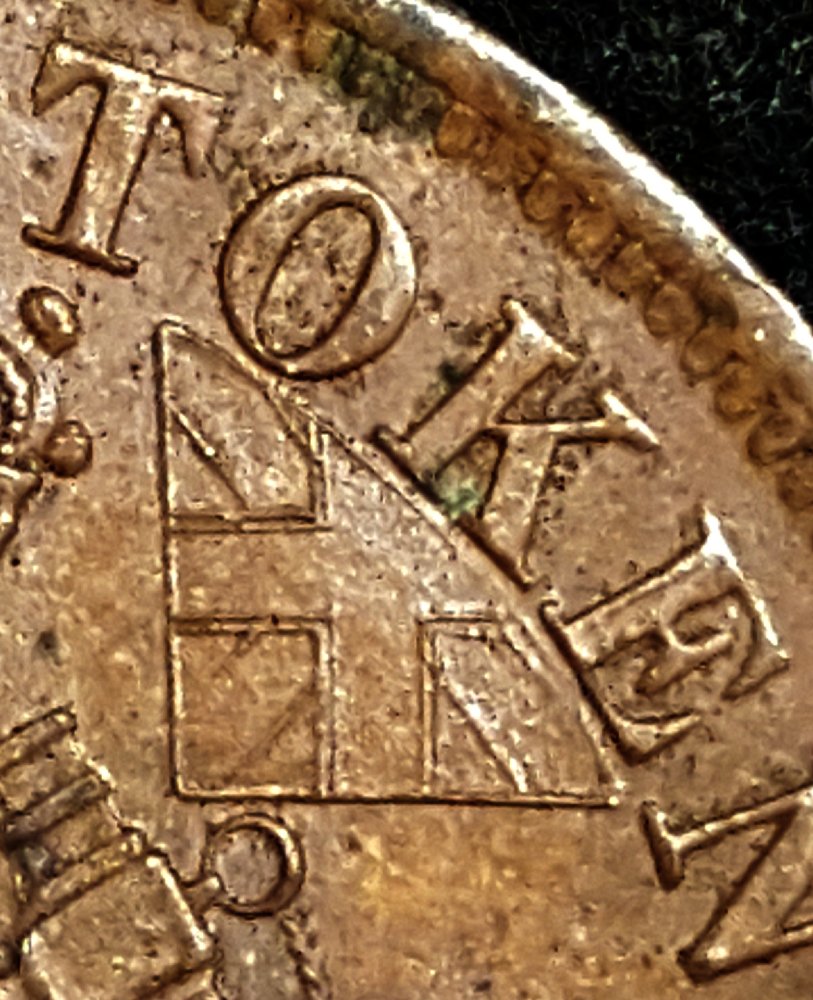 as always, thank you ! |
|
Pillar of the Community
United States
840 Posts |
Doctor Courteau identifies varieties 111-158 inclusive within this series.
Dr. Courteau separates these into two primary groupings dependent upon whether
or not a dot is within the right Rosette in the reverse.
Group I -- Varieties 111-132 shews no dot within the right Rosette on the Reverse.
Group II -- Varieties 133-158 has a dot within the right Rosette.
Your token is of Group II.
Dr. Courteau identifies many diagnostics, but the Shield is an excellent place to start.
We are concerned with the specifics of the Union Jack and St. Andrews Cross frame opposite the E in TOKEN.
1). The outline of the Union Jack and the St. Andrews Cross frame are clear and away from each other.
Varieties 133, 134, 137, 138.
2). The U.J. and frame of the St. Andrew's Cross are perfect.
Varieties 135, 136, 144, 145, 146.
3). Perfect U.J. - St. Andrew's Cross frame is wavy
Varieties 139, 140.
4). The U.J. and St. Andrew's Cross frame are close together.
Varieties 141, 142,143.
5). The U.J. is perfect, only the upper section of the St. Andrew's Cross frame shews. In some cases the Cross frame is absent.
Variety 147, 148.
6). The U.J. ends in a small fork, the Cross frame is broken in the middle.
Variety 149, 150.
7). The terminals of the U.J. and Cross frame merge.
Varieties 151, 152.
8). The U.J. below the E is broken, only the upper section of the Cross frame shews.
varieties 153, 154, 155, 156.
9). The outline of the U.J. below the E does not shew, only the upper section of the Cross frame shews.
Variety 157.
10). The middle of the U. J. outline does not shew, the lower section of the U.J. is very close to the E, no Cross frame shews.
Variety 158.
more to follow in next thread.
doug
Edited by colonialtokens
05/14/2017 01:33 am
|
|
Pillar of the Community
United States
840 Posts |
By the way, great photo.
From the previous post, you can imagine the difficulty in attributing lower grade ensamples.
In any event, We can narrow the search to varieties 153, 154, 155, and 156. The U.J. is broken
opposite the E in TOKEN and only the upper section of the Cross frame shews.
Below are exact quotations from Dr. Courteau (his verbiage takes some getting used to):
153. Obv. Fig. 4 close to 5, its stand ends on-line with the left of tooth.
Rev. The U.J. outline below E is broken, only the upper of St-Andrews cross frame
shows below this letter. Lump above upper part of rope around sword. R. 7.
154. Obv. Fig. 4 away from t, its stand ends opp. the left of tooth. Small dash between
horse's hoof and letter N. Die-crack to fig. 8.
Rev. Same as No. 153. R. 10.
155. Obv. Same as No. 154.
Rev. Same as No. 153, but from a stronger impression, and a small dot to the right of
upper Rosette. R. 8.
156. Obv. Fig. 4 close to 5, its stand ends opp. the left of tooth. Perf. and brok. dies,
a crack through A of BANK.
Rev. Same as No. 155. R.7.
more to follow in next thread.
doug
|
|
Pillar of the Community
United States
840 Posts |
Wade, I would have to study this further, but consider the following...
155 R-8 NEED
Note - The author is not privy to this variety. This variety is absent from all known collections. The information provided was extrapolated from varieties 153 and 154, of which Doctor Courteau references as the same.
On the contrary, Doctor Courteau references the reverse of 156 as the same as 155. The reverse of varieties 153 and 156 differ on many accounts. The author suspects the reverse of 155 could be the same as 156, and not 153. Both reverses will be included and future research may ferret the proper.
This information has not been verified or confirmed by the author.
Obverse characteristics: The same as variety 154.
The numeral 4 is away from the numeral 5.
The Stand of the numeral 4 is on-line with the left-side of a Denticle.
An imaginary line along the right-side of the Upright of the numeral 4 is on-line betwixt the Uprights of the initial H, below the ground.
An imaginary line along the upper-side of the diagonal of the numeral 4 extends to the underside of the upper section of the Leg of the Ampersand, below the ground.
The Man left Foot is complete, but the Toes are weak.
The outline of the Left Wing of the Dragon is Perfect.
No horizontal lines are below the Left Wing of the Dragon.
A short stubby line is below the Man's right Arm.
The left Bridle Rein is as a thin line.
The Knob to the Dagger-Hilt is nearly round.
The outline of the Belly of the Horse is double-cut.
A small Dash is betwixt the Horse's Hoof and the N in CANADA.
From broken dies.
Note - Variety 154 has a Die-Crack to the numeral 8. Doctor Courteau references variety 155 as the same as variety 154. Habitually, Doctor Courteau would reference similar dies as either having different Die-Cracks, or being from the broken die of the referenced variety. In this case, no disclaimer was provided by Doctor Courteau. The author is unsure whether this is the identical Die-Crack found on variety 155. In any event, the author opted to include the Die-Crack. Future research may prove otherwise.
A Die-Crack is to the numeral 8 in the date.
This rather straight diagonal Die-Crack is from the left-section of the Denticle to the immediate left of the numeral 5, extending to the right-side of the mid-section of the lower half of the lower circle of the numeral 8.
Reverse characteristics: The same as 153, but from a stronger strike, and having a small Dot to the right of the upper Rosette.
The Dot within the right Rosette is Arrow-head shaped, of normal size and joins by a Stem to the upper right inner corner. The Dot is very close to the lower right inner corner and distant from the upper left corner.
The Stand of the T in TOKEN is Perfect.
The Stand of the N in TOKEN is Perfect.
The outline of the Union Jack below the E in TOKEN is nearly broken.
The outline of the Union Jack bewixt the Leg of the K in TOKEN to the vertical of the E in the same word is weakly struck, and barely discernable below the Upright of the same E. The terminal end of the Union Jack is normal. The strike of the Union Jack is better executed than on variety 153. This indicates that variety 154 preceded that of variety 153.
Only the upper section of the St. Andrew's Cross frame shews below the E in TOKEN.
The St. Andrew's Cross frame terminates on-line with the right-side of the Upright of the same E.
A small Dot is to the right of the upper Rosette.
No additional information is currently available.
The hole in the Battle Axe appears as a large depression.
The inner ornamental Balls are disconnected from the Cornucopia.
Four normal sized squiggly Dots are betwixt the Feather and Anchor Shaft.
The Anchor Rope ends with one Dot.
The lower right-side ornamental Dot is present.
The Anchor Ring is Perfect.
A Lump is above the upper part of the Anchor Rope around the Sword.
This is a rather large globular Lump in the field, nearly touching, and slightly to the left of the apex of the upper section of the Anchor Rope Dots above the terminal end of the Sword.
Note - This diagnostic is not readily discernable on lower grade specimens.
From perfect dies.
Thus:
155 A Die-Crack is to the numeral 8.
THE OTHER CONSIDERATION
Reverse characteristics: The same as variety 156.
Note - Doctor Courteau references variety 156 as the 'same as variety 155.' Variety 155 is referenced as 'same as variety 153, but from a stronger impression, and having a small dot to the right of upper Rosette.' Variety 153 is referenced as 'The Union Jack outline below E is broken, only the upper of St. Andrew's cross frame shews below this letter. Lump above upper part of rope around Anchor.'
Doctor Courteau fails to define what is meant by a 'stronger impression.' The token currently being described has the 'lump' above the rope, and the 'dot' to the right of the Rosette, and the proper compliment of obverse characteristic diagnostics. However, unlike the definition of variety 153, the Union Jack is Perfect and the St. Andrew's Cross Frame is strongly struck, but slightly broken in the middle. Is this what was meant by a 'stronger impression.' or is this a new variety.' Absent sufficient ensamples to reference, the author opted to identify this as a genuine variety 156.
The Dot within the right Rosette is Arrow-head shaped, of normal size and joins by a Stem to the upper right inner corner. The Dot is very close to the lower right inner corner and distant from the upper left corner.
The Stand of the T in TOKEN is Perfect.
The Stand of the N in TOKEN is Perfect.
The Union Jack is Perfect; the terminal is forked.
On high grade specimens the terminal is forked, however wear will quickly merge the fork into a wider terminal.
The St. Andrew's Cross frame is broken in the middle.
The outline of the Union Jack and St. Andrew's Cross frame are close together, yet do not meet.
The hole in the Battle Axe appears as a large depression.
The left inner ornamental Balls is disconnected from the Cornucopia.
Four normal sized squiggly Dots are betwixt the Feather and Anchor Shaft.
The Anchor Rope ends with one Dot and a thin line. A small Dot is attached to the underside of the line.
The lower right-side ornamental Dot is present.
The Anchor Ring is Perfect.
A Lump is above the upper part of the Anchor Rope around the Sword.
This is a rather large globular Lump in the field, nearly touching, and slightly to the left of the apex of the upper section of the Anchor Rope Dots above the terminal end of the Sword.
A bold Dot is to the right of the upper Rosette.
This Dot is in the field betwixt the upper Rosette and the T in TOKEN. The Dot is on-line horizontally with the right-side of the lower Lobe of the same Rosette, and on-line vertically with the left-side of the upper right-side inner Crown Jewel.
A Lump is to the right of the E in ONE.
This is a bold globular mass to the right of the vertical of the upper Serif of the E in ONE.
The grouping of three Anchor Rope Dots above the right Anchor Fluke are large, with the left nearer the Anchor Shaft. The terminal of the Union Jack joins fully to the base of the Shield.
Note - Varieties 153, 154, 156, 157, and 158 are easily and readily confused. Doctor Courteau references the outline of the Union Jack and St. Andrew's Cross frame of varieties 157 and 158 being defective and makes no mention of the matter concerning varieties 153 and 154. But all are very similarly defective. Upon close scrutiny they appear identical. Upon tedious scrutiny two noticeable diagnostics emerge. On one, the right end of the Base of the Shield extends slightly beyond the broken segment of the vertical line (probably the St. Andrew's Cross frame), while on the others the Base and vertical make a corner. However, on worn specimens this may be inconclusive.
All varieties have the terminal Anchor Rope Dot as a single Dot. However, concerning the horizontal row of three Anchor Rope Dots betwixt the underside of the lower section of the Anchor Shaft and the right Anchor Fluke we encounter a strong diagnostic marker. One group consists of three large uniform Dots, the left is near the Anchor Shaft. The other group shews three smaller Dots, with the left Dot even smaller, and distant from the Anchor Shaft. Details concerning each will be addressed as encountered.
This is a significant deviation from varieties 153 and 154.
From perfect dies.
156 R-7 The author finds this variety much rarer than the rarity factor indicates. The author has but one ensample.
Note - Caution must be exercised as this variety is easily mistaken for variety 155.
Obverse characteristics: The same as varieties 155 and 157, and similar to variety 158.
The numeral 4 is close to the numeral 5.
The left end of the Stand of the numeral 4 in the date is on-line betwixt the Denticles.
Note - Doctor Courteau identified this as left-side.
An imaginary line along the right-side of the Upright of the numeral 4 is on-line betwixt the Uprights of the initial H, below the ground.
An imaginary line along the upper-side of the diagonal of the numeral 4 extends to the underside of the mid-section of the Leg of the Ampersand, below the ground.
The Man left Foot is complete, howbeit weakly struck.
The outline of the left Wing of the Dragon is Perfect.
No discernable horizontal lines are below the left Wing of the Dragon.
The design elements below the Man's right Arm are rather inconclusive. There appears to be two separated thick masses. The lower is the shorter and is cloven at the origin.
The left Bridle Rein is as a short line.
The Knob to the Dagger-Hilt is nearly round.
The outline of the Belly of the Horse is double-cut.
The left Leg of the Dragon is detached from the Body of the Dragon.
Die-Clash Marks are behind the Man's Back.
Note - Being struck from 'upset dies' or a coinage die-axis, the mimicked image is shewn in reverse. The characteristic Die-Clash of the lower section of the Anchor Shaft and both Anchor Arms is behind Man's Back. Multiple strikings are above the left Wing of the Dragon.
From perfect and broken dies.
A Die-Crack is to the A in BANK.
This Die-Crack is from the right corner of the Denticle above the left Leg of the A in BANK, extending to the upper left-side of the same Leg, and continuing through the Cross-Bar of the same letter, passing betwixt the Stands of the same letter, and exiting to the vertex of the upper inner curve of the Tail of the Horse.
A Die-Crack is to the 3rd A in CANADA.
This Die-Crack is from the right section of the Denticle above the D in CANADA, passing by and touching the right-side of the same letter, and continuing through the lower section of the left Leg of the 3rd A in CANADA (on-line with the cross-bar), and exiting the left-side of the Stand of the right Leg of the same letter, and extending to the 1st Stone above the right ground.
Note - This Die-Crack was not mentioned by Doctor Courteau.
Reverse characteristics: The same as variety 155.
Note - Doctor Courteau references variety 156 as the 'same as variety 155.' Variety 155 is referenced as 'same as variety 153, but from a stronger impression, and having a small dot to the right of upper Rosette.' Variety 153 is referenced as 'The Union Jack outline below E is broken, only the upper of St. Andrew's cross frame shews below this letter. Lump above upper part of rope around Anchor.'
Doctor Courteau fails to define what is meant by a 'stronger impression.' The token currently being described has the 'lump' above the rope, and the 'dot' to the right of the Rosette, and the proper compliment of obverse characteristic diagnostics. However, unlike the definition of variety 153, the Union Jack is Perfect and the St. Andrew's Cross Frame is strongly struck, but slightly broken in the middle. Is this what was meant by a 'stronger impression.' or is this a new variety.' Absent sufficient ensamples to reference, the author opted to identify this as a genuine variety 156.
The Dot within the right Rosette is Arrow-head shaped, of normal size and joins by a Stem to the upper right inner corner. The Dot is very close to the lower right inner corner and distant from the upper left corner.
The Stand of the T in TOKEN is Perfect.
The Stand of the N in TOKEN is Perfect.
The Union Jack is Perfect; the terminal is forked.
On high grade specimens the terminal is forked, however wear will quickly merge the fork into a wider terminal.
The St. Andrew's Cross frame is broken in the middle.
The hole in the Battle Axe appears as a large depression.
The left inner ornamental Balls is disconnected from the Cornucopia.
Four normal sized squiggly Dots are betwixt the Feather and Anchor Shaft.
The Anchor Rope ends with one Dot and a thin line. A small Dot is attached to the underside of the line.
The lower right-side ornamental Dot is present.
The Anchor Ring is Perfect.
A Lump is above the upper part of the Anchor Rope around the Sword.
This is a rather large globular Lump in the field, nearly touching, and slightly to the left of the apex of the upper section of the Anchor Rope Dots above the terminal end of the Sword.
A bold Dot is to the right of the upper Rosette.
This Dot is in the field betwixt the upper Rosette and the T in TOKEN. The Dot is on-line horizontally with the right-side of the lower Lobe of the same Rosette, and on-line vertically with the left-side of the upper right-side inner Crown Jewel.
A Lump is to the right of the E in ONE.
This is a bold globular mass to the right of the vertical of the upper Serif of the E in ONE.
The grouping of three Anchor Rope Dots above the right Anchor Fluke are large, with the left nearer the Anchor Shaft. The terminal of the Union Jack joins fully to the base of the Shield.
Note - Varieties 153, 154, 156, 157, and 158 are easily and readily confused. Doctor Courteau references the outline of the Union Jack and St. Andrew's Cross frame of varieties 157 and 158 being defective and makes no mention of the matter concerning varieties 153 and 154. But all are very similarly defective. Upon close scrutiny they appear identical. Upon tedious scrutiny two noticeable diagnostics emerge. On one, the right end of the Base of the Shield extends slightly beyond the broken segment of the vertical line (probably the St. Andrew's Cross frame), while on the others the Base and vertical make a corner. However, on worn specimens this may be inconclusive.
All varieties have the terminal Anchor Rope Dot as a single Dot. However, concerning the horizontal row of three Anchor Rope Dots betwixt the underside of the lower section of the Anchor Shaft and the right Anchor Fluke we encounter a strong diagnostic marker. One group consists of three large uniform Dots, the left is near the Anchor Shaft. The other group shews three smaller Dots, with the left Dot even smaller, and distant from the Anchor Shaft. Details concerning each will be addressed as encountered.
This is a significant deviation from varieties 153 and 154.
From perfect dies.
Thus:
156 Perfect - no Die-Cracks.
156A A Die-Crack is to the A in BANK.
Die-Crack as above, plus a Die-Crack is to the 3rd A in CANADA.
Note - Some Die-Cracks were not mentioned by Doctor Courteau.
This is the Die-Crack progression.
doug
Edited by colonialtokens
05/14/2017 02:22 am
|
|
Pillar of the Community
Canada
2785 Posts |
The level of study on these is truly amazing.
Thanks again Doug!
|
| |
Replies: 26 / Views: 4,389 |
To participate in the forum you must log in or register.
Disclaimer: While a tremendous amount of effort goes into ensuring the accuracy of the information contained in this site, Coin Community assumes no liability for errors. Copyright 2005 - 2026 Coin Community Family- all rights reserved worldwide. Use of any images or content on this website without prior written permission of Coin Community or the original lender is strictly prohibited.
Contact Us | Advertise Here | Privacy Policy / Terms of Use
|
| Coin Community Forum |
© 2005 - 2026 Coin Community Forums |
| It took 0.41 seconds to rattle this change. |
 |
|
| |
| |






 First Page


 Posted 05/05/2017 8:48 pm


